• This forum is the machine-generated translation of www.cad3d.it/forum1 - the Italian design community. Several terms are not translated correctly.

problem with distinct and subaxial compounds of series

  • Thread starter Thread starter raf
  • Start date Start date

raf

Guest
Bye to all,
I have a very strange thing with the distinct components of a set made up of various sub-assistances. I can't get out of it.
practically the subaxis that are composed of series do not appear with all the parts that make up them but are displayed as a single part, in the main distinction I mean, subaxiemi composed by series and mixed parts are displayed correctly.
It's as if the distinction of the main axieme can't read within the subaxiemi series, so he sees the subaxieme as a unique part. .
How do I get out?

I hope I've explained well!
 
Does anyone have any idea how to solve this problem?
Have you tried with all the settings available for the distinction?
It seems strange that you can't at least see the nested components.

the inconvenience of doing the overalls with the subgroups is that the distinct, if it must be unique throughout the whole, is unmanageable.
you can't order the items properly, for example if you have 20 screws of a type in a group and 10 in another two, you can't have a total of 40 screws with a unique description.
There was a macro that gave the possibility to group things but I never managed to make it work well.
Luckily, my clients prefer the distinction in excel, so I have no further detail.

Bye.
 
I'm afraid I don't understand.
I did some tests with inv2011 and, set as hidden the subaxis (sets by series of objects), the structured distinct display me (correctly) only objects.

Can you post an example?
Hi.
 
Therefore, examples I cannot post because they are too complex and heavy.

I try to get back better by simplifying:
I have a set, consisting of subassiemi b and c. subassieme b is composed only of series of the same part x, the subassieme c is composed of various instances of the part y and also series.

outcome:
if I open the distinct components of the axieme to do not see the x part that is serialized in the subaxieme b but sees the y part in the subaxieme c.

conclusion:
the subaxieme b, consisting only of series, is not read correctly by the distinct components of the axieme that contains it (a) insofar as the x part is not reported in the separate itself, while the other subaxieme (c) is read correctly inasmuch as the y part is displayed correctly in the distinct.

Why?
 
If I don't remember badly when you put the table you have to tell him to put all the levels then once you put the table you click on and you should see signs + next to the names "fathers" (in this case b and c ). If you click on the + in question the table expands.I go to memory, unless you have already done this test.
Hi.
 
Therefore, examples I cannot post because they are too complex and heavy.

I try to get back better by simplifying:
I have a set, consisting of subassiemi b and c. subassieme b is composed only of series of the same part x, the subassieme c is composed of various instances of the part y and also series.

outcome:
if I open the distinct components of the axieme to do not see the x part that is serialized in the subaxieme b but sees the y part in the subaxieme c.

conclusion:
the subaxieme b, consisting only of series, is not read correctly by the distinct components of the axieme that contains it (a) insofar as the x part is not reported in the separate itself, while the other subaxieme (c) is read correctly inasmuch as the y part is displayed correctly in the distinct.

Why?
I recreated your example with very simple parts and did not find the problem you denounce.

I believe, however, that we should make clear on a couple of points:
1. there are three distinct types; take for granted that you refer to the distinct structure (first level) which, in practice, is that displayed in the second of the three tabs;
2. with the assumption of point 1, it is necessary that you correctly impose the properties of the components (dx --> separate structure components or, within the distinct with a double click on the cell you want to change). According to me, your b set is "normal" while c is "hidden". try to change also the b in "hidden" and the structured separate of the axieme to show you its parts (i.e. part x). :finger:
3. unless denied by those who know more than me, the "series" has no property, for the purposes of the distinct (normal, hidden, reference, etc.); consequently, its presence (or not) should not be detected by any distinct (unless bugs or corrupt files...:confused:).

I hope I've been helpful.
Hi.
 
I thank you all for the valuable support but unfortunately the problem is not resolved.
the distinct that I look at is indifferent, because in all three I do not see what I would expect to see. the assemblies are all "normal" and in fact they are well visible, the problem is that, in fact, they are assembling and not leaving!
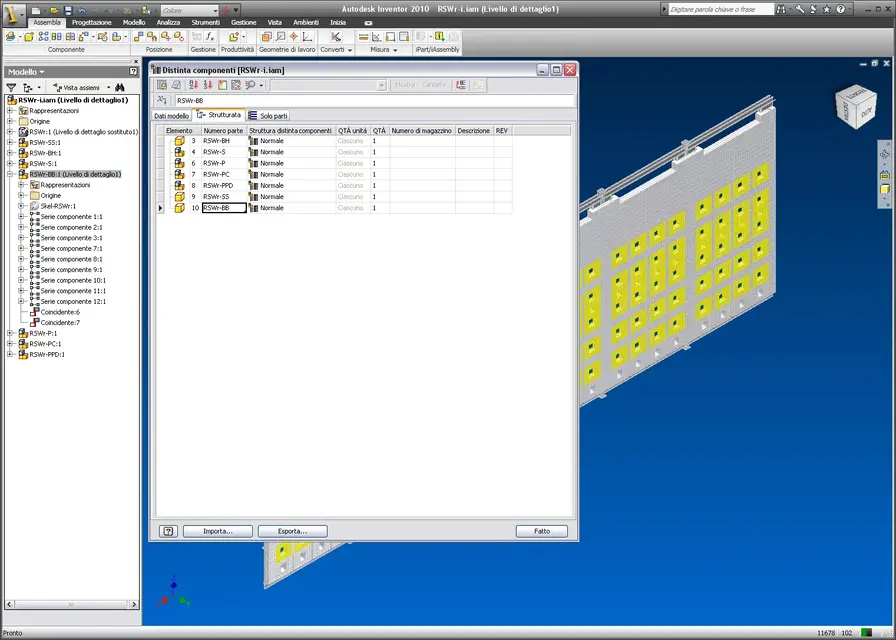
I put an image, useless, I know, but the place anyway! :smile:

as seen from the image, in the distinct part "rswr-bb" would seem a part, as it can easily be seen also from the iconcin and the absence of the "+", but from the design highlighted in yellow and from the tree it is very well seen that it is an axieme, besides the fact that I know it's a set Because I designed it... :mad:

I'm beginning to think that the inventor's distinct not "register" assemblies of a certain size. . .
 

Attachments

  • RSW.webp
    RSW.webp
    96.6 KB · Views: 39
I'm beginning to think that the inventor's distinct not "register" assemblies of a certain size. . .
There is no problem of size.

I tried to replicate your situation (on 2009 & 2010 ) and I distinctly corrected it.
If you want, just pack & go of the serialized set and try to send it here.

Bye.
 
Last edited:
I think it doesn't depend on the fact that the subaxieme is composed of series. In fact, in the image it is known that in separate also other subaxis (e.g. rswr-bh) are displayed as a single part.
Hi.
 
I thank you all for the valuable support but unfortunately the problem is not resolved.
the distinct that I look at is indifferent, because in all three I do not see what I would expect to see. the assemblies are all "normal" and in fact they are well visible, the problem is that, in fact, they are assembling and not leaving!
I put an image, useless, I know, but the place anyway! :smile:

as seen from the image, in the distinct part "rswr-bb" would seem a part, as it can easily be seen also from the iconcin and the absence of the "+", but from the design highlighted in yellow and from the tree it is very well seen that it is an axieme, besides the fact that I know it's a set Because I designed it... :mad:

I'm beginning to think that the inventor's distinct not "register" assemblies of a certain size. . .
you see that you have an active level of detail, is it not that at the rswr-bb axieme you have activated the simplified level of detail where it suppresses the rswr schel and suppresses the series or activates the simplified detail levels?
Have you tried to disable the level of detail to see if something changes?
 
I think I understand your problem. and indeed with the 2010 version has happened to me the same situation and at the moment I have not yet been able to get out of it. . .

I think, however, that a solution must be.
 
quoto daniele (there are other assemblies that are recognized as separate parts... :confused:).

As for the hypothesis of peppe, I did some tests with levels of detail, with inv2011, but the distinction remains correct.

In all honesty, something like that never happened to me... :frown:

Could I make two demands? you could post:
1. an image of the distinct "model data" with the level of detail 1
2. an image of the same distinct but with the main level? :wink:

p.s.
pack&go would be ideal.. .
 
components -> structured tab -> dx button on the structured "language" -> properties seen -> in the tense level selections "all levels" -> ok. you should see a + beside the assemblies, if so it does not mean or that the components (parts) inside are set in the properties of the separate components as hidden or reference, then you should enter into one of these parts and change their

test
 
components -> structured tab -> dx button on the structured "language" -> properties seen -> in the tense level selections "all levels" -> ok. you should see a + beside the assemblies, if so it does not mean or that the components (parts) inside are set in the properties of the separate components as hidden or reference, then you should enter into one of these parts and change their

test
I said shit. I realized that you said "they are seen as a part."... I see that in the browser you expanded there is a hidden part called "skel..."; I'm guessing why I don't remember, is it not that the assemblies defined as "framework" are seen as parts? or are copies (copy/paste) of other frames or stuff like that for which they create this drawback?
 
you see that you have an active level of detail, is it not that at the rswr-bb axieme you have activated the simplified level of detail where it suppresses the rswr schel and suppresses the series or activates the simplified detail levels?
Have you tried to disable the level of detail to see if something changes?
If you notice the "skel" is only grey, if it were suppressed it would also be barbed in the name... I don't think it depends on that, because I tried several times to suppress things that I didn't want in separate but it was convenient to have different configurations only by activating the levels of detail and all the time I was also calculating the stuff suppressed unfortunately.
 
I also found the same problem on a 2008 set and use inv.. .

I have not been much help but my intervention in this case is only for statistics. . . :
 
is it not that the series is seen as distinct as a reference??? So he doesn't count it? ?
 
hello to everyone, excuse the absence but between 1000 things to do and holidays I have not been able to consult you!
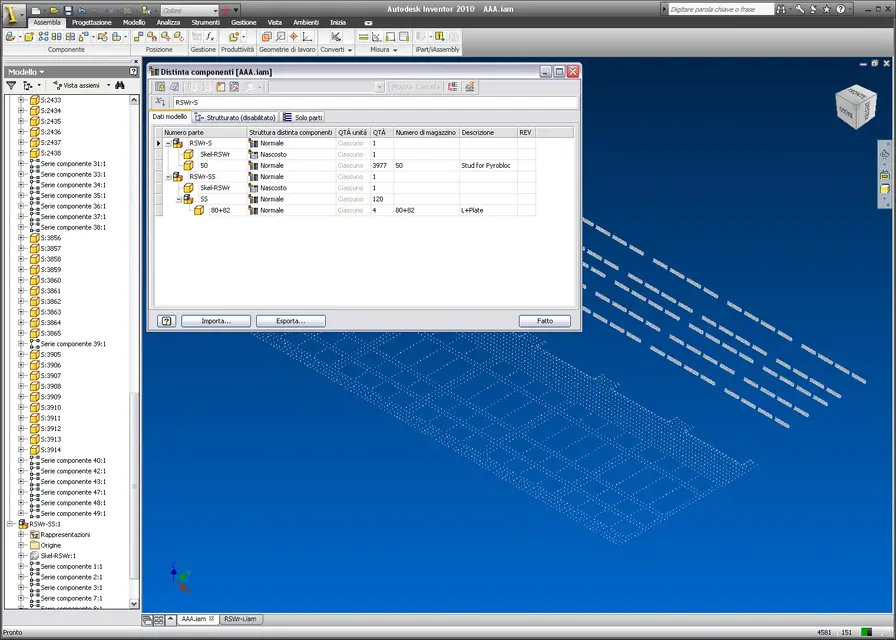
So the problem I haven't solved yet, I have made a test, I have created a new set, I have inserted two subaxes, one working and the other not, for the accuracy rswr-s and rswr-ss and... Surprise, in my new set it's all right, apart from my sub-assistances, they're both displayed properly, why?!?!? ! ! ?

p.s. the incriminated series is not a reference but default recurrence, just like those that "work".
 

Forum statistics

Threads
44,997
Messages
339,767
Members
4
Latest member
ibt

Members online

No members online now.
Back
Top