• This forum is the machine-generated translation of www.cad3d.it/forum1 - the Italian design community. Several terms are not translated correctly.

demand on turbocharged air flows

  • Thread starter Thread starter snaroz
  • Start date Start date

snaroz

Guest
Hello, friends. I found on the internet this photo of an old cosworth engine of formula 1 supercharged by two turbochargers (a 1500 cc from over 1000 horses!!!).
My questions, probably very stupid, are:
1) exhaust gases, after exiting the engine, make the route indicated by the red arrows I designed, then rotate the turbine blades and then exit the turbos heading towards the discharges, right?
2) the turbocharger propeller, rotated by exhaust gases, "resucking" an atmospheric pressure air flow that goes into the turbo as indicated by the blue arrow; Subsequently, this air mass, compressed at higher pressures, comes out of the turbo and, as indicated by the second blue arrow, goes to channel into the conduit (which I suppose is the suction one) that ends in the engine head.
I may have been somewhat imprecise in the explanation, but I wanted to know, intuitively, if things work like this.
Thank you! ! !
 

Attachments

  • 3977686434_9f3ccfa761_b.webp
    3977686434_9f3ccfa761_b.webp
    84.2 KB · Views: 53
Hi.
if with blue arrows we identify the air of aspiration and with the red ones exhaust gases, then the red arrows that you designed from the exhaust collectors at the entrance of the turbine are right: the discharge of the turbine is not seen, is hidden. being the turbine always centripetal, the gas input is tangential while the exit is axial.
instead the red arrows drawn on the spiral of the compressor are wrong: Those should be blue by air. being the compressor a centrifugal machine, the input is axial and the tangential output. the compressor's mandate is connected to the post cooler of the charge (aftercooler, not visible in photos as well as other accessories) and then to the suction manifold (and there blue arrows are correct).
 
....make the path indicated by red arrows
....
Hi, very interesting topic, from the photo you posted, you only see the compressor because it's in the foreground. quoto paulpaul! from the compressor output to the suction duct lacks the intercooler. If you refer to the photo I posted you see a little better.

Subaru docet
 

Attachments

  • turbocharger.webp
    turbocharger.webp
    91.1 KB · Views: 29
  • 130_0311_06_zoom2003_subaru_im.webp
    130_0311_06_zoom2003_subaru_im.webp
    94.1 KB · Views: 21
perfect!!! I really had a wrong idea about the turbochargers. I thought there was only that piece. In fact the name "turbocompressor" recalls the fact that there are two pieces, the turbine, driven by exhausted gases, and the compressor, operated by the turbine and compressing the air. The photos you posted are very clear!

the intercooler placed between the compressor output and the aspiration serves to cool the air in such a way as to increase its density (and decrease its volume) and thus make it possible to enter more in the combustion chamber (more air implies more gasoline)?
 
the intercooler placed between the compressor output and the aspiration serves to cool the air in such a way as to increase its density (and decrease its volume) and thus make it possible to enter more in the combustion chamber (more air implies more gasoline)?
Yes exactly, the purpose of the "turbo" in motors is to practically increase the average pressure in the combustion chamber and this entails greater work at equal displacement, then consequently more gasoline is placed for the stechiometric ratio. then for the temperature speech it is right to have the flow in suction possibly "fresh" for a better volumetric performance, but also to take into account the combustion efficiency (which prefers high temperatures).
 
Yes exactly, the purpose of the "turbo" in motors is to practically increase the average pressure in the combustion chamber and this entails greater work at equal displacement, then consequently more gasoline is placed for the stechiometric ratio. then for the temperature speech it is right to have the flow in suction possibly "fresh" for a better volumetric performance, but also to take into account the combustion efficiency (which prefers high temperatures).
Be careful not to be confused... the turbo does not increase the average opening in the room, but the pressure in the intake manifold and allows to enter more air in the room: it blows instead of aspiring it. This allows you to send more fuel = more power! Moreover, and above all I would add, it allows to maintain constant the stenchiometric ratio to the high regimes (which otherwise should necessarily fall) getting greater powers.
the increase of the average pressing depends on the compression ratio, which depends on the volume between pmi and pms.
 
all right here, but on this I disagree
Moreover, and above all I would add, it allows to maintain constant the stenchiometric ratio to the high regimes (which otherwise should necessarily fall) getting greater powers.
the stechiometric ratio does not depend on the presence or not of the turbo!
depends on the construction/tapping of carburetors or injection system
on the fact that the stechiometric ratio falls to the high regimes is decliningly opineable.
in the "turistic" carburations, the "cruising" mix was lost for the economy of exercise, except then grease it slightly at full power to reduce combustion temperatures, sacrificing something in terms of maximum power
in "competitive" fuels, things change. . .
 
quoto mbt. you can design a driven ignition motor that can maintain the correct a/c ratio even at very high speeds of rotation without the need for any superpower (and we have examples in f1) engines.
Moreover, one of the ways to increase the pmi (indicated average pressure) is precisely that of overlay.
 
quoto mbt. you can design a driven ignition motor that can maintain the correct a/c ratio even at very high speeds of rotation without the need for any superpower (and we have examples in f1) engines.
Moreover, one of the ways to increase the pmi (indicated average pressure) is precisely that of overlay.
Of course you can do it, you put an ecu of those series and set for good and you can do everything you want... but you have to put something extra!

the superpower is directly connected to the increase of the pmi if you have a carburetion engine. ..but with any type of injection you only have the possibility of burning more fuel, if you don't do the pmi doesn't increase.... .
 
Of course you can do it, you put an ecu of those series and set for good and you can do everything you want... but you have to put something extra!

the superpower is directly connected to the increase of the pmi if you have a carburetion engine. ..but with any type of injection you only have the possibility of burning more fuel, if you don't do the pmi doesn't increase.... .
Well it is obvious, overflow to increase the density of the charge and thus be able to introduce more fuel! but this with any fuel system, both carburetion and injection! if I only throw in air... you'll see that I get little (if we talk about engine powered on) in both cases.

Let's leave aside the electronics that doesn't fit here! high-volume aspired and turbo engines existed when the electronics had to be invented...she allows you to optimize control!

or maybe I didn't understand your observation. ..confused:
 
Well it is obvious, overflow to increase the density of the charge and thus be able to introduce more fuel! but this with any fuel system, both carburetion and injection! if I only throw in air... you'll see that I get little (if we talk about engine powered on) in both cases.

Let's leave aside the electronics that doesn't fit here! high-volume aspired and turbo engines existed when the electronics had to be invented...she allows you to optimize control!

or maybe I didn't understand your observation. ..confused:
Well, in a carburetor engine it is a little difficult to dispel air and fuel. More air enters even more fuel. . .
in the injections..you can put all the air you want, but if the amount of fuel you send is always the same...the rest you wrote it!

the electronics you invited her: if you mention me as an example of an ignition vacuum commanded the engine of the f1...beh, I hardly think that the engine can "turn" without electronics! !
 
You mentioned the ecu!
comuqnue, we leave for a moment back electronics and carburetors, we draw a nice sigh of relief and we take a step back!

the indicated power of a c.i motor. is proportional, among other things, to:

1. displaced
2. rotation speed
3. average pressure indicated

wanting to maintain constants 1 and 2 and increase the power, we might think to increase only 3 (in reality we can have repercussions on 2 so doing, but suppose that 2 not various for simplicity). increase the pmi means to increase the torque of the engine.

the average pressure indicated in turn is proportional to (for a certain calorific power of the fuel and for a certain a/c ratio that, as we know, in a motor with a controlled ignition not with direct injection must be contained within a fairly narrow interval close to the stechiometric):

1. performance indicated
2. Filling coefficient
3. Intake charge density.

Whereas a variation of one of the sizes has repercussions on the other, the superpower increases mainly 2 and 3.
then increases the pmi.

the discourse of the greatest fuel that must always be introduced, regardless of the feeding system of the same, follows from the fact that we have kept the relationship constant a/c. therefore, a carburetor calls itself "naturally" (for construction) more fuel. in an injection engine, it will be the control unit that, taking in the debitmeter data, will increase the fuel flow so as to maintain the ratio a/c within the default values for each operating condition.

the speech I made about the increase of the pmi was therefore entirely general, independent from the fuel supply system.

As for the aspired motors f1, these were fast even in the years when electronics were nonexistent: one of the "fortunes" of the gasoline engine is that the combustion of the same "speed increase" at the increase of the speed of rotation, because basically of the greater turbulence. in fact for a gasoline there is almost no upper limit dictated by the combustion velocity as it happens in diesel (compared with the chemical+physical delay of the ignition, reduced but not eliminated). so if I can make a motor that can turn fast, which means:

1. good fluid dynamic and acoustic behaviour (and the f1 engines have it) to get the necessary air
2. excellent mechanical behaviour (tolerant inertias), and f1 engines have it) because it does not break
3. good form of the combustion chamber (the large quantities due to small strokes due to point 2 and any reductions of fractionation cause regulation do not help in this) because the flame front develops correctly

the combustion will not give me problems, electronics or not! if anything the latter allows a better control.
 
If you mention me as an example of an ignition vacuum commanded the engine of f1...well, I hardly think that engine can "turn" without electronics! !
to name one because it is among my favorites:
[youtube]o_3oyc89lqa[/youtube]aspired by carburetors, he trottered cheerfully at 19'000 laps:finger:
 
...if you mention me as an example of an ignition suction commanded the engine of f1...beh, I hardly think that engine can "turn" without electronics! !
at least risked, as a statement.
I think it is necessary to reassemble on the operation of a carburetor before putting a tombstone on the motors with ignition commanded "without electronics".

p.s., it's okay that I'm "vintage" though, please, don't provoke me. :biggrin:
 
but to adjust the pressure of oversupply is there any valve of "sphorus" on the suction duct? How do you do that? Thank you!
because turbo engines when turning too low (and therefore are not overcharged because the speed of rotation of the compressor is too low), are "empty"? Shouldn't they be acting like normal aspirates?
is the fact that the compressor, turning too slowly, hinders the air aspiration?
 
but to adjust the pressure of oversupply is there any valve of "sphorus" on the suction duct? How do you do that? Thank you!
c'è la famoso waste-gate feeling the pressure in the pumps from the compressor to the engine
when it reaches a given pressure, a by-pass opens to vent the gases directly downstream of the turbine.
because turbo engines when turning too low (and therefore are not overcharged because the speed of rotation of the compressor is too low), are "empty"? Shouldn't they be acting like normal aspirates?
and when in here the aspirates are "full" at the bottom as an overcharged turbine?
However, you have the aggravating to have, in low regimes, a motor with a reduced compression ratio (otherwise superpower you would have serious detonation phenomena) and "topped" to the discharge from a turbine that brakes the outflow of exhaust gases and that is accelerating
is the fact that the compressor, turning too slowly, hinders the air aspiration?
the turbo-lag is the delay from when you accelerate to when the turbo reaches the speed (and pressure) of operation
is due to the fact that you have a moving mass (slow) that must be accelerated.
Consider that a small size turbo trotterella at 200'000 rpm when it is on schedule. Big ones a little less, say 160'000
engine at least, it stands at 60'000.
 
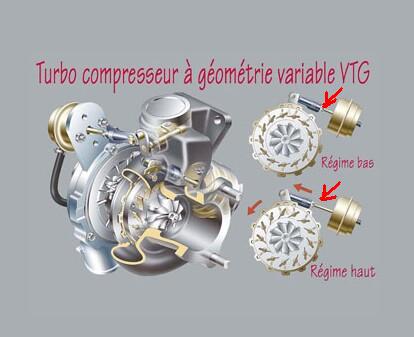
to avoid problems with low turns, a "variable geometry turbine" is not used. . ?

the "variable geometry" (i.e. the length of the turbine blades) serves to vary the air flow that the turbine blows.
to the low regimes the palettes are short, so to have little inertia and therefore to make sure that the turbine starts blowing from the lowest regimes; at the heights instead the palettes become long therefore bring more air (and consequently more power), and there are no problems of inertia as, of course, the turbine is already in motion.

the variable geometry is like having "two turbines" one instead of the other, which give the change when needed: thus combining the beneficial effects of both.
post-6735-1208590879.jpeg
enigma
 
Wait. I think the speech is quite complicated:biggrin:
Can you first tell me if what I write now is correct?
We consider an aspirated engine that works at a number of laps and which is delivering some power. if you want to increase the power provided by the engine, you need to do two things:
1) increase the amount of fuel entered in the combustion chamber;
2) increase the amount of air entered in the combustion chamber (in order to reach the stechiometric ratio).
in an injection gasoline engine, these two needs are met simply as follows: the accelerator, connected to the butterfly valve, provides to increase the air flow in the cylinder and simultaneously an electronic control unit orders the injector to spray more gasoline. Moreover, as a result of all this the engine turns increase.
Are they here?
Thank you so much!! ! ! ! !
 

Forum statistics

Threads
44,997
Messages
339,767
Members
4
Latest member
ibt

Members online

No members online now.
Back
Top