• This forum is the machine-generated translation of www.cad3d.it/forum1 - the Italian design community. Several terms are not translated correctly.

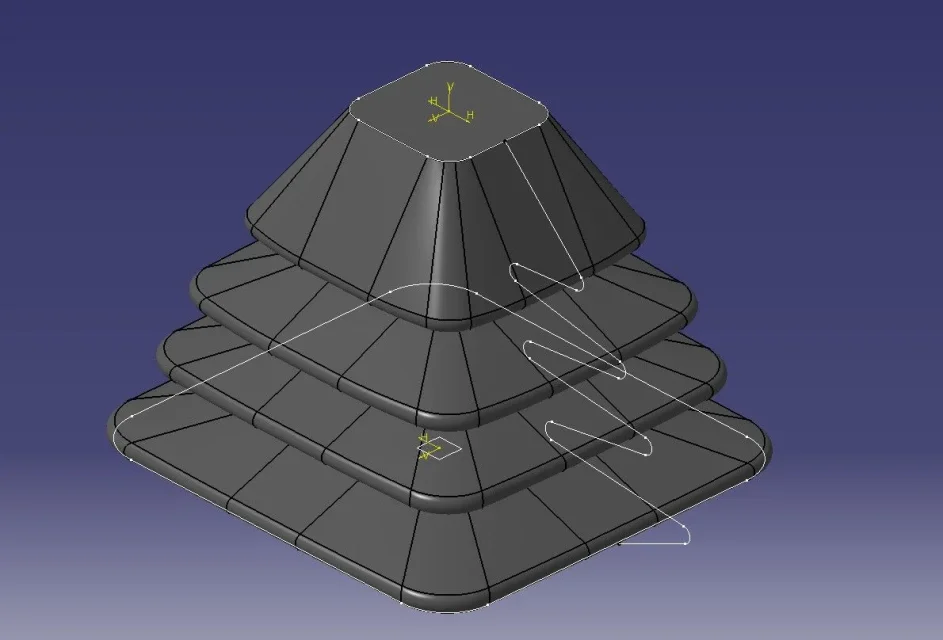
shape a rectangular bellows

  • Thread starter Thread starter marcofa
  • Start date Start date

marcofa

Guest
I have to model a rubber bellows as a photo attached.
If it were conical there would be no problem, I made it very easily: profile>> tree
because it is rectangular I couldn't get a spider out of the hole.
I tried with coast but the rectangular director must be squared without rounding and interrupted to get the splash in the photo
thanks for a help
Mar
 

Attachments

  • Cuffia.webp
    Cuffia.webp
    60 KB · Views: 9
  • Schifezza.webp
    Schifezza.webp
    99.8 KB · Views: 2
you can do as magic said, modeling a level at a time, or try in surfaces with sweeps.

not having the bellows under the eyes and without being able to measure it, it is difficult to suggest the suitable construction.. .

with the sweep using only one guide and profile, it is not good because the external rays become bigger and bigger

instead with the explicit sweep-profile - with two guide curves:
a high guide curve for the small rectangle
a low guide curve for the big rectangle
(the profile is the sketch of the steps).

depending on how you put anchoring points, the figure looks more and more like the headset, but be careful that with the "wrap" sweep is a moment.

the middle attachment seems acceptable

Let me know.

Bye-bye
 

Attachments

  • sweep 2.webp
    sweep 2.webp
    63.2 KB · Views: 1
  • sweep 3.webp
    sweep 3.webp
    52.4 KB · Views: 1
  • sweep.webp
    sweep.webp
    65.3 KB · Views: 2
Thank you.
I don't understand what you mean by
depending on how you put anchoring points, the figure increasingly resembles the headset

How do you close the upper hole?

Mar
 

Attachments

  • Soffietto.webp
    Soffietto.webp
    86 KB · Views: 3
I don't understand what you mean by
depending on how you put anchoring points, the figure increasingly resembles the headset
the anchoring point is the point of the sketch you want to "enter" to the driving curve, while the other profiles being free, are deformed, therefore depending on what you choose modeling always looks more like the headset.
How do you close the upper hole?
with the operation: menu-insert-superfici-filling

be careful that in order to maintain a geometric compliance with the measurements of the sample, perhaps it is better to do it at levels and in surfaces i.e. you create parallel planes, on each build a sketch of the view in the plant (of the level) and make an extrusion and after building the external and internal edges, join them with connections. then do the fillings and cuts to close everything and radiate (although from your questions I seem to understand that you know better solids).

Let me know if you can.

Hi.

years ago
 

Attachments

  • livello 1.webp
    livello 1.webp
    78.8 KB · Views: 2
  • livello 2.webp
    livello 2.webp
    87.8 KB · Views: 2
in fact I make mechanical design and the surfaces I have never used them.

My test bellow comes all clear, could you please post me the part of the two systems? I've got it.
If I change the point of hooking comes out more than I managed to do.
 

Attachments

  • Sghimbescio.webp
    Sghimbescio.webp
    114.2 KB · Views: 2
why is the result deformed compared to the profile?
Mar
 

Attachments

  • Deformata.webp
    Deformata.webp
    101.3 KB · Views: 4
the sweep consists of a series of commands that use many modifiers, in order to obtain a surface starting from curves and profiles and surfaces. apart from some cases where geometry is simple, in many others the system is forced to deformations to give a result. for this reason I judge it great for "free" forms like the classic perfume bottle, or vice versa for 90° alettatures, for piping etc. while instead if I have to build something that has a geometry that conforms to a sample, I prefer to work with multiple sections, so that I have a greater control over what I do.

sending you the sweep is a little, I'll send you the draft of that for levels so that you have a base to work on even if I see that your section is very different from mine.

do some tests, if you can't: send me your typical section, the base, the final with the rays you want, that I will correct it (in iges that I don't have r21)


Hi.
 

Attachments

I have to model a rubber bellows as a photo attached.
If it were conical there would be no problem, I made it very easily: profile>> tree
because it is rectangular I couldn't get a spider out of the hole.
I tried with coast but the rectangular director must be squared without rounding and interrupted to get the splash in the photo
thanks for a help
Mar
Hello marcof,
before proposing some other solution to you besides the correct ones, which has given you years ago, I wanted to ask you two things:
1) What aesthetic requirements does the finished piece have ? class a or is it sufficient to die and function ?

2) with which technology will the final piece be made? blow moulding, injection moulding, rotational, prototype with "silicone" molds. ?

if you can't answer for various reasons, no matter. .
 
Just die and work.
I have no idea of technology, it will probably depend on the supplier
 
Hello, Marco.

I have the r19...

eye that the draft I sent you was made in a few minutes and is really only indicative!!! connections should not be done in a single stroke, but separated, with the help of other curves, otherwise the result is a surface type "filled with caramel", as well as fittings could be appropriate to make them with the conical parameter.

look iges or step or sketch quoted to send you something decent.

Hi.

years ago
 
I played a bit with your file, but I can't change anything as it's full of formulas.
I wish I could figure out what sequence you used.
btw but then it would be possible to do it also with solid multisection by tapping and bevelling.
I thank you and try to send you an idea of what I would like as measures, but I would also like to learn something.
Mar
 

Attachments

  • Direttrice.webp
    Direttrice.webp
    114.5 KB · Views: 7
  • Base.webp
    Base.webp
    77.6 KB · Views: 3
  • Vertice.webp
    Vertice.webp
    84.6 KB · Views: 5
Hello, Marco.

the only formula that is in the file is related to the rays of the sketch, of which only one is editable: that without writing (fx) while others are connected. this is achieved automatically when you want to insert equal rays into a sketch, just select all geometries and put the connection (or the bevel) that the system puts it everywhere.

the sequence is the one you see in the tree, the result is obtained "to the target" using copies and pastes so much to give an idea.

now with the sections and plants you understand better.

rightly you want to find out something new, as soon as I can send you something.

Hi.

years ago
 
Albero di Natale.webpHello,
I'm going home a little bit. If you realize I write something wrong, tell me.

1) define a "vertical" axis that coarsely corresponds to the amenicle that will have to go inside the attic . if it is a straight line completely vrrticale better.
2) define a stamping axis that could be about 90° with axis 1) . I know that you said that you don't know but, so, to give a feasible hypothesis;
3) define a "external" pyramid trunk, which represents, approximately, the included surface of fittings that connects the outer curves of each individual bellows;
4) as you did for point 3) do the same for the inner curves (or, if you have it available, the internal mechanism, to avoid interference )
5) plan to pass by axis 1) and 2)
6) normal line to plan 5)
7) passing plan for 2) and 6)
8) 2 floors, parallel (distance between them how wide the radius x 2) to 7), for each "roy"
9) intersection between 8) and 3) or 4) depending on whether the theorist is "inside" or "outside"
10) for each internal intersection 9) and its external correspondent , sweep with two limits , thorns 9) inside (to prevent "fill" you put the extension to the limits 0 mm)
11) Now you should have the breath without rays
12) to "draw "extremities" you can use n methods:
12a) tritangent radius : sweep 10) upper, sweep 10) lower, surface 3) or 4) depending on whether external or internal
12b) standard radius : medium plane between planes 8) , intersection with 3) or 4) . then ray "shape" , surface 10), surface 3) or 4) , "more" , thorn the intersection you just created, limit the same intersection . It makes you half radius. You'll do the same for the other half.
12c) "connected" rays: like 12b) create a "media" intersection. then, parallel curve to each intersection 9) , surface support 10) . how many mm? depends on how much you want to "extend" the connection . then blend command, parallel curve created, relative surface, medium intersection", surface 3) or 4).
13) at this point you should trim everything .
14) remain the upper and lower closure.
for the moment I would simply make a flat fill. the internal cutting curve define it on another floor and then project it on the fill, so that if one tomorrow your surface becomes "rounding" you will always have the correct curve on a plane.
15) solid:
15a) surface thickness
15b) close volume, shell
15c) if 15a and 15b do not work, the rays defined in 12) are less than the thickness. Therefore, either enlarge the rays or, if the technology allows it, build an offset equal to the thickness for each surface 3), 4) and 10) . trim everything. you will have a "big" bellows and a "little". Boolean, you will take away the little one from the great.

nb: my file format is v4r12, but you can also read with nx or pro-e, if you prefer :-))))))))))
 
Hello, Marco.

interesting the reader solution, then I study, while I send you my draft!

I press that your sketch was all green, while my not: Maybe I don't see a quota, but the bottom rays still "egg". . .

What I did:

sketch your section
squirt the plants
reconstructed theoreticians
rotated 90° the section
10 mm translated to align the exterior to the rectangular plant
created plans in correspondence of the theorists and their sketches (projecting theorists and building all intermediate plants)
join points with lines
filled areas
combined surfaces
internal and external connection

all only for 1/4 of the figure, then I symmetry 2 times for the whole figure

thickness in the body

by comparing with your section: it looks like it.

Let me know.

Hi.
 

Attachments

  • cuffia 03.webp
    cuffia 03.webp
    73.8 KB · Views: 4
  • cuffia 03.zip
    cuffia 03.zip
    2.2 MB · Views: 4
Let's see if I understand your procedure. you have decided to model 1/4 of the total, creating a wireframe without fittings, making rotation and translation of the profile, creating the profiles in the plant on the various planes and then connecting the extremes of the rays of the various levels by connecting all the transla1 points minus the upper point replaced by line 23. in advance you did the sweep2 of the channel to u leaving it so separated from the rest.
I don't get sketches 3 and 15, why don't they match?
after which you have made the filling of all surfaces as well as their union. then internal and external fittings then two symmetries and union. closed the above, made the hole (thickness1) and given the thickness.

I tried to change the size of the u channel but I couldn't. from what I understood the summits of the sketch 16 must coincide with the sketches 18 and 19. and therefore I have to change the sketches 16 and 18 to vary the base. if in the sketch 16 I change the quota 70 of the channel to u, in the model does not change anything, although 16 and 18 always coincide.
Mar
 
I don't get sketches 3 and 15, why don't they match?
I'm the result of the odds you gave me that don't match... in the sketch of the section the quota is 20,5, while in the plant is 20, not knowing what is valid I left both
Let's see if I understand your procedure ... by connecting the extremes of the rays of the various levels by connecting all the transla1 points minus the upper point replaced by line 23.
I did it because you didn't send me the section of that side (it has to change, but I don't know where and how), of course the true geometry depends on the object you have in front, mine is an interpretation to explain the process.
I tried to change the size of the u channel but I couldn't.
you have to change the sketch 6 odds (while I did the tests, I made a copy and paste of the sketch and left only the u to see how the sweep came: it's not correct, better extract the profile you need and make the sweep...was dinner time and I was hungry!)


you have a mp

Hi.

years ago
 

Forum statistics

Threads
44,997
Messages
339,767
Members
4
Latest member
ibt

Members online

No members online now.
ciao
Back
Top