• This forum is the machine-generated translation of www.cad3d.it/forum1 - the Italian design community. Several terms are not translated correctly.

pneumatic electro drilling unit

  • Thread starter Thread starter DarioR.
  • Start date Start date

DarioR.

Guest
I have to build a small equipment consisting of three drilling units, arranged on the same floor, at 120° one respect the other, in order to realize at the same time three holes rigged for screw m5 in an aluminum tube of a few mm thick.
I've looked at what the market offers (I don't know if you can put the names of builders) and all seem to me to be oversized for the purpose.
for an application intended to remain unique it is obvious that it is not convenient to design ex-new a drill system
I would like to know if there is a relatively compact system on the market to be considered.
the tip will be maximum diameter of 10 mm, for the race is sufficient 20/30 mm
 
I would say that the design of an on/off pneumatic axis costs 4 hours to 30€/h and the realization costs approximately 200€ painted. it takes an air cylinder, a support, two columns tempered with bushings, a sleigh and a pneumatic drill attack.IMG_20190421_011702.webpthen buy an equipped pneumatic drill and you're done.
 
manage the motion of advancement of a helical tip with a pneumatic cylinder, especially when drilling thin walls, is a bad choice.

in order to drill, the pneumatic cylinder must generate a considerable axial force, but since it has no position control, as soon as the tip comes out from the piece, all the potential energy represented by the pressure necessary to the advancement effort, is discharged in a very short time, causing the sudden acceleration of the tool and the shock against the damping system.

in the case of thin wall, this effect is even more harmful because it causes the screwing of the tip in the unfinished hole. in the execution of these holes it is necessary to reduce the speed at the time of the tip exit, while the pneumatic handling causes exactly the opposite.

in order to perform a proper hole it is necessary to check not only movement and thrust, but also the axial position of the tip.
 
manage the motion of advancement of a helical tip with a pneumatic cylinder, especially when drilling thin walls, is a bad choice.

in order to drill, the pneumatic cylinder must generate a considerable axial force, but since it has no position control, as soon as the tip comes out from the piece, all the potential energy represented by the pressure necessary to the advancement effort, is discharged in a very short time, causing the sudden acceleration of the tool and the shock against the damping system.

in the case of thin wall, this effect is even more harmful because it causes the screwing of the tip in the unfinished hole. in the execution of these holes it is necessary to reduce the speed at the time of the tip exit, while the pneumatic handling causes exactly the opposite.

in order to perform a proper hole it is necessary to check not only movement and thrust, but also the axial position of the tip.
What to say... .they are a tide of years that you make the tire axes of drilling and rigging with the eventual ace dampener, all adjustable millimeterly and the tire axle with double command, so quick arretri and enter plane (they are valves and regulators that costs little).
automation and assembly companies do it without too many problems whatsoever.
drilling machines with air/oil or screw axis are used only for very heavy applications or for deep holes where you need to download the chip or have the parameterizable axes for similar products but at different strokes.
If you have to stay compact and you can't buy things already done, you have to do things independently, with the relative risks of the prototype craft.
for a screw m5 holes with a diameter 6mm and then flanked, or use the combined tips that turn and vanish.

But if you don't feel like risking, take an axis equal to the tire but with ball screws and mount a step-by-step motor... you'd always be compact, spend a little more and then you need to be able to program the electric axis.
There's always a kick to pay.
 
in order to drill, the pneumatic cylinder must generate a considerable axial force, but since it has no position control, as soon as the tip comes out from the piece, all the potential energy represented by the pressure necessary to the advancement effort, is discharged in a very short time, causing the sudden acceleration of the tool and the shock against the damping system.

.
In reality the problem is obvious by putting the flow regulator on the chamber not in pressure, i.e. by stroking the air output from the cylinder rather than the input (it does so in all the pneumatic drives, except very special case).
 
I doubt it, because on such a short run the possibility of adjusting speed by means of a flow strozer on the output is not so accurate. the drilling speed will determine the progress speed of the slide until the tip unleashed the residual part of the wall and the propeller of the tip will drag forward the slide. Perhaps you can try with a cylinder largely oversized compared to the only forces required to move the sled to a vacuum, so as to make less significant the load variations between drilling and "breaking" compared to the force applied by the cylinder itself. the units to perform these holes are, that I know, pneumo-hydraulic, with the control of the speed entrusted to a passive oil cylinder in parallel to the pneumatic cylinder.
 
here you learn something! I had thought about the possibility of a hydraulic drive, but not as a servant of an air: interesting. Today I do not think these solutions are adopted, given the abundance of motorized sleds that allow any profile of torque, acceleration, speed and position.

about the flow regulator, as wttm also said, of course it does not serve anything: in the drilling phase, the pressure in the downstream cylinder is that environment, while in the upstream cylinder is the maximum; at the time of the break of the diaphragm, the piston snaps forward at the maximum speed until the balance of pressures (without passing a cube of air in the regulator).

This way of design is moving: "if the piston goes too fast, then you use a regulator"; If this works, then it always works! It doesn't matter if you don't ask questions about system dynamics, it works by force!

to those who suggested this great solution I recommend to devote just a minimum of their time and draw the trend of flows.. .

How to say: "if the piston is stuck in half-race while pomposing in 0.5 mpa and barrel release the load, where the stem arrives before the air begins to pass into the regulator and be limited in its passage?" meditate, meditate. . .
 
here you learn something! I had thought about the possibility of a hydraulic drive, but not as a servant of an air: interesting. Today I do not think these solutions are adopted, given the abundance of motorized sleds that allow any profile of torque, acceleration, speed and position.

about the flow regulator, as wttm also said, of course it does not serve anything: in the drilling phase, the pressure in the downstream cylinder is that environment, while in the upstream cylinder is the maximum; at the time of the break of the diaphragm, the piston snaps forward at the maximum speed until the balance of pressures (without passing a cube of air in the regulator).

This way of design is moving: "if the piston goes too fast, then you use a regulator"; If this works, then it always works! It doesn't matter if you don't ask questions about system dynamics, it works by force!

to those who suggested this great solution I recommend to devote just a minimum of their time and draw the trend of flows.. .

How to say: "if the piston is stuck in half-race while pomposing in 0.5 mpa and barrel release the load, where the stem arrives before the air begins to pass into the regulator and be limited in its passage?" meditate, meditate. . .
Unfortunately, your spocchia makes you blind to understand what others say: we make the cutting effort to drill both 50n, and the cylinder pushes 500. means that in the downstream chamber of the feed cylinder I have a counter-spinta of 500-50 = 450n. at the break of the diaphragm I will actually have a 20% sudden load increase, which is different from zero but different from that spring stretched to the spasm you were talking about. probably the pneumatic handling technique is a field that you do not know perfectly and perhaps it would be better to avoid giving incompetent to people who from twenty and passing years design automatic machines with good customer satisfaction.

Since I do the moderator I still have to maintain a certain balance so I dare to manifest my thoughts on your way of interacting with other users.
 
we make the cutting effort to drill both 50n, and the cylinder pushes 500. means that in the downstream chamber of the feed cylinder I have a counter-spinta of 500-50 = 450n.
and who would give you the 450 n in the room "not in pressure"?
That's what you wrote. .

if you refer to the solution proposed by wttm, which once again proved to see us along, it is a nice solution, but if the stretching was also only 20% of the piston race (the lengthened of the race, not the load increase, as you wrote), that stretching would be enough to ruin the hole.

note, since you suffer from not being able to tell me what you think in public, as a moderator, you can always do it in private, even message. I will answer you.
 
and who would give you the 450 n in the room "not in pressure"?
That's what you wrote. .
the rear braking. I doubt you've never seen a pneumatic actuator, otherwise you would know that braking is done on the exhaust chamber and not on the pressure chamber. the air flow out of the cylinder is laminated through a stroking, which naturally causes a persistence of a certain air volume in the exhaust chamber that opposes the advancement of the piston. basically the pressure in the exhaust branch is atmospheric downstream of the regulator, but it certainly isn't upstream. This is the abc of the tire, and I'm surprised by a very obvious gap, I hope that in other fields where you've intervened with so much ease you're more experienced than in this, I still start questioning everything you've written so far.
if you refer to the solution proposed by wttm, which once again proved to see us along, it is a nice solution, but if the stretching was also only 20% of the piston race (the lengthened of the race, not the load increase, as you wrote), that stretching would be enough to ruin the hole.
It is obvious that this is an improved solution, but real life is made of cost/benefit ratios, and maybe that solution is not worthwhile for an application that requires low performance. There are many applications where the asynchronous engine is fine, without needing to brushless us, to say.
you probably think you have to deal with practical cellarers that put together four pieces of iron at the best, but maybe instead some of us are working on designing machines that cost hundreds of thousands of euros. You should at least approach with the benefit of doubt who brings a different idea, which maybe is corrupted by experience.
note, since you suffer from not being able to tell me what you think in public, as a moderator, you can always do it in private, even message. I will answer you.
I intervene in the forum only to exchange opinions on technical qestioni or to maintain discipline. I don't care about you at a human level and I would never take my time to support a private conversation with a user showing recurring provocative attitudes, removing it from people or more important activities.
 
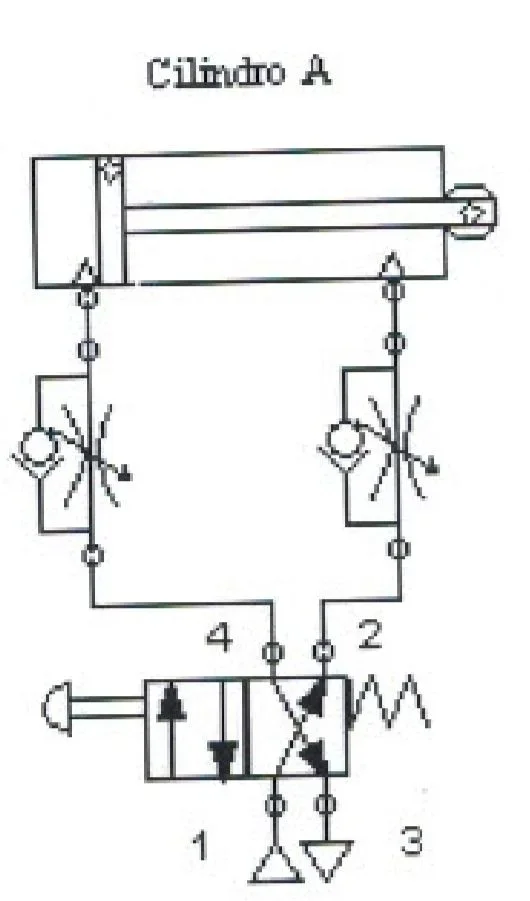
If the cylinder moves forward the sled that must drill, you have a metal resistance towards the black connection (motor opposition)...therefore the chamber subject to pressure loss due to the flow that comes out quickly when I have no material to drill is the front chamber.
in tire and hydraulic always stops the room that undergoes the retrograde motion and not that of the direct motion because the regulation must be able to win the mass or the main force and not hinder the bike.

the unidirectional control valve is so structured:IMG_20190422_112115.webpTherefore while hole I need to close the front chamber and keep the rear chamber regulator open enough to be able to have enough flow, unless I want to delay the bike and make the cylinder progress very slow.
attention that closing the back strozzo you have the phenomenon of stick-slik and you need to close the front strozzo a lot.IMG_20190422_112228.webp
 
Shake the incredible. . .

Who ever said that the flow regulator would be put at the entrance of the room upstream?
Are you there or are you doing it?

what you have not understood is that even with the flow regulator at the exit of the room downstream, when the load is missing, the piston snaps forward without the regulator being even interested. is the concept clear? Maybe something to do with the balance of pressure?

It would be better to read and understand, before... more.

#cacciatorino
about judgments about me, you are tu that you regret not being able to give as a moderator (#8), I don't feel the lack...
 
for those who have difficulty in understanding what they are writing about, understandable, given the confusion raised by some users, we explain why the flow regulator can do nothing to improve the situation of a pneumatic cylinder that suddenly loses the load while being pushed.

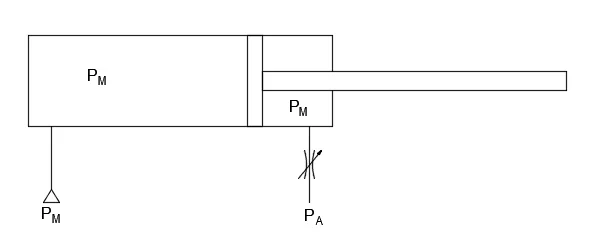
we see the starting situation in figure 1.
P1.webpcylinder is fed to p pressurem while the downstream chamber discharges into the atmosphere through the flow regulator. the piston is held in position by a resistant force equal to that developed by the pressure of dispatch (it is the condition in which the helical tip is drilling).

when the strong force is removed suddenly (condition of the helical tip that comes out posteriorly from the perforated piece), virtually instantaneously, with speed limited only from the inertia of the moving parts, you pass to the condition in figure 2.
P2.webpIn fact, if the strength is lacking, the system will immediately balance the pressure in the two rooms. in the upstream, the pressure will always remain pm, because the fluid is fed by the source; in the downstream chamber, the fluid will begin to compress with the movement of the piston until the volume reduction will not equal the pressure in the other room.

all this, without the flow regulator entering even the game, if not for the passage of a minimum amount of fluid (which moreover moves even further the balance point). only after the balance of pressures, the flow regulator will begin its work, slowing down the piston stroke.

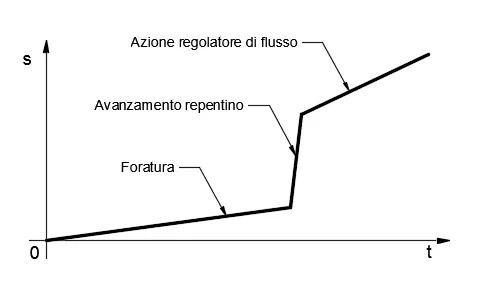
this dynamic is deleterious for a helical tip, which would enter the material screwing before closing the hole and end the cut using the side of the tip instead of the cutting edge, with unpredictable results and however poor.
P3.webpin Figure 3, above, the progress of the piston advance is visible depending on the time. the first discontinuity is when the tip comes out posteriorly; the second discontinuity when the pressure balances between the two rooms.
 
Last edited by a moderator:
I am very sorry to see these tones in a technical discussion, however simple as this, but I am no one to call you to a different behavior. I can just say I'm sorry. .

returning to the subject I want to better clarify what I said in my previous post.
It is clear that the flow regulator with unidirectional valve must be mounted on the opposite chamber to the one in which the push you want to control in speed is exercised. that then both the front or back room is all to be established: for example I prefer to do the opposite, that is to push the tip with the room on the stem side. the reason is linked to the opinion I have expressed before: what should be evaluated in cases such as these are the greatness of forces at stake: If I use a cylinder that barely makes it to push down the tip, the ability to control it when the resistance changes sharply is practically nothing. instead if the tip is screwed into the material (and screws without the se, otherwise they did not invent the bite ..) the resistance to the advance changes of sign. therefore it is good to use a cylinder that is almost "insensitive" to the implied load variations in the application. if the percentage difference between the force needed to drill and that to advance after drilling - and even before, in combination with the piece- is very low, perhaps you can make it work decently. In the photo posted by mecanicamg, which I think would only be an indicative example, the cylinder will be, by the eye, a dn20. to the useful surface of the room side we remove 8 or 10 mm of stem diameter and we find ourselves in the condition that oppose to the push to control the speed is already difficult. for this I would climb a seemingly oversized cylinder - even a 40, but it also depends on the weight of the drill to move - and I would use it by operating the "debole" chamber, since we will not have a force problem, but only speed control.
the other aspect that makes the system unstable is the low speed: the counterpression in the opposite room that should stop the progress lasts little, because the regulator, (unless it is closed completely, but then it is better to put a spring...) however tends to draw towards the free air and the force that opposes the advance of the piston decreases in a short time. so if the speed is low the room will be emptied alone before being able to intervene effectively.
here the friction of the first detachment or stick slip, does not worry very much because the force generated in the room that pushes must necessarily exceed the other strengths.
 
for those who have difficulty in understanding what they are writing about, understandable, given the confusion raised by some users, we explain why the flow regulator can do nothing to improve the situation of a pneumatic cylinder that suddenly loses the load while being pushed.

we see the starting situation in figure 1.
View attachment 53262cylinder is fed to p pressurem while the downstream chamber discharges into the atmosphere through the flow regulator. the piston is held in position by a resistant force equal to that developed by the pressure of dispatch (it is the condition in which the helical tip is drilling).

when the strong force is removed suddenly (condition of the helical tip that comes out posteriorly from the perforated piece), virtually instantaneously, with speed limited only from the inertia of the moving parts, you pass to the condition in figure 2.
View attachment 53263In fact, if the strength is lacking, the system will immediately balance the pressure in the two rooms. in the upstream, the pressure will always remain pm, because the fluid is fed by the source; in the downstream chamber, the fluid will begin to compress with the movement of the piston until the volume reduction will not equal the pressure in the other room.

all this, without the flow regulator entering even the game, if not for the passage of a minimum amount of fluid (which moreover moves even further the balance point). only after the balance of pressures, the flow regulator will begin its work, slowing down the piston stroke.

this dynamic is deleterious for a helical tip, which would enter the material screwing before closing the hole and end the cut using the side of the tip instead of the cutting edge, with unpredictable results and however poor.
View attachment 53264
you forgot to consider the condition in which the force of the pneumatic actuator is 10-20 times higher than the strong force of drilling.
 
While I was writing exxon, he has already deepened the subject. Now I read the post more carefully, but, to the eye and cross, it seems to me in the same direction.
 
you forgot to consider the condition in which the force of the pneumatic actuator is 10-20 times higher than the strong force of drilling.
Toh, but wasn't the position of the flow regulator?

Do you know that by reading you there is a very strong doubt that you did not understand the question of the oversized pneumatic cylinder? Why don't you explain it, even if it's not the flour of your bag? so we also see how it should be realized, which certainly not banal. . .

Besides this, even if the sudden stroke was only a few millimeters, the damage in the hole would already be present, so...
 
exxon why write that" the fluid will begin to compress with the movement of the piston until the volume reduction will not equal the pressure in the other room. "? Flow regulators also incorporate a unidirectional valve, so from the moment the power is stopped from the control valve, the pressure air remains trapped in the chamber and can only come out through the regulator's stroking. What did I not understand?
 
probably the equivoco originates from the type of regulator/stroke: that of the symbol in your scheme does not have the unique and regulates the incoming flow in the room. what I mean has a different symbol - you see it in the mecanicamg scheme- and regulates the flow out of the room.
However I repeat that he too "lost" and after a few, very few, seconds no longer brake anything.
 
exxon why write that" the fluid will begin to compress with the movement of the piston until the volume reduction will not equal the pressure in the other room. "? Flow regulators also incorporate a unidirectional valve, so from the moment the power is stopped from the control valve, the pressure air remains trapped in the chamber and can only come out through the regulator's stroking. What did I not understand?
at the moment when the tip comes out posteriorly, there is no change in the pneumatic circuit, no valve changes position. in my scheme the unidirectional valve was not indicated because in the analysis we do not consider the phase of return of the stem, but only the one of way.

when the sinking takes place, the connection of the downstream chamber may also be hermetically closed; In any case, the stem would make a leap forward until pressure is cleared.
 

Forum statistics

Threads
44,997
Messages
339,767
Members
4
Latest member
ibt

Members online

No members online now.
Back
Top