• This forum is the machine-generated translation of www.cad3d.it/forum1 - the Italian design community. Several terms are not translated correctly.

exercise design construction of machines

  • Thread starter Thread starter Martakynghi
  • Start date Start date

Martakynghi

Guest
Hi I did point 2 of this appeal verifying that it is possible to mount a conical roller bearing I wanted to ask if the design is done well

 
Hi I did point 2 of this appeal verifying that it is possible to mount a conical roller bearing I wanted to ask if the design is done well
 

Attachments

  • IMG_20200306_221440.webp
    IMG_20200306_221440.webp
    80.5 KB · Views: 63
  • IMG_20200306_221446.webp
    IMG_20200306_221446.webp
    107.2 KB · Views: 69
I have not understood what point two is but the design is mechanically possible wrong for several reasons and above all because there are no valid jokes on bearings/shafts and the right bearing interferes rings/hag with shoulders and therefore disintegrates.

Haven't you soldered the bearings to the shaft?
 
this reducer carcass I would say that it has several defects and one of these is that the design of the seats, if it is complete as well as to figure has some problem.Screenshot_20200306_231034.webpfor simplicity we put on Radial ball bearings, imagining that the axial thrusts due to helical gears are very low.
certainly at the school level and given the particular "simplicity" of the reducer I don't think it is necessary to shake up any other type of bearing.
the right bearing has the inner ring on the shaft and on one side of the hub. the other bearing is clearly floating axially.
If I push the gear to the right it moves everything.... if I push to the left it does not move.
solution 1 (hyperstatic)- I push the left bearing in line to the right hub shoulders.
- spacer range equal to outer ring and put it between bearing and wreath so the outer rings are firm
- to the left of the monto left bearing a seeger for tree so it does not move
solution 2 (best isostatic)- seeger holes to put right of the right bearing
- spacer between the two bearings for bearing inner ring pack
- seeger left of the left bearing


...then there are other solutions... .
 
a coaxial reducer with 25kw at 1450rpm in input and reduction ratio i=1/0,13= 7,69 with two stages practically identical (so it seems from the proportions of the drawing).
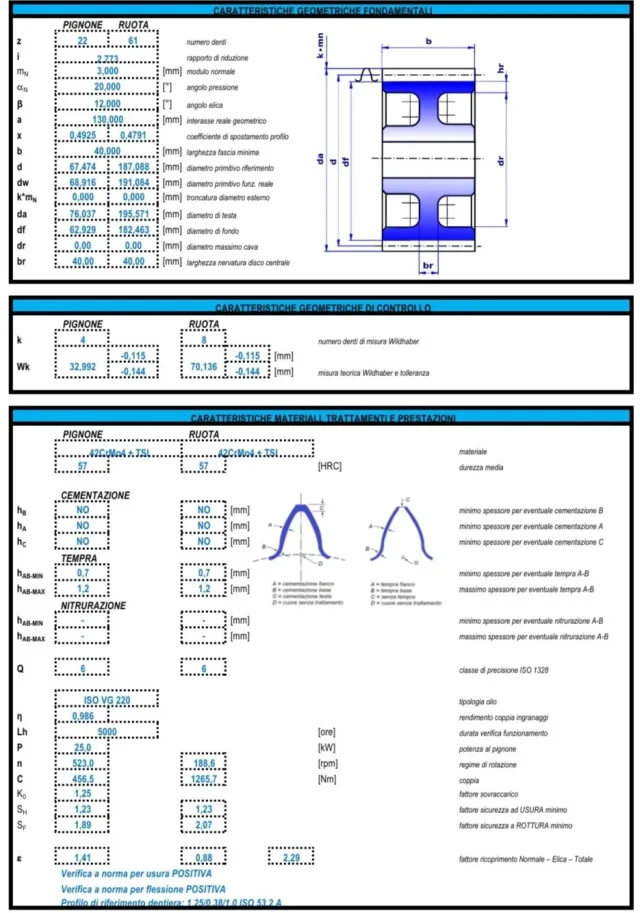
you can say that you can make two stages with ratio 2.77 and then z=22 and z=61.

the second pair, identical to the first but with upper couple will be subject to verification so we will pass 25kw to 1450/2,77= 523rpm and imagine a service factor 1,25.
Screenshot_20200306_233609.webpcalculating the radial, axial and repulsion forces of the two stages we obtain a configuration like the one below, with equal propeller to be able to subtract the axial forces.
Screenshot_20200306_235558.webpthere are negative evaluations because perhaps they are applied in the point to but on the side above the gear and arms to and there are null because the bearings are internal.
the basic scheme represented in the basic calculation sheet is for parallel axes classic but on this you can change the signs with a little reasoning and get a two-stage coaxial.

therefore the forces on the central tree are the forces of the gears and reactions to the bronzes.

for how the tree is bound is a hyperstatic 2 because on the right there is an ink and on the left a sleeve...so there is to have fun solving the exercise or simplifying of bad and oversized to the eye....but it is not a good thing, so the best practical thing would be to use ftool and draw the tree and put the forces and see the cutting values and stinging moment to calculate with those determine the circular effort.
 
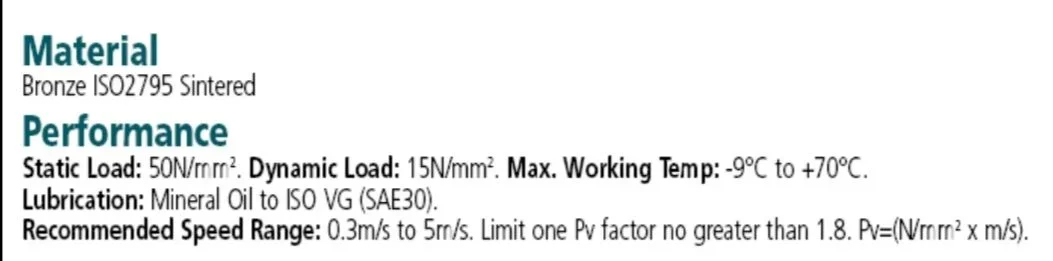
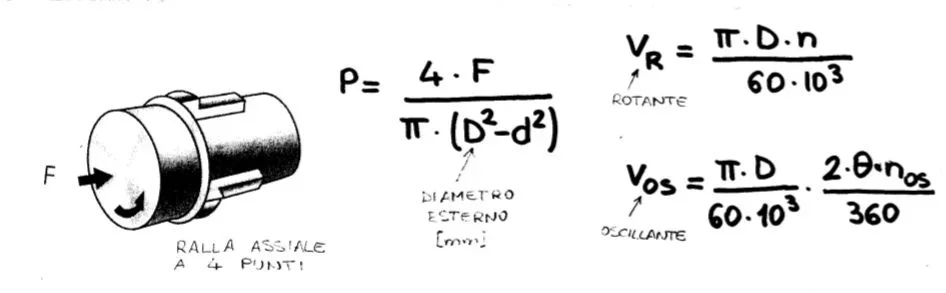
regarding bronzine we will use those in sintered bronze that have the following performance:Screenshot_20200307_000915.webpthe calculation formulas for verification are these:Screenshot_20200307_000618.webpwhere for the bronzine that must not have axial load, but has only radial you have:Screenshot_20200307_000703.webpwhile for the bronzine that bears axial and radial load we will have the assessment of the axial as ring:Screenshot_20200307_000724.webpin addition to the radial seal as a previous point.
 
this reducer carcass I would say that it has several defects and one of these is that the design of the seats, if it is complete as well as to figure has some problem.View attachment 56543for simplicity we put on Radial ball bearings, imagining that the axial thrusts due to helical gears are very low.
certainly at the school level and given the particular "simplicity" of the reducer I don't think it is necessary to shake up any other type of bearing.
the right bearing has the inner ring on the shaft and on one side of the hub. the other bearing is clearly floating axially.
If I push the gear to the right it moves everything.... if I push to the left it does not move.
solution 1 (hyperstatic)- I push the left bearing in line to the right hub shoulders.
- spacer range equal to outer ring and put it between bearing and wreath so the outer rings are firm
- to the left of the monto left bearing a seeger for tree so it does not move
solution 2 (best isostatic)- seeger holes to put right of the right bearing
- spacer between the two bearings for bearing inner ring pack
- seeger left of the left bearing


...then there are other solutions... .
Thank you very much. I've been studying machine construction for a few days and I'm trying to understand these bearings well. Thank you very much.
I wanted to ask you when you put the x-mounted conical radial bearings?
 
type in this case has mounted conical x-mounted radial bearings . why here are these bearings well and in the first design not?
 

Attachments

  • IMG_20200307_094124.webp
    IMG_20200307_094124.webp
    108.6 KB · Views: 36
  • IMG_20200307_094108.webp
    IMG_20200307_094108.webp
    76.6 KB · Views: 37
because when I chose the bearing and did the verification I came out that the cr <co where co was taken from the bearing table since I checked and so I went to put the radial roller bearings
 
type in this case has mounted conical x-mounted radial bearings . why here are these bearings well and in the first design not?
my May that you used is theoretically correct but practically not because it is right that if I push axially it does not move anything but realize a bearing pack with a joke on the seeger without a shaving ring it almost certainly turns out that there is too much axial game and your tree begins to flicker.
sure the bearings if they are able to carry the load and have a duration greater than the desired they go well.
 
my May that you used is theoretically correct but practically not because it is right that if I push axially it does not move anything but realize a bearing pack with a joke on the seeger without a shaving ring it almost certainly turns out that there is too much axial game and your tree begins to flicker.
sure the bearings if they are able to carry the load and have a duration greater than the desired they go well.
in the fatigue sizing of the tree so I proceeded and there is no axial and radial load? So are the bearings I chose?
 

Attachments

  • IMG_20200307_142738.webp
    IMG_20200307_142738.webp
    124.5 KB · Views: 27
  • IMG_20200307_142732.webp
    IMG_20200307_142732.webp
    108.6 KB · Views: 27
in the fatigue sizing of the tree so I proceeded and there is no axial and radial load? So are the bearings I chose?
the bearings, apart from the purely axial ones (reggispinta) are all suitable to withstand a radial load and axial. the equivalent load is always given by the two components,

the radial bearings to a crown of balls carry not so much axial but they are well radial.
the radial bearings to a crown of oblique contact spheres carry radial and a little more axial than the previous ones.
roller bearings only carry radial...almost all.
barrel roller bearings make combined.
 
I don't know if you have adequate dispenses or books on the topic bearings but I suggest you look qui e qui.

if you want an overview to understand every type of bearing what is able to bring as loads I recommend the attached table that is the starting point for the choice.

there are all types of bearing with their general features.
 

Attachments

dynamic load bearings are calculated by regulation as follows:Screenshot_20200307_170626.webpconsidering the equivalent dynamic load that is the coupling axial/radial forces that the bearing will bring and calculate the duration using the life formula and dynamic load coefficient c.

If you use letters always explains what they are.....I use skf nomenclature that is universal.

What is it?
 
sisi the nomenclature that I use is skf. in fact having axial and radial load I chose a conical roller cushion with x mounting which is also economical then I made the verification and it comes out that I load of the bearings is less than the one chosen by table and also the axial force is negligible
 

Attachments

  • IMG_20200307_152201.webp
    IMG_20200307_152201.webp
    115.9 KB · Views: 24
sisi the nomenclature that I use is skf. in fact having axial and radial load I chose a conical roller cushion with x mounting which is also economical then I made the verification and it comes out that I load of the bearings is less than the one chosen by table and also the axial force is negligible
That's why I think those bearings are good. Then the bearings are not welded, but they're stuck.
 

Attachments

  • 15836170430053222714170122081951.webp
    15836170430053222714170122081951.webp
    107.7 KB · Views: 30
blocking a bearing that also has axial thrust with a seeger is not the best of solutions.
I would start by placing the bearings against how you arranged them, so with the outer ring inside.
said this, below the bearing is blocked by the seeger instead of making a space between the shouldering and the outer ring of the bearing, or if you turn it, as mentioned before, to place the inner ring directly on the lower shoulder. It should be said that the seeger ring has minimal distances from the edge, which in your design are not maintained and it must also be possible to mount it and also this from your design does not seem possible.
the top bearing would block it in a different way than with a seeger, in fact flipping the inner ring out, you can safely lock with a wreath and safety rosette.
the intermediate spacer should be made more often than that designed
 
from the site skf
0901d196805ecdd2-1702-0020---17000-w_tcm_12-292193.png
 
I don't know if that type of bearing is good; I'm saying that with that kind of bearing, the locks you chose are not good.
 

Forum statistics

Threads
44,997
Messages
339,767
Members
4
Latest member
ibt

Members online

No members online now.
Back
Top