• This forum is the machine-generated translation of www.cad3d.it/forum1 - the Italian design community. Several terms are not translated correctly.

design reducer

  • Thread starter Thread starter Gabriele17
  • Start date Start date

Gabriele17

Guest
good evening, I wanted to thank in the meantime for the help provided previously on the question tree-mode that led to results more than positive. I find myself struggling with my first experience on a reducer, mainly on everything that concerns the design, excluding calculations on powers, angle speeds, moments and couples. I attach the indications for the realization of the overall, a sketch realized as first interpretation more a small design to the cad created to first display the situation. (nb: the bearings and the relative zones are missing on the cad, the intention was only to see how the total three-dimensional is presented, so also the case does not conform to that drawn by hand). regarding the design I tried to block the necessary and to compensate for the radial and axial spins present through appropriate bearings, I hope to have done it correctly, are accepted advice and criticism. I have a doubt: the incoming tree on which the pinion is mounted has a greater diameter than that it holds the conduct, I designed it so however I can not find an online confirmation or on the book, I also consulted old discussions but it does not seem to me that this problem has arisen. Thank you.
 

Attachments

  • Conti.webp
    Conti.webp
    42.6 KB · Views: 96
  • EsempioCAD.webp
    EsempioCAD.webp
    59.8 KB · Views: 95
  • Istruzioni.webp
    Istruzioni.webp
    70.2 KB · Views: 125
  • Schizzo.webp
    Schizzo.webp
    65.6 KB · Views: 139
the way to draw is much cleaner and sharper. on the two main axes of the trees is missing (or not seen) the line drawn/point.

input tree:
- bearings ok
- the two spacers you put can be eliminated, and make the tree jokes directly. However if you leave it there can be a more adjustable degree if the spacers are born with overmetal to be adjusted to the mounting
- seeing it as represented, the sprocket is hot calettated with interference
- normally if it is a turn reducer, then a torque multiplier, incoming the trees are smaller (low pair and high turns) while out are bigger (high pair and low turns)
- I would have chosen a different way of juggling just for not running something like the second tree.

Exit tree:
- radial bearing on the left, to be isostatic must have air on the right of the outer ring and not only on the left
- mounting toothed wheel with uncertain mounting as tolerance but always with tongue... .is not very different from the first tree... seen that you have a wreath and spacer lends itself to change the calettamento from tab to groove
- left spacer toothed wheel too small in diameter. you have to make two steps the spacer: large towards the wheel and small towards the bearing
- right radial bearing....the same thing of the other, must have air in two directions otherwise not straight and not load the axial bearing. is represented differently the middle above from the middle below....is inserted from left in a turn equal to the outer ring?
- bidirectional axial bearing mounted correctly even if the spacer on the left I would lever it and make us the direct tree line

other general question about trees is the hub of interface with the world. The trees coming out of the box are short, and they should have a tongue, a groove, something. so they are two pimples.

other question are the seals for rotating trees that you did not put, so once filled with oil the reducer starts to lose.

These are the first things that jump to the eye.
 
Good morning, I attach here a correction of the assembly following the advice provided, I should have solved all the problems highlighted, are as always accepted constructive criticism and advice, thanks for the attention and for the answers!
 

Attachments

  • Schizzo corretto.webp
    Schizzo corretto.webp
    62.6 KB · Views: 107
I have a doubt: the incoming tree on which the pinion is mounted has a greater diameter than that which holds the conduct,
the output shaft is always larger (if the torque increases you need a greater diameter to ensure the same mechanical resistance).
I see the upper tree hyperstatic. Here are some notes:
Immagine.pngfor input and output shafts (protruding side) there is to set the connection method to the motor/user :d

for the type of seals /tenute depends on the rotation speed. .
the fast shaft (input) has conical roller bearings that at equal dimensions bear loads greater than those with spheres but do not lend themselves so much to the high speeds. while instead the outgoing shaft that instead bears more heavy loads and moves more slowly has ball bearings, which a little knows about strange :unsure:. ..but everything should be contextualized to the case under consideration and could also be ;)
 
Last edited:
Good morning, I attach here a correction of the assembly following the advice provided, I should have solved all the problems highlighted, are as always accepted constructive criticism and advice, thanks for the attention and for the answers!
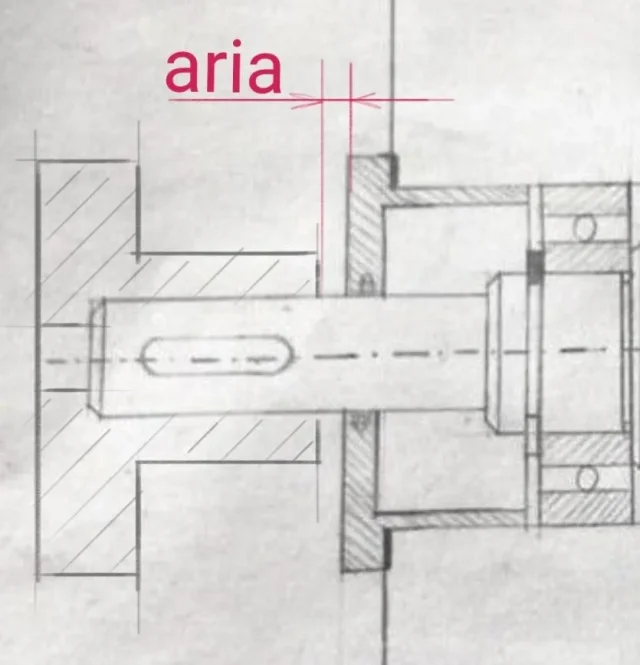
the most obvious errors concern the ends of the trees (both entrance and exit); must be much longer (thinking that the tab is mounted and you immediately realize that this is not good...). you should prolong the lines necessary to ensure a correct calettamento of the elements that will go to couple to the reducer (e.g. incoming motor and outgoing pulley)
 
the output shaft is always larger (if the torque increases you need a greater diameter to ensure the same mechanical resistance).
I see the upper tree hyperstatic. Here are some notes:
View attachment 58170for input and output shafts (protruding side) there is to set the connection method to the motor/user :d

for the type of seals /tenute depends on the rotation speed. .
the fast shaft (input) has conical roller bearings that at equal dimensions bear loads greater than those with spheres but do not lend themselves so much to the high speeds. while instead the outgoing shaft that instead bears more heavy loads and moves more slowly has ball bearings, which a little knows about strange :unsure:. ..but everything should be contextualized to the case under consideration and could also be ;)
I should have solved the problems mentioned. for the issue of conical roller bearings it is true, at the same size would be more advantageous than ball mixes, but theoretically for the purposes of the exercise should go well, as long as they are correctly mounted.
the most obvious errors concern the ends of the trees (both entrance and exit); must be much longer (thinking that the tab is mounted and you immediately realize that this is not good...). you should prolong the lines necessary to ensure a correct calettamento of the elements that will go to couple to the reducer (e.g. incoming motor and outgoing pulley)
ok therefore they have to be more protruding from the reducer to ensure that the calettamento is always favored right? I realize now that this way the tab would be "under" the cap and therefore it would be difficult to manage a coupling. Thank you for your help.
 
I have arranged the protruding parts of the tree both in and out, so I attach the project arranged taking into account all the errors reported until now, according to you now okay?
 

Attachments

  • Schizzo corretto.webp
    Schizzo corretto.webp
    75.7 KB · Views: 86
missing the axial line on the ledges; or you'll put some seegers or floods where there are bearings. Conical roller bearings require an axial game adjustment system. search for some online
 
missing the axial line on the ledges; or you'll put some seegers or floods where there are bearings. Conical roller bearings require an axial game adjustment system. search for some online
but the conical roller bearings are not already stuck with the plugs?
 
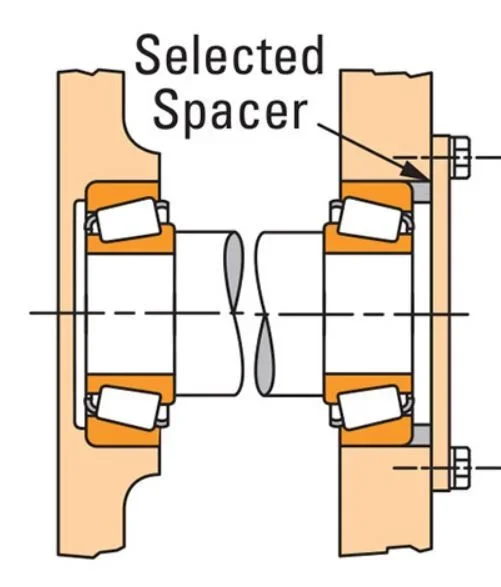
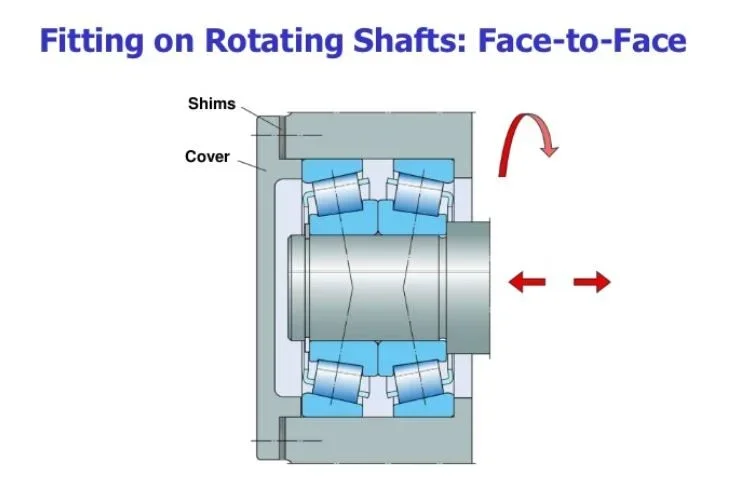
those bearings need to have the axial game practically canceled; in your reducer there are several details that determine that game and, considering the sum of tolerances, it will be impossible to keep the game "zero", for this you need a system of registration of the game. you chose the layout at"x", so you should adjust the game by acting on the outside rings. with the "or" layout, the adjustment is made by acting on the internal rings. as I wrote, search on the net and you will find several examples.
 
I have seen doing that kind of fittings with conical rollers several times (with the two plugs and distantial in straight, which perhaps you do not see well from the image that placed gabriele17). . .Cattura2.JPGCattura.JPG
 
another method not always feasible (especially for large diameters/dimensions) is to use a threaded plug and a locking ring on one side :) ...
1590939614480.webp
 
I have seen doing that kind of fittings with conical rollers several times (with the two plugs and distantial in straight, which perhaps you do not see well from the image that placed gabriele17). . .View attachment 58173View attachment 58174
Yes, I used this method, precisely the first indicated. The only doubt I have is whether the two conical roller bearings are stuck on the seat by ring, for example, or that's enough what I've done already.
 
the speech of the outside joke of the trees, in itself it is not necessary but could be useful.

the version with the external bar can be useful to improve notice objects with passing hole.Screenshot_20200531_174113.webpIf you leave them without a bar, you are obliged to mount objects with blind hole and thread one or more screws to hold fixed axially.Screenshot_20200531_173409.webpon the adjustment of the axial bearing game there are many ways. I personally prefer the spacer to be adjusted to fit so if you reassemble there is no need to adjust the wreath that could be wrongly preloaded by properly trained personnel.
 
ok in the meantime thanks as always for the answers and the help, I believe that regarding this exercise can go well without joke on the external seat, as it is turn to the correct assembly in the inside of the case, thanks anyway for the information that will certainly be useful to me :)
 
ok in the meantime thanks as always for the answers and the help, I believe that regarding this exercise can go well without joke on the external seat, as it is turn to the correct assembly in the inside of the case, thanks anyway for the information that will certainly be useful to me :)
Okay, that's good for exercise. but if you get back in the future, take out the line, because the seat of the liguetta becomes a razor and when you stick the flange that has the seal ring, there is a strong risk that you can cut the seal.
 
good evening, I have reflected on the design and your advice, so I modified the assembly by placing on the exit shaft of the conical roller bearings, as you have also specified you hold a greater load and bear lower speed than the ball bearings, vice versa I mounted radial ball bearings and double-acting braces on the incoming shaft. I attach the design, as always are welcome criticism and advice.
 

Attachments

  • Nuova impostazione.webp
    Nuova impostazione.webp
    189.9 KB · Views: 102
good evening if I can a question regarding this exercise,the use of spacers is intended to register to the right assembly?
 

Forum statistics

Threads
44,997
Messages
339,767
Members
4
Latest member
ibt

Members online

No members online now.
Back
Top