• This forum is the machine-generated translation of www.cad3d.it/forum1 - the Italian design community. Several terms are not translated correctly.

applications for gearboxes

  • Thread starter Thread starter AnnaK
  • Start date Start date

AnnaK

Guest
Hello, I am a three-year mechanical ing student, are struggling with the design of a single-stage helical gear reducer with parallel axes. My starting data are as follows:
output power of 30 kw
710 rpm input rotation speed
transmission ratio 5
I have seen that on this forum there are many discussions about the gearboxes many useful for the design, but I was wondering if someone would know how to orientate me on a possible application of a gearbox with similar data to my own, especially what kind of machine could I couple them out? from an online search I found only general information about possible applications, with helical gear reducers such as mine with range of change of power and rotation speed however very wide, such as lifting organs or handling machines as conveyor belts. Would someone help me by framing the problem more specifically, with similar applications suitable for such a reducer? I thank in advance anyone who can pay attention to me.
 
Bye. applications are endless and so even the downstream machines of your reducer can be of all kinds. clearly an entry to 710rpm we say that it matches a motor regulated by inverter to that rotation regime, rather than one by a first gearbox.
all steel industry machines, to cut, wrap, push, smooth, roll, roll out sheet... iron filter etc can have these performance.
Of course, you can connect us conveyor belts, rotating baskets of small valleys, textile machines etc. drills, forming machines, milling machines, lathes etc. your question has infinite answers....so if you have to....take a user you know and calculate the requests.
 
thank you so much for the quick answer and for the different ideas you provided me. I do not have to do any particular calculations but only design according to a possible use, for example taking into account in the accuracy of the dimensional and geometric tolerances to be adopted, if I have a strong need to ensure a good rigidity of the trees and ensure the alignment of the centers, if there are safety coefficients or penalties to be considered for any risks in particular environments etc.
 
ciao annak, This is what It's a discussion from a request similar to yours.
the applicability of a parallel axle reducer consisting of only one pair of cylindrical gears (at helical toothing) is conditioned in addition to the output speed and the power, also by the morphological variants.
the same gearbox with a commuter configuration will find more possibilities of use in conveyor belts and conveyors for feed. if you have feet, or flanges, or mounting brackets will satisfy a greater number of applications such as surface aerators, waste water lifting screws, pumps, furnace fans for the production of bricks, and many more.

the sizing of industrial gearboxes is foreseen with a ka=1 application factor, then, in phase of choice, will be applied a corrective factor that takes into account the various parameters that characterize the various applications as you can see in the attached document.

to have a visual idea of applications and solutions applied, you can consult the site of a manufacturer where:markets and applicationsfind applications and gearboxes normally used and in:products and applicationsfind some of the applications where a certain reducer could be used, in the specific case you can see the series s that even if with powers lower than you expected and with a different morphological aspect, it is however a parallel axle reducer normally called monostage.
 

Attachments

good morning tretrastore and thank you very much for the answer and the numerous ideas and material, I will look at it calmly and in case of further doubts, I will not hesitate to explore the forum. Have a good day.
 
ciao annak, This is what It's a discussion from a request similar to yours.
the applicability of a parallel axle reducer consisting of only one pair of cylindrical gears (at helical toothing) is conditioned in addition to the output speed and the power, also by the morphological variants.
the same gearbox with a commuter configuration will find more possibilities of use in conveyor belts and conveyors for feed. if you have feet, or flanges, or mounting brackets will satisfy a greater number of applications such as surface aerators, waste water lifting screws, pumps, furnace fans for the production of bricks, and many more.

the sizing of industrial gearboxes is foreseen with a ka=1 application factor, then, in phase of choice, will be applied a corrective factor that takes into account the various parameters that characterize the various applications as you can see in the attached document.

to have a visual idea of applications and solutions applied, you can consult the site of a manufacturer where:markets and applicationsfind applications and gearboxes normally used and in:products and applicationsfind some of the applications where a certain reducer could be used, in the specific case you can see the series s that even if with powers lower than you expected and with a different morphological aspect, it is however a parallel axle reducer normally called monostage.
good sander, I saw calmly the material you indicated to me; for applications you practically advised me to find me a reducer similar to mine from the site of the bonfiglioli manufacturer and go to see the applications that bonfiglioli himself recommends. thanks first for the advice, also the monostage motor of the series s previews how you wrote you powers of little lower. I have also seen a pendulum reducer of the ta series, namely ta50 or ta60 which instead provides a range of powers which includes my own of 30kw series ta: bonfiglioli Since the pairs in play are in input about 400 nm and out of 2017 nm. is this pendulum reducer actually a single-stage parallel axle reducer? gearboxes say commuters if the shafts transmitting the bike are one above the other vertically? therefore the fact that it is commuting however definitely affects the applications. I had thought to realize the reducer as I saw doing to my classmates with axes placed next to each other in a horizontal sense, and make us a rectangular carcass that enclosed the components and the oil lubricant. in lesson it was not talked about taking into account how the reducer went then connected upstream and downstream and I thought that a gearbox with axes on a horizontal plane could easily be mounted vertically, with the appropriate fixing methods to the motor and the user depending on the applications. Maybe I'm wrong? in case you want to make it commuter the reducer, being my wheels dentate through a first dimensioning of maximum 65mm respectively the primitive diameter of the pinion and 315 that of the wheel, changes something in the design beyond the disposition of the boards?
I attach the catalog of the bonfiglioli of the translator commuting series ta and the two types of the series ta that I chose being closer to my application.
A1.webpA2.webp
 

Attachments

Bye. Classic parallel axle gearboxes have the trees placed side by side and each pair of wheels has a different interasse, increasing the stages.
A coaxial parallel axle reducer has a fixed inter axle for two wheels. a parallel axle reducer can be mounted with a commuter system by connecting a reaction arm. red gearboxes in fact has a somewhat more modern use also nea definition.
In reality the ta series reducers are compact as cookies but you can easily forget.
Of course you are doing a little bulky monostage reducer since you have a diameter of 315/65....4,8.
Actually no manufacturer recommends the application of nothing. simply give you the performance of the reducer.
that then some sugar and mining reducers are particularly robust etc.... but the rest is at the discretion of those who buy.
In reality the commuters of large consumption of bonfiglioli are also the series f.
reducers can be mounted in all ways in space, clearly seals and oil caps should be put right.Screenshot_20210811_221145.webp
 
Hello annak, here are the answers.
Is this pendulum reducer actually a single-stage parallel axle reducer?
Yes, although it has a slightly dated shape being one of the first series of gearboxes built by bonfiglioli and used in the past mainly for the operation of conveyor belts for quarries and mines; the most current form has evolved in the f series highlighted by @meccanicamg but with two/three/four stages of reduction.
gearboxes say commuters if the shafts transmitting the bike are one above the other vertically?
no, they say commuters the cable shaft gears that are mounted on the shaft of the operating machine which also acts as a support and have the need for a reaction arm or tensioner that contrasts its rotation.
It is a solution that, where it is possible to adopt it, simplifies assembly and determines economic savings.
therefore the fact that it is commuting however definitely affects the applications. I had thought to realize the reducer as I saw doing to my classmates with axes placed next to each other in a horizontal sense, and make us a rectangular carcass that enclosed the components and the oil lubricant. in lesson it was not talked about taking into account how the reducer went then connected upstream and downstream and I thought that a gearbox with axes on a horizontal plane could easily be mounted vertically, with the appropriate fixing methods to the motor and the user depending on the applications. Maybe I'm wrong?
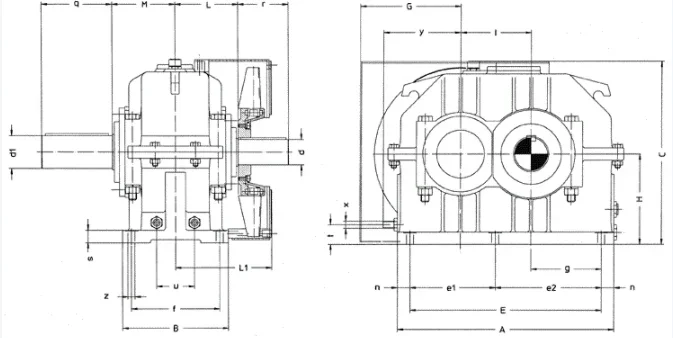
no, not wrong, is the most classic representation still in use; for this you can take inspiration from the parallel axle series rxp700 of stm gearboxes that has a quite current shape and from whose catalog you can see the external dimensioning of the carcass also in the version to a single reduction and, through the online configurator, download the model 3d.
for the upstream and downstream connection you can see pages 16 and 19 of Basic course on power transmissions; while entering the gearbox, the direct connection can also be provided by coupling a b5 (flammed) motor and a corresponding flange on the gearbox, but in your case not to complicate your life I would limit myself to a simple connection with coupling.
in case you want to make it commuter the reducer, being my wheels dentate through a first dimensioning of maximum 65mm respectively the primitive diameter of the pinion and 315 that of the wheel, changes something in the design beyond the disposition of the boards?
no, changes only the external shape of the carcass that would need only one floor worked for fixing the reaction arm. I think, however, that in this case the teacher may ask you what application you have provided with this type of assembly and the only one that comes to mind with commuter mounting and with the output speed indicated by you is a waste water lifting screw, but in this case the coupling between engine and gearbox is directed. we would also consider the correct position of the lubricant level as the reducer would be tilted.

if you want to see some examples of mounting of various gearboxes (mounting on base, commuter, flange, etc.) you can always find them in Basic course of power transmissions quoted by p.167 on page 172.
to get an idea of the types of fasteners provided in the various applications you can see them at the trade fairs, or if you see many also in the amusement parks like gardaland and mirabilandia in the drives of the various attractions.
 
in the first place thank you very much Mechanical e tetrastore for answers.
Then as for the pendulum reducer, I realized that it is not what the prof asked.
As from what I understand, it has a reaction arm that I should measure because it is still part of the gearbox. then return to my idea of standard parallel axle reducer.
therefore from the catalog bonfiglioli the only reducer that could do to my case is that of the series s that tetrastore had already indicated me series s : bonfiglioli despite the max power is 11,6kw and the max torque is 220nm (my torque out is 2017nm)
also I had found as possible application this industrial textile machine since the speeds in play t.n.2e/m - t.n.3e/m), am I in a range that also includes my of 142 rpm, although the powers are also here lower, i.e. 10 kw . but thinking in both cases (food and textile machines) of wanting to use the same applications however on a slightly larger scale, requiring therefore a power greater than 30 kw that at equal turns to the min produces me an even greater couple, could go well both applications for true reducer?
 
Last edited:
Since applications mainly school need to learn the basics of gearboxes, I suggest you look at the elliptical gearboxes that are practically the ones that were done 30 years ago.
the link al monostadio.1628852135402.webpyou will find the main dimensions, the characteristics of power / spins and the thermal power. Moreover if you look very well on the site, you will also find how you calculate thermal power and other things that are complementary.
from the various patterns it is possible to understand also how they are built inside.1628852266149.webpAs for applications, it is interesting how tiring you imagine a machine and understand how much power it takes.

I recommend something more "mechanical" simple. for example a nice pinch-roll that is nothing but a pair of metal or rubberized counter-rotating rollers, which are closed with a sheet ribbon in the middle to drag it into a process plant.1628852507744.webpwe have spoken several times in general qui.
the process is simple enough to calculate and to determine, without having to finish on specific sites, specific builders,....where there is no real information to be able to calculate.
the calculation formulas find them qui, where we talked about how this machine is calculated.

I would say that by inserting some plausible number, you can get your reducer.
I invite you students, to take what you can calculate and calculate it. normally in mechanical technology make cutting processes, deformation etc... take inspiration to dimensional the machines that make these processes. without removing anything from the textile machine, but how would you calculate the frictions of the real organs, the shuttles moving, the needles going up etc?
pinchroll:- speed can be between 100 and 300 m/min
- roller diameter can be between 200 and 400 mm
- specific shooting can be between 2 and 5 mpa
- sheet metal tapes can go from any thickness from 0.1 to 16 mm with width from 300 to 2500 mm (then there can also be 30mm sheet and 3000 mm wide but we do not go there in that giant)
1628853426354.webpIf you want to do a complete thing, and you will surely dedicate an oct to doing things and you will understand an aspect of mechanics, where you will be able to combine the theory that taught you (activities, slipping, wheel deformation etc) with a process of mechanical technology and you can say that you dimensioned the machine.

doesn't need to dimensional intergalactic things. ... let's remember that everyday and/or widespread objects are not complicated.
 
in the first place thank you very much Mechanical e tetrastore for answers.
Then as for the pendulum reducer, I realized that it is not what the prof asked.
As from what I understand, it has a reaction arm that I should measure because it is still part of the gearbox. then return to my idea of standard parallel axle reducer.
therefore from the catalog bonfiglioli the only reducer that could do to my case is that of the series s that tetrastore had already indicated me series s : bonfiglioli despite the max power is 11,6kw and the max torque is 220nm (my torque out is 2017nm)
also I had found as possible application this industrial textile machine since the speeds in play t.n.2e/m - t.n.3e/m), am I in a range that also includes my of 142 rpm, although the powers are also here lower, i.e. 10 kw . but thinking in both cases (food and textile machines) of wanting to use the same applications however on a slightly larger scale, requiring therefore a power greater than 30 kw that at equal turns to the min produces me an even greater couple, could go well both applications for true reducer?
If I find a gearbox that brings more than the torque you need is normal and the ratio between the torque and the torque you need does the service factor....which is usually good that it is higher than 1. then at the same time you will need to do the thermal verification and often need a large case or fan to dissipate heat.
sincerely regarding bonfiglioli gearboxes you are looking at small gearboxes (series ta, series s...c....f...) but you are not looking at the hdp that are the real gearboxes for the medium/heavy parallel axle industry. so much so that you look at the elli gearboxes or the g series red gearboxes.Screenshot_20210813_144945.jpgthen you have to understand if the engine you want to attack flanged or with joint and legs....30kw is not a small motor.

a general note: Of course, using an 8-pole motor is not the right choice to have a motor with a small axis height....of against the thermal power could be less affected by turning at ease, but if I put a fan not so much. the ideal however would be to use a 1460rpm 4 pole motor and a reducer with i=10 and however it is not the transmission but reduction ratio (one is the opposite of the other).
 
thanks really mechanicalmg for the ideas you gave me, at the moment I want to give priority to the dimensioning of the reducer, and to make the necessary choices for that, but then I believe in the end I will make a small account with a user machine that I already know to take away any doubt about the consistency of the application.
About the size of the reducer, I would have a question that ties me. I looked on the net, on the book recommended to me for the gears, young people vol ii, and on the manual bonfiglioli, but I do not find congruent formulas between them and the thing brought me in confusion. I'll explain the problem now. being my helical toothing gear, I used for the calculation of the module the formula of lewis, which I took from the young vol ii, valevole for the straight teethLewis.webp1628865811466.webpand I calculate the transversal module. the young man says however that it can also be used for helical toothing wheels, for a series of motions that explains and seemed plausible.
in that case to pass from the transverse module to the normal you use the formula above, always says the johns.
What should I consider to the denominator? the ideal one if the wheel had straight teeth or the smaller one, z_elicoidal derived from the formula below?numero min di denti.webpI have always thought of using z that calculation with the formula of straight teeth, since I use it in the formula of lewis that young people wrote valevole for straight teeth and then I calculate the normal module multiplying per cos( angle of helix).
Am I right?
also the transverse module use it to calculate the primitive diameter of the wheel and the normal module to calculate addendum and dedendum?
I also compared my formula with what in other discussions you posted on this forum, which I put to ask you for clarifications.lewiss.webpwhere your ylw would be in my formula the klw you call. only the z to the denominator is the number of teeth of the right helical tooth wheel, given by the ideal z product to straight teeth for cos(beta) to the cube? that thing (beta) does not derive from the passage from the transversal module to normal because otherwise I am not, perhaps it is precisely in the lack of cos(beta) to the numerator under root the simplification that makes the johns?
I'm sorry if I've been too prolissa, I hope I've explained well.
 
z is the number of teeth, straight or helical.
zv is the number of virtual teeth, which only for straight teeth equals z. for the helical is approximated with z/cos3anglehelica. beta is the inclination of the propeller.
Unfortunately, each book has slight differences or errors in print or confusion between the various sizes.

Actually, the sizing, i.e. the search for the module, can be done also by chance. only verification must be done with appropriate formulas and possibly regulated.

In fact in my formula there is clearly the calculation of the normal module, which is the form of choice of the creator to standards. as you see there is the multiplier of beta cosine that for straight teeth is worth 1....if it were helical would be less than 1.

always in my formula refers to z i.e. the number of teeth that counts with fingers.

only the coefficient of lewiss reads it considering z for straight teeth and zv for helicals.

I'll get you a pantry with the steps to get to the formula.

the cross module uses it for the geometry of the helical.Screenshot_20210813_180208~2.webp
 

Attachments

Last edited:
good morning mechanicalmg, thanks for the pantry and explanations, now I understand better. there are practically different formulas for calculating the module, I did not know that of reuleaux, which I had also found elsewhere but I thought wrongly it was always that of lewis, written differently. cmq using the formula of helical tooth lewis, this requires the cos(beta) under cubic root and the number of teeth to the denominator I will have to use the "real" for helical teeth, which in the case of a sizing, is in the first attempt the minimum number of helical teeth of the wheel. However, if you use lewis, it is that in identifying the coefficient of lewis y you will have to use not z but zid, which is obtained from the formula also present in the pantry that is the following: 1628928682462.webpbut in this formula z will be the number of teeth of the wheel as if it had the right teeth, because otherwise if it were z min helical we will have again the equality zid=z since it is worth the formula:1628928911147.webpRight? cmq in all this, in the end it really changes little and rightly as you pointed out to me, what counts, beyond what formula is used in the sizing, is that you find the final verification.
Thank you very much for the tips!
 
Just like you wrote in the last post.
If you need anything else, I'm here.
I like you're interested in these things. Don't quit?
 
mechanical savingmg are still carlore23 We had made a discussion on the dimensioning of gearboxes and we had concluded the speech that should only be chosen to the catalog because they are already present in the trade, I reading the discussion of annak I did not understand then why here you said that you could choose the module randomly and possibly verify it to resistance. my question then and this, but the verification of the gear reducer should be made cmq the test of resistance or not because it has already been verified being already all the electric motor included the gearbox already planned? also because then I believe that the verification besides the material should be made also for the service life that is not equal for all types of application so the fatigue resistance should change and if not mistaken even if it was commercial then, the wheel or sprocket gear should be verified to resistance even if and commercial? forgives my insistence but I continue to have the doubt of the discussion before and also reading that of annak
 
Last edited:
forget everything. Let's start from scratch.

if you have to use on your project a gearbox already ready from the trade (bonfiglioli, red, motovario, trasmital, gsm, stm etc.) you have to make the selection from their catalog as an internally unknown entity but that is able to guarantee the outgoing pair you request, relationship close to the desired and that thermally is unable to exceed the temperature of 60/65 degrees centigrade. the service factor will be established as a relationship between the torque dispensed by the reducer divided the one that serves the application.

If you have to use a gear with a rack, or two gears and take them from a catalog (clavalli, sit, khk gear, misumi) you have to verify that it is able to bear the load, because if you choose them randomly it is easy that the teeth break because too small to hold the load or too oversized and then bulky. verification is usually done by verifying the tangential force at an admissible catalog compared to the one that serves your application. where there is no data you need to know the material/or treatment and then make calculations according to regulations.

There's nothing else to say or think about.
 
then my question continues to be this, if besides the choice of the gear motor outside the gearbox you can apply further gears? Usually in conveyor belts are applied chain gears or seldom belts but never dense wheels, from what I saw in industrial machine explosions I found that are rare applications of gear pairs further applied to the gear motor to the same....
 
and then would there not be a constraint that limits on the choice if to insert a gear motor or a simple transmission of toothed wheels? because in theory it should be enough only the gear motor if it is to put gears, then in the design of machines I do not see then the reason to dimensional the wheels or calculate the module to resistance and possibly to choose it to catalog, since and often preferable the choice to the catalog of the gear motor instead of the use of pairs of dense wheels.
 

Forum statistics

Threads
44,997
Messages
339,767
Members
4
Latest member
ibt

Staff online

Members online

Back
Top