
You are using an out of date browser. It may not display this or other websites correctly.
You should upgrade or use an alternative browser.
You should upgrade or use an alternative browser.
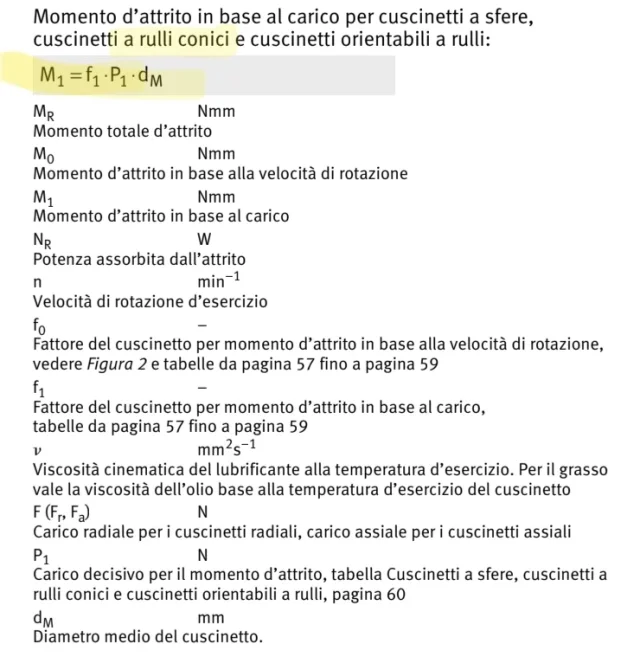


meccanicamg
Guest
then there is to calculate the component coming from the speed:
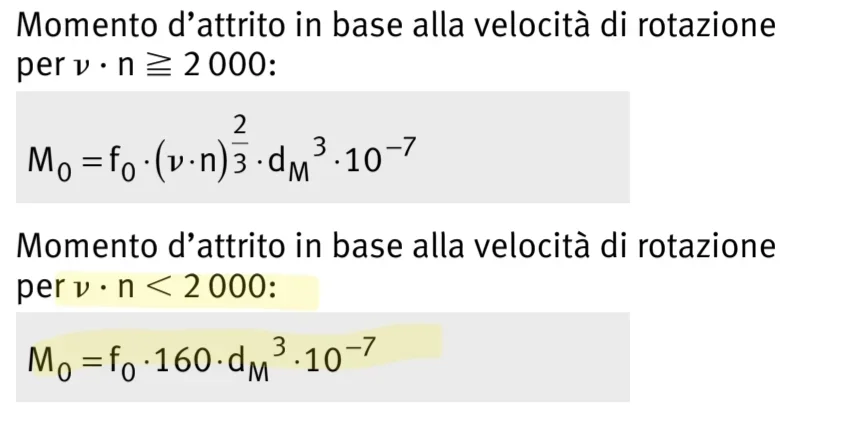 being that the application turns to 600rpm and dm is worth about 140mm and f0=2 we get:
m0=2•160•1403•10–7= 87 nmm.
then says that mtot=m0+m1=367nmm.
boh...we are poorly counted to 0.5nm bearing therefore 1nm to tree applying 5kn radial.
I actually did wrong because I have to see what v•n does and maybe I have to use the other formula.. I'll see you soon.
being that the application turns to 600rpm and dm is worth about 140mm and f0=2 we get:m0=2•160•1403•10–7= 87 nmm.
then says that mtot=m0+m1=367nmm.
boh...we are poorly counted to 0.5nm bearing therefore 1nm to tree applying 5kn radial.
I actually did wrong because I have to see what v•n does and maybe I have to use the other formula.. I'll see you soon.
meccanicamg
Guest
iso vg 220 has viscosity at40°c of 220cst.
600*220 is worth more than 2000.
so the formula is the other.
m0=2•(220•600)2/3•1403•10-7=1315nmm.
therefore
mtot=1682nmm=1,7nm
600*220 is worth more than 2000.
so the formula is the other.
m0=2•(220•600)2/3•1403•10-7=1315nmm.
therefore
mtot=1682nmm=1,7nm
meccanicamg
Guest
make the bearings two on a tree and we roll up... 4nm to a tree. to get to over 20nm there must be something else that doesn't go:iso vg 220 has viscosity at40°c of 220cst.
600*220 is worth more than 2000.
so the formula is the other.
m0=2•(220•600)2/3•1403•10-7=1315nmm.
therefore
mtot=1682nmm=1,7nm
- or formulas are all not true
- bearing flowers are disallined
- skf bearings are second series
- there is still fat tropo
TETRASTORE
Guest
considering the low torque available to move the tree to 600 rpm, surely the fat flows heavily but it is not that even removing the fat, given the size and weight of the tree/cuscinets you can not even win the initial inertia?
meccanicamg
Guest
the initial inertia wins it. when it was full of fat it was wrong to drive and it didn't reach 300rpm.considering the low torque available to move the tree to 600 rpm, surely the fat flows heavily but it is not that even removing the fat, given the size and weight of the tree/cuscinets you can not even win the initial inertia?
TETRASTORE
Guest
therefore this shows that the problem is fat, in fact the strength of the medium increases with the square of the speed. I don't know how much lubricant remained but at this point it would be to remove completely and to introduce (after careful washing) a synthetic oil (max iso vg220) that washes the rollers; and since you have no axial loads, also the replacement of the bearings with two balls, as you had anticipated, would help because you would avoid the loss of torque due to the preload of the conical bearings.the initial inertia wins it. when it was full of fat it was wrong to drive and it didn't reach 300rpm.
meccanicamg
Guest
Thank you, I see that after a thousand reasoning you are converging towards this road.therefore this shows that the problem is fat, in fact the strength of the medium increases with the square of the speed. I don't know how much lubricant remained but at this point it would be to remove completely and to introduce (after careful washing) a synthetic oil (max iso vg220) that washes the rollers; and since you have no axial loads, also the replacement of the bearings with two balls, as you had anticipated, would help because you would avoid the loss of torque due to the preload of the conical bearings.
thanks to all for ideas.
Now I have to wait for something to be done in the workshop... but the bridge doesn't help.
I keep you up to date when I have practical feedback.
meccanicamg
Guest
I found quite interesting and complete the fag manual that I linked just above.
continuing in the analysis, there is to say that the fat at room temperature 20°c contained in the fat iso vg 220 has a density of 850cst which is definitely almost 4 times as much. retracing the previous formulation we obtain:
m0=2•(850•600)2/3•1403•10-7=3'660nmm
mtot=3'940nmm ≈ 4nm
demonstration that in cold rises the friction couple. However curse at 23nm there is still a lot to remove ...visk, glue, still in the room that obstructs the rolling of the reels on the slopes.
I look forward to seeing washed bearings and reassembled to see more gains.
continuing in the analysis, there is to say that the fat at room temperature 20°c contained in the fat iso vg 220 has a density of 850cst which is definitely almost 4 times as much.
retracing the previous formulation we obtain:m0=2•(850•600)2/3•1403•10-7=3'660nmm
mtot=3'940nmm ≈ 4nm
demonstration that in cold rises the friction couple. However curse at 23nm there is still a lot to remove ...visk, glue, still in the room that obstructs the rolling of the reels on the slopes.
I look forward to seeing washed bearings and reassembled to see more gains.
meccanicamg
Guest
continuing in the reading of the manual we have the following: so we multiply 5 times and get a pair required at regimen with a 5•4=20nm cold fat tide.
theoretically, sadly and really we are with what measured by the retroaction of the engine drive.
so we multiply 5 times and get a pair required at regimen with a 5•4=20nm cold fat tide.theoretically, sadly and really we are with what measured by the retroaction of the engine drive.
meccanicamg
Guest
also skf reports....no, the paper version I have 18 years ago was the section of the student kitwhile in This is complete manual since 2021 which is part of the student kit... I did not find the formulas of the calculation moment of friction used by fag.
skf refers to This is link and use more complicated scorpable formulas.... You will have to see if they are more realistic or what. it would be interesting to understand why he abandoned the classic formulas.
skf refers to This is link and use more complicated scorpable formulas.... You will have to see if they are more realistic or what. it would be interesting to understand why he abandoned the classic formulas.
Mattymecc
Guest
try to see if with this more accurate formulation you reach similar results compared to those measured. . .
specifies however that it is valid for lubrication with fat after several hours of use, not again.... and then if the reducer box is full of fat also the trees are subject to remarkable viscous forces.
specifies however that it is valid for lubrication with fat after several hours of use, not again.... and then if the reducer box is full of fat also the trees are subject to remarkable viscous forces.
Attachments
meccanicamg
Guest
Unfortunately it is what I saw with skf, a completely different formulation and revisited however as you say, is valid at regimen and rodato.try to see if with this more accurate formulation you reach similar results compared to those measured. . .
specifies however that it is valid for lubrication with fat after several hours of use, not again.... and then if the reducer box is full of fat also the trees are subject to remarkable viscous forces.
When I have a moment of time I will try to go into detail and do two accounts.
I actually, as you have emphasized I have serious problems of filling and from new just fattened.
meccanicamg
Guest
this is the performance of the torque consumption of a single conical roller bearing fattened according to prescription with 29g of fat depending on the number of spins of the shaft. this instead is the behavior with inside a tide of fat, then 5 times the couple of the correct operation.
 this is the trend of the viscous friction at 20°c as long as you do not heat fat. but at regime of 50°c will be a little lower the pair but the trend is similar.
I am curious to see in the next few days the ball bearing if it really gives me at least 40% of a pair as from calculations.
but I suspect something else: the tapered roller bearings were pulled too much and they were sharpened and so tracks and rollers are "deformed" and this eats me a tide of torque.
We'll also see this with the accounts.
this instead is the behavior with inside a tide of fat, then 5 times the couple of the correct operation.this is the trend of the viscous friction at 20°c as long as you do not heat fat. but at regime of 50°c will be a little lower the pair but the trend is similar.I am curious to see in the next few days the ball bearing if it really gives me at least 40% of a pair as from calculations.
but I suspect something else: the tapered roller bearings were pulled too much and they were sharpened and so tracks and rollers are "deformed" and this eats me a tide of torque.
We'll also see this with the accounts.
Mattymecc
Guest
but are curves "calculated" or detected by the real?
meccanicamg
Guest
calculated... but are not far from those detected by reading the inverter current.but are curves "calculated" or detected by the real?
Just that after a while it warms up and curves drop a little bit.
meccanicamg
Guest
even today some game....with fat and oil, I have to consider their behavior at 30°c because however in the area where there is fat, put in a correct or almost, there is a little 'fastidium' to turn in the sense that after hours it warms a little but actually as a stop, the first miniti is more difficult.
I also saw that the famous oversized factor that can reach up to 5 for fat, it is practically around 2....unless you blow fat like a beast....as it was at first.
then taking the first chart of the post #34 there is to multiply approximately for 2 the pair (curve made with k=1) and drop it slightly due to the viscosity greater than 20°c compared to 30°c.
I would say I found the calibration of this system of greased bearings.
We pass to all ball bearings and in fact with these parameters we have torque and current values measured as by calculations.
I also saw that the famous oversized factor that can reach up to 5 for fat, it is practically around 2....unless you blow fat like a beast....as it was at first.
then taking the first chart of the post #34 there is to multiply approximately for 2 the pair (curve made with k=1) and drop it slightly due to the viscosity greater than 20°c compared to 30°c.
I would say I found the calibration of this system of greased bearings.
We pass to all ball bearings and in fact with these parameters we have torque and current values measured as by calculations.