Joshua662
Guest
Hi guys I write this topic only to have a confirmation on an exercise found on a book that I am reading i.e. project and construction of machines of shigley the text recità so.
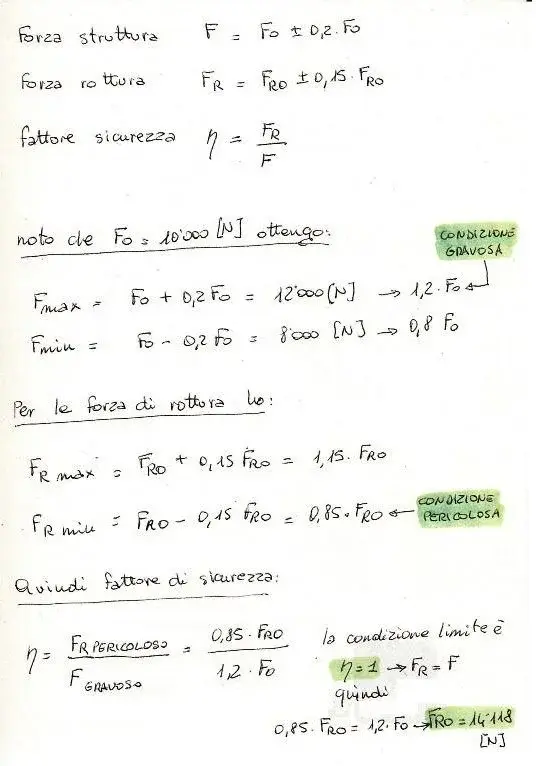
the load of a structure is known with an uncertainty of + or - 20% and the load that causes the break is known with an uncertainty of + or - 15 %.
if the load causing breakage is rated at 10000 n determine the safety coefficient and the maximum permissible load to exceed all uncertainties.
I performed so:
10000+20%=12000
12000/10000 = 1.2
10000-15%=8500
8500/10000=0,85
nd= 1/0,85 / 1/1,2 = 1,4 about 1/0,85
maximum permissible load = 10000/1,4 = 7140 n
How to proceed is it right or is it wrong? I know that for you it is trivial as what, but for me that I have resumed my studies at 32 years it is very complicated.
with this wording 1/1,2 what is indicated? that every n has a break rate 1.2%?
ps. Excuse my ignorance... .
the load of a structure is known with an uncertainty of + or - 20% and the load that causes the break is known with an uncertainty of + or - 15 %.
if the load causing breakage is rated at 10000 n determine the safety coefficient and the maximum permissible load to exceed all uncertainties.
I performed so:
10000+20%=12000
12000/10000 = 1.2
10000-15%=8500
8500/10000=0,85
nd= 1/0,85 / 1/1,2 = 1,4 about 1/0,85
maximum permissible load = 10000/1,4 = 7140 n
How to proceed is it right or is it wrong? I know that for you it is trivial as what, but for me that I have resumed my studies at 32 years it is very complicated.
with this wording 1/1,2 what is indicated? that every n has a break rate 1.2%?
ps. Excuse my ignorance... .