• This forum is the machine-generated translation of www.cad3d.it/forum1 - the Italian design community. Several terms are not translated correctly.

choice

  • Thread starter Thread starter industrial
  • Start date Start date

industrial

Guest
Which bearings are more suitable for the input shaft of a parallel axle reducer composed of a pair of toothed conical wheels?
thanks to anyone who wants to help me.

 
we see the gearbox pattern, how and where you would like to mount the bearings and then discuss it. . .
 
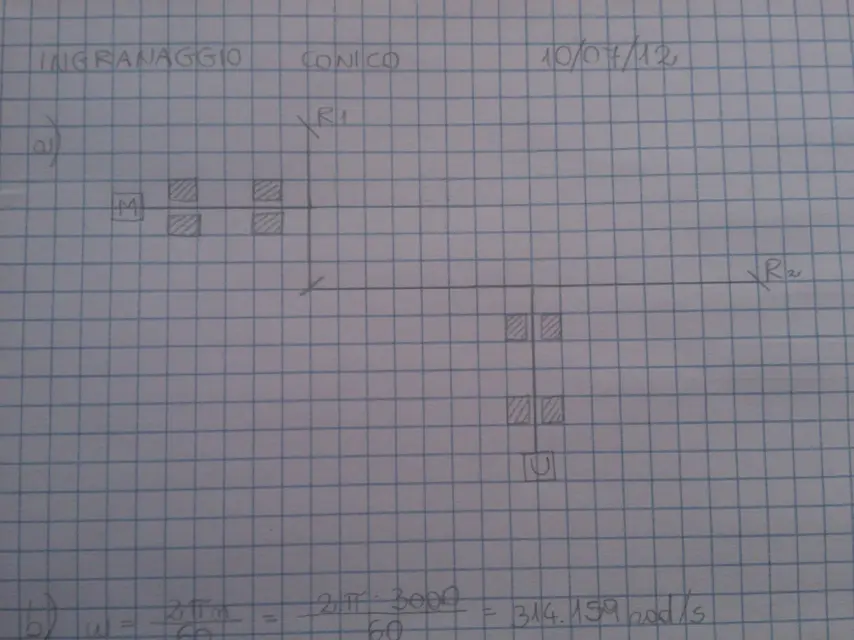
the cinematic scheme of the reducer is this:IMG_20140318_085452.webpI would like to mount them where I designed the supports but I don't know which to choose.
I correct the first post: it is an orthogonal and not parallel axes.
 
Good
now add the forces that the dense wheels exchange and how they discharge on the bearings
 
the forces should be these (I considered a single plan because I only have a wheel):IMG_20140324_113712.webpI don't know how to discharge the bearings
 
I take the numbers for good, but I don't think so.
If you have calculated binding reactions, you also know what the bearing has to bear.
Axial loads? zero?
 
Yes, I specified it in a later message.
Yeah, right, I didn't notice it under the picture.
Now I ask you a question, according to you, the load (which generates couple) with which a toothed wheel transmits the bike is purely radial?

Hi.
 
It is not said to be negligible, the axial force is calculated, once you have all the forces in play you can choose the bearings suitable for purpose.

Hi.
 
but it is so difficult first of all to search on google dispenses with formulas? Actually, there should be everything about school books that you're doing... ..in my time there was to wake up if you wanted to move on....while now with all the tools you could....can't find a solution?
 
Yes, there should be no axial loads.
in the conical wheels the loads that you have are three: tangential, radial and axial. (http://www.isislauria.it/public/asp...lessandri/tecnologia/ruote_dentate_teoria.pdf Page 13

I would advise you first of all to find the incoming torque (made by the engine) and the outgoing torque (resistant by the user). imposing the torsion balance of each tree then find the pairs agents on the wheels (which will be opposite to the previous ones) and from these the tangential forces necessary to develop them.
with the formulas of the conical wheels that you find in literature (on juvinall or on shigley) you also get the radial and axial forces.
 
to have a correct analysis of the orthogonal reducer and determine reactions to the bearings advice This is post.
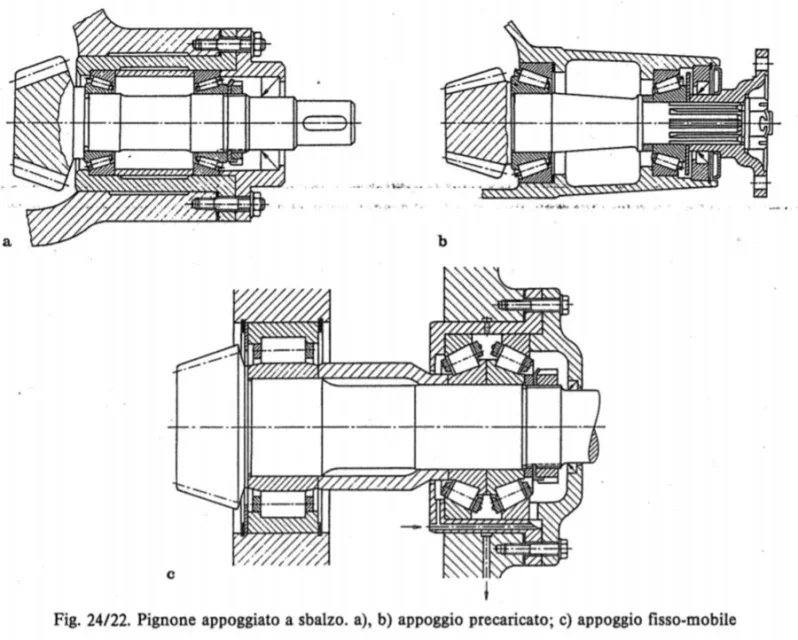
As for the type of bearings, we can mount the input shaft or supported, while the output shaft will have two supports.

These are the regulations with bearings.Screenshot_20190822_235843.webp
 

Forum statistics

Threads
44,997
Messages
339,767
Members
4
Latest member
ibt

Members online

No members online now.
Back
Top