
• This forum is the machine-generated translation of www.cad3d.it/forum1 - the Italian design community. Several terms are not translated correctly.

component processing aisi 316

  • Thread starter Thread starter jugerman
  • Start date Start date

jugerman

Guest
Hello everyone,
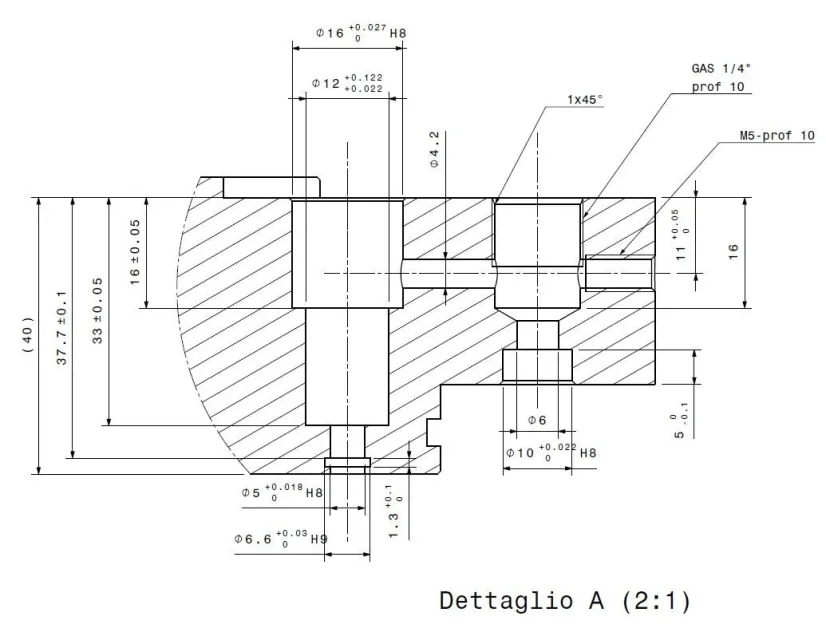
I am analyzing the processing cycle of a 316 aisi steel component. It is a diameter round of 220 mm and a thickness of 43mm. I have some doubts about how to make flat-bottom holes with different tolerances, as shown in the technical detail in the figure.

the idea is to realize in the first phase the deep side drilling of diamentro d = 4.2 mm, then use a centrin to determine the correct position of the axis of the holes with flat bottom, carry with a diameter tip of =5 mm the passing hole, alesare to obtain in hole of diameter 12 mm , finally widen and bring to tolerance h8, with a bare, the hole of diameter 16 mm. after it is provided to realize the hole with gas thread, knowing that the opposite side is still rough and will be worked after the tipping of the piece.

hoping to be clear, but I have my doubts, I ask you if you can help me understand what is the correct way to make these holes and what tools are most suitable (alser, bare, etc.).
 

Attachments

  • sede_asta.webp
    sede_asta.webp
    46.8 KB · Views: 36
depends on different variables:
- What machines do you have?
- How many pieces do you have to make? (a cycle that is good for making 50 pieces is not said to be the same if you have to make 500 per month for the next 2 years)

according to the functionality of the piece you have to pay attention to the coaxiality of the holes and the trunks to the intersections of the holes
 
the piece can be made on a 5-axis vertical milling machine, like the haas 750.
it is custom elements for a lot of 30 pieces.

for a better understanding, I carry a whole section of the disk.
sezione.webp
 
you can also realize between traditional lathe and drill using good tips and lamatists and alestors, but already with a lot of 30 pieces is long history.
 
30 pieces worth doing a good program on the cnc that at least if I had to do it again you are fine.
if the bottom of the holes has to be completely flat you can make them a candle cutter made to sharpen specially with front to bright edge and to lame. of alestore you would do before but a minimum of radius/smusus remains.
the side hole dia 4,2 will be a 10x depth, use quality hm tips with internal lubrication.
if you have the possibility you could ask your reference tool a workmanship study
 
Sorry but I was busy these days and I couldn't participate in the discussion.
Thank you for your precious advice.

regarding the two holes of diameter ф 12 mm and ф 16 mm, I would like to receive some technical advice. the procedure is as follows:
are intended to proceed with a deep drilling with a tip ф 11.8 mm and for a length of 31 mm (compared to the 33 required), using a cusp insert corodrill with a tip length of 1.8 mm. later by means of a coromill plura candle cutter ф 10 mm I first carry the roughing of the hole ф16mm and then I bring to tolerance the hole ф 12. Finally, I perform the drilling on the hole ф16 to bring it to tolerance h8. Finally I run the hole ф 5 h8.

I was wondering:
- is it correct to stop the drilling at 31 mm, to allow the proper lamination of the hole ф 12 mm?
- with a coromill plura candle cutter can I reach the required tolerance for the ф 12mm hole?
- for the hole ф5 h8, do you need to do centring before drilling and subsequent finishing?

Thank you.
 
Sorry but I was busy these days and I couldn't participate in the discussion.
Thank you for your precious advice.

regarding the two holes of diameter ф 12 mm and ф 16 mm, I would like to receive some technical advice. the procedure is as follows:
are intended to proceed with a deep drilling with a tip ф 11.8 mm and for a length of 31 mm (compared to the 33 required), using a cusp insert corodrill with a tip length of 1.8 mm. later by means of a coromill plura candle cutter ф 10 mm I first carry the roughing of the hole ф16mm and then I bring to tolerance the hole ф 12. Finally, I perform the drilling on the hole ф16 to bring it to tolerance h8. Finally I run the hole ф 5 h8.

I was wondering:
- is it correct to stop the drilling at 31 mm, to allow the proper lamination of the hole ф 12 mm?
- with a coromill plura candle cutter can I reach the required tolerance for the ф 12mm hole?
- for the hole ф5 h8, do you need to do centring before drilling and subsequent finishing?

Thank you.
for the 大h8 if you don't want to do it with a 4mm diameter cutter I would say that a center hole takes us, then a nice preforum and then alestore.
 
the hole diameter 5 is passing because to complicate life with interpolation when with trivial alestore passes fear?
flat bottom hole you have a tenth of tolerance in contouring you get it quiet on those depths, but I also of overmetal deep I would leave less than 2mm.
alternative if you often have to make laminated holes are the tips with 180° front different manufacturers have them in range (memory kennametal) and all provide them as special on non-catalogue size
 
later by means of a coromill plura candle cutter ф 10 mm I first carry the roughing of the hole ф16mm and then I bring to tolerance the hole ф 12.
with a series of 30 pieces but I would recommend it in general I would dedicate two different cutters (although of the same code) one to the roughing and one to the finish so as to preserve the finishing cut with minor adjustments of the machine program.
the cutter to finish the diameter 12 you need strictly to live edge while for the roughing you could evaluate a cutter with a small bevel or a small radius so as to preserve the edge that could be a critical point for the wear of the cutter.
 
the hole diameter 5 is passing because to complicate life with interpolation when with trivial alestore passes fear?
flat bottom hole you have a tenth of tolerance in contouring you get it quiet on those depths, but I also of overmetal deep I would leave less than 2mm.
alternative if you often have to make laminated holes are the tips with 180° front different manufacturers have them in range (memory kennametal) and all provide them as special on non-catalogue size
I think it's a good choice. the 2 mm that I intended to leave is due to the depth of the footprint of the drilling tip, which is accentuated over 31 mm. If too much is exceeded, the footprint over 33 mm of depth would leave an excessive flux. leaving a small bevel on the 5 mm hole is acceptable and also functional at the end, but should not be excessive (0.3x60° max).
 
when I need to get to a hole with the flat surface below I usually prefer to use a bare after the hole. otherwise I normally prefer the speaker. for the rest I find correct all the reasonings of those who anticipated me (y)
 
Good evening, everyone. I address myself again to you because I need some advice always on the processing in question.


I have searched in every place, but I never find any precise and correct traction, on how to obtain the specific pressure of cutting for a candle cut and especially how to choose the speed of advancement for tooth fz according to the required surface roughness. Can anyone help me or enlighten me on this?
 
according to my experience surface roughness is conditioned by advance to the tooth, depth of pass (ae and ap in a lesser way) tool wear, fixing system piece, geometry piece, machine in use and its state, lubrication.
In practice I have always seen making adjustments for each processing based on very practical feedback. I make the piece misjudge roughness, monitor over time the situation
 
remaining on the practical, the advancing parameters recommended by catalogs (e.g. sandvik) for finishing, are related to a class of roughness you know? ovverse, using the cutting speed and the fz advance provided by catalog, can you deduce the finishing grade or the finishing range that you could get?
 
I don't have that experience.
in the past I have worked for an Italian company producing whole milling tools and I can tell you that to the eye I would keep good something around ra=3,2 that then you can optimize.
all of course with tool centering and spindle line made well, absence of vibrations
 
I don't have that experience.
in the past I have worked for an Italian company producing whole milling tools and I can tell you that to the eye I would keep good something around ra=3,2 that then you can optimize.
all of course with tool centering and spindle line made well, absence of vibrations

ti ringrazio.
 

Forum statistics

Threads
44,997
Messages
339,767
Members
4
Latest member
ibt

Members online

No members online now.
Back
Top