
• This forum is the machine-generated translation of www.cad3d.it/forum1 - the Italian design community. Several terms are not translated correctly.

conventions not written in norms ..

  • Thread starter Thread starter antonio_sc
  • Start date Start date
there are 3 types of quotas:
-project
- construction
-verification
these 3 types can involve different quotas, but also coincide.
is up to you carry in 3 cases and develop the drawing board and surely more tables do, more shopping experience both for yourself, and based on where you will make the component later.
the "head of the people" should not divert you from the goal of making a universally accepted and correct table.
There is a lot of people who have never made a design and only because he thinks he's seen so many, he thinks he's more "good" than many professionals.
 
Many of these doubts are resolved through the use of geometric tolerances (gd&t), in the case of specific localization tolerances that can reconcile and standardize functional requirements, production techniques and testing methods.
In any case, a partial representation may be used for symmetric pieces by providing the symbol Other on the symmetry axis.
 
In any case, a partial representation may be used for symmetric pieces by providing the symbol Other on the symmetry axis.
hello pie81, I have adopted that system several times but I have noticed that it is ostico to many operators as it compels them to carry out more accounts (when fixed a origin/point of reference), although it goes more than well and saves a lot of effort to the designer (it is that once, when using the pantograph had much more sense)
 
hello pie81, I have adopted that system several times but I have noticed that it is ostico to many operators as it compels them to carry out more accounts (when fixed a origin/point of reference), although it goes more than well and saves a lot of effort to the designer (it is that once, when using the pantograph had much more sense)
if quoti using the axis of half-carry that is "virtual", certainly not easy the operator, but if quoti from a edge, the easy and make the table more rational.
Obviously it is not always possible, but when you can...
 
hello pie81, I have adopted that system several times but I have noticed that it is ostico to many operators as it compels them to carry out more accounts (when fixed a origin/point of reference), although it goes more than well and saves a lot of effort to the designer (it is that once, when using the pantograph had much more sense)
I ran into this problem several times.
in Italy unfortunately we are decades back on gd&t and, as 320i s says, with dimensional tolerances for the location of the holes it complicates control, making it not repeatable and unique.
 
if quoti using the axis of half-carry that is "virtual", certainly not easy the operator, but if quoti from a edge, the easy and make the table more rational.
Obviously it is not always possible, but when you can...
this statement is valid only for the cellarers who use manual mills.
on all cnc and manual machine with axes displayed sets the zero where you want.
the norms, still in force indicate to go in economy of representation if possible.

Besides the problem of widespread ignorance of the dimensional tolerances, there is to say that there is a machine tool park still old and not revised annually....so this more useless footage of the pieces make sure that not even the position of the holes is right.
 
this statement is valid only for the cellarers who use manual mills.
on all cnc and manual machine with axes displayed sets the zero where you want.
the norms, still in force indicate to go in economy of representation if possible.

Besides the problem of widespread ignorance of the dimensional tolerances, there is to say that there is a machine tool park still old and not revised annually....so this more useless footage of the pieces make sure that not even the position of the holes is right.
Of course, but if I know that I will always pass through a cam, I pass to delegate everything to the .step file (recalled on the table) and quoto only the ingombs, tolerated geometries and notes.
if I have to make a "universal" design, I put myself in conditions to facilitate the quotation, with fewer possible calculations in the workshop, which can generate errors.
 
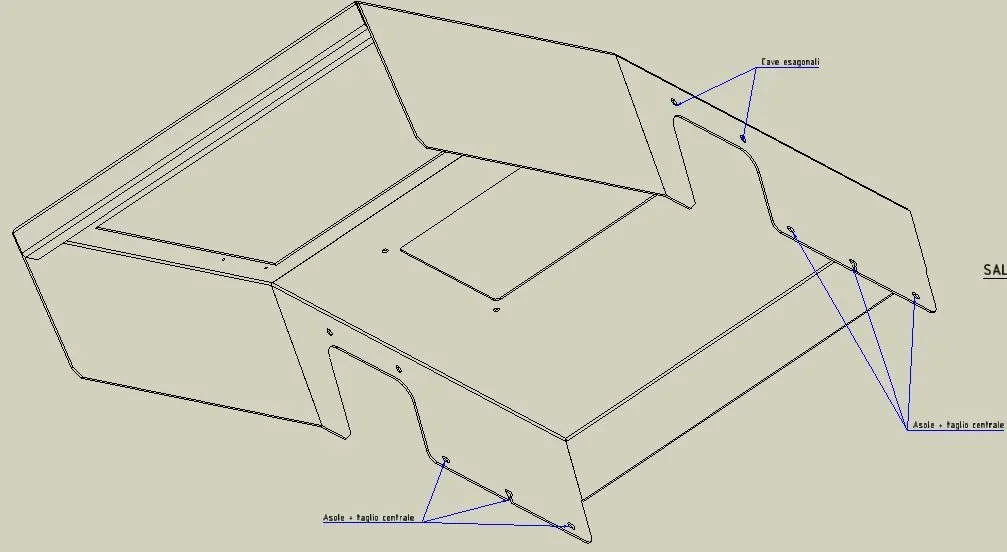
good evening, I have read the various posts and I take advantage of it to expose a doubt that it absules me from a nice piece... I find myself often to quota components that have numerous symmetries ,mainly holes and pockets on opposite faces, pieces but are not completely symmetrical... for reasons of space within a bit of difficulty on how to correctly indicate them to the operator, without having to waste views or dedicated sections that go to fill the sheet completely.. they told me to indicate these elements with a note of the type: "n°x holes for each side" or "n°x asole on both sides" and each company does a little in its own way from what I saw (while the correct/unified method I think is unique). Let's make a simple example. . suppose to quote the sheet in figure (concentrate us on the only subject of discussion). .Cattura.webpthe sheet has a certain symmetry but, while the asolettes that are seen in the details j and f are present on both sides of the sheet, the hexagonal cavities are present only on one side... is it fair/exaustive to indicate them in this way (I refer to the notes near the quota)?
Immagine 1.webpWhat does the legislation mean? (I know that the ideal would devote appropriate sections, but there is no method to reduce the number of views/sections on the sheet and save time in drawings? )
 
I don't think it's fair. What do you mean by side? following the definition of the word is il side, flat geometry, is each of the segments that delimit a Polygon. being the polygon defined by a broken closed, the segments that make up the closed break are called polygon sides. (cit. wikipedia)it goes from if that can also indicate any of the other lembi in which instead there is no hole and therefore if the operator makes 3 suns on all 5 lembi you can not contest anything.
I would do both side views of which one whole (which you must represent to size the object) and the other, if for reasons of space it is not, cut by showing only the portion containing the holes. it goes from if that in the whole side view you have to see the hidden lines and then deem that on the other side there are no other variations in the part not represented because excluded from the cut
 
I understand, thank you very much.. adopting your method the number of holes to indicate on the view is the total one? In other words, taking as an example my case ,quote the suns only on one side and write n°6 suns or do I have to share them in a separate way on both views (with note n°3 suns and relative positions)?
 
Why do you have to write the number? will an operator be able to count the amount of sunshades that must be done or presumed not? and if you write us number 6 and the other sunshades are coaxial, as I think I understand, what the operator understands by looking at a view with 3 sunshades?
you have made two quota views on both (which then suffice the positioning axles and recall detail f)
 
You're right, I was saying a crappy thing, taking the speech first.. If I understood your reasoning well, would it be okay with that? ..you don't see well but the line of hexagons is interrupted in the right view...
Immagine.webp
 
That's right, but you put the odds on the left sunbeds. you know that they are symmetries, but the operator does not
 
Why do you have to write the number? will an operator be able to count the amount of sunshades that must be done or presumed not?
in more complex designs with numerous holes have always forced me to put it because it facilitates them somehow I suppose. .
you have made two quota views on both (which then suffice the positioning axles and recall detail f)
I would like to avoid repeating two times tens and tens of quotas for a hole of difference on two opposite faces of the particular :roflmao:... the method that you have exposed me (quote only the elements of difference on opposite faces) would make me very comfortable also for this reason ... my doubt has always been on whether it is lawful to share only some elements or if you have to necessarily re-equate all hundreds of odds once you have made the other view...so that it may seem intuitive, but different business experiences have a little deviated from what is the correct practice according to me.
 
You're right, I was saying a crappy thing, taking the speech first.. If I understood your reasoning well, would it be okay with that? ..you don't see well but the line of hexagons is interrupted in the right view...
View attachment 50445
I write "symmetrical work as another side". Unfortunately, I have to break down the times of putting into the table, avoided extrapolation of templates that make up the multilame carpenters by entrusting me to the suppliers who use dwg and step.
 

Forum statistics

Threads
44,997
Messages
339,767
Members
4
Latest member
ibt

Members online

No members online now.
Back
Top