• This forum is the machine-generated translation of www.cad3d.it/forum1 - the Italian design community. Several terms are not translated correctly.

couple two plates and antisvitation

  • Thread starter Thread starter antoniopf
  • Start date Start date
din137b. The b137a are those bombed.

we have never made a seal comparison between the two types, but the 137a are not symmetric compared to the orthogonal plane to their axis and the operator must decide the direction of assembly (what to avoid. . ).
 
If we take for example a m4 screw, the 137b has dimensions 4.3/9.0/0.5 (of, de, s), when the plane iso7089 has dimensions 4.3/9.0/0.8. it is immediately seen that the diameters are the same, therefore it does not make sense to overlap the two types. Indeed, being the very stricter din137b, the load transfer to the clamping piece is even better than the support given by the flat ring.

different is the case for the split washer din127b (to avoid) which is size 4.1/7.6/0.9. this has a very lower support section and does not replace the renella plane.
 
this is not the independent one, but the company that led it is the one that launched the stone in the pond. looking with the same keywords you find a lot of material.
very interesting the video, effectively of systems of anti-savory there are many.
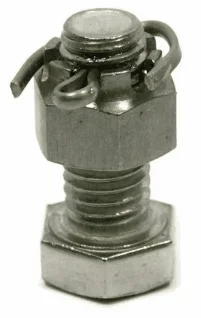
I know that to have some reliability is also the uncut cup and bolt system (although in the machinery sector I have not seen it often use, much more in the automotive sector) and safety platelets (the latter I do not see them practically ever).
 
the "castle nut" are widely used in the avionic sector. They are obviously unbeatable.
I have never foreseen the use in any project. Did any of you use them?
CastleNut.webp
 
very interesting video, only a perplexity, but the nut with nylon insert has a greater power
antisvitating a contradado? I knew (and I had also read on the forum) that the counterpart was the safest method ever.
Did I know wrong?

on nl I had heard a few months ago the bossard commercial and I confirm that on small diameters and maybe stainless steel are a salasso
 
nuts with nylon insert normally work well. if environmental conditions allow it, they are an interesting and economic choice. but they have a huge defect: once unscrewed they should be replaced and, if reused, it is not possible to determine it with a visual inspection.

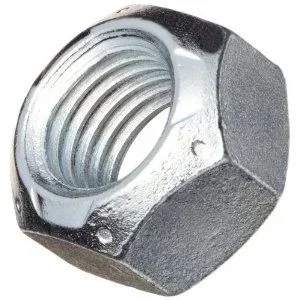
an even better solution would be cyanphritine dice, like these.
Nut1.webphowever, they have the same defect and, in addition, the screw must also be replaced in case of disassembly (therefore are excluded the wallpapers and the captive screws).

double nut is not a great solution, but in any case you should use a normal and a low nut, with the low nut screwed first. in the footage I posted, this test unfortunately was not done. this solution is effective only on consistent diameter screws.
 
I had to use the stainless steel nl also for small diameters - from m4 , m5 to m10 - because a rather demanding customer had specifically requested it, and I can guarantee that they are really expensive, without comparison with self-locking or other washers systems. Moreover, according to the supplier, also these washers should be replaced at each disassembly. I'm not convinced, but I've been very careful anyway, and I've only had them fitted at the last moment before loading the car on the truck.
 
Good morning.
still antoniopf? Are you always vibrations? Hopefully you're not coupling aluminum and steel again...

As we are, I understand, in advertising space, I add another contribution.
From 65151 o from 25201?
 
the "castle nut" are widely used in the avionic sector. They are obviously unbeatable.
I have never foreseen the use in any project. Did any of you use them?
View attachment 52254
is the standard piaggio system to fix the rim flow to arms on the wheel shaft, which its mad or motorized. wasp and bee are like that.
 
wasp and bee, always flying stuff... (battery).

that perhaps it is not entirely, since piaggio was a company that worked a lot in the aeronautics industry: who knows if the use of that type of dice does not result from a company know-how transported from one sector to another.
 
the "castle nut" are widely used in the avionic sector. They are obviously unbeatable.
I have never foreseen the use in any project. Did any of you use them?
View attachment 52254
I used them on some critical threaded couplings of some alternative machines "lente" (to understand us, machines with cross head, speed max 1500 rpm, push to the spindle of the order of 50 kn in traction and equally in compression since we speak of double-acting cylinders - alternate masses up to 15 kg): in particular screws of biella, rod/pistone fixing nut and another position on the cross head (from m16 to m27). the first version of the project was born with nuts (or screw heads) perforated and iron wire :rolleyes:; )
everything replaced with Nordlock for several years, with excellent results.
 
I agree that for "vitines" it is not the best solution. also the cost is prohibitive for smaller sizes, while it is almost negligible for the screws that are sold in boxes for a piece.

for small screws we use elastic wave washers, for intermediate ones the elastic cup washers, then we pass to nl.

p.s. a customer buys clones nl from the cream. it seems to me that they are patented, but if the purchase is regular and documented, I don't think they can be raised responsibility for those who buy, but only to those who sell...
interesting topic

I have personally performed several tests on Chinese clones of nl. the holding percentage on the number is not guaranteed, maybe 7 are ok and 3 are not. the time after all or no

depends on the application, often already that you spend more than a grower washer, it becomes the original nl and you take a thought

work in the north lock and such cases are quite frequent
 

Forum statistics

Threads
44,997
Messages
339,767
Members
4
Latest member
ibt

Members online

No members online now.
Back
Top