• This forum is the machine-generated translation of www.cad3d.it/forum1 - the Italian design community. Several terms are not translated correctly.

coupling wheel and rail for heavy loads

  • Thread starter Thread starter Ing.Vedder
  • Start date Start date

Ing.Vedder

Guest
I propose an old theme that I had already requested many years ago here on the forum but that I never completely clarified.

Do you know any norm and/or calculation procedure of proven reliability that explains how to size a steel wheel system for heavy loads (>500 kn)?
as an example think of a chariot wheel that flows over a rail formed by steel square.

I would be particularly interested in the wheel sizing method (wheel radius, counting band width) and also the choice of the materials and surface hardness to be preferred to make the wheel consume rather than the wheel.
beyond the uni 10011 that from some infarination on the hertzian theory I know the fem 1.001 that explains how to calculate the wheel but does not deepen much on the material of the rail because almost always as a rail is used a commercial profile, while for my needs I would need to dimensional also the rail and decide how superficial treatments affect the operation of the system. (I would like to tempt the wheel induction and reclaim the rail).

thanks to all
 
for standards see uni en 15011 and the technical notebook aise tr6 (it is the American association for the steel industry, now it should be aist, you can buy it online).
the problem of wheel/rotary wear in the wagons is always open: the aise has published a book with many experiences in the steel industry since the 1950s. I had a way to analyze it a few years ago, and the result is that there are so many of those factors that influence it that each user, after various tests, found a remedy that typically works only there, but obtains different results, if not even opposed, on other cranes or other sheds.
by direct experience, I noticed that to protect the sliding wheels, if this is the main objective, the solution to put shoulder wheels eliminates the problem of wear of the edges and prolongs the life of the wheels. of course transfer side wear to shoulder wheels (easy replacement) or rail: at this point, more than wear, typically arise bump problems, with rot deformations or breaks in joints or anchors. It also happens that the axis of the rootini is cracked (and you usually do not have the possibility of direct control on site) and therefore you must also foresee some system of restraint of the rootino itself.
also among the various builders there are different opinions, often discordant, so you say well that you failed to find a solution, simply because it is not unique.
someone thought of facing it with traction control (motors under inverters and controlled by encoders and load cells), and some good result there was, but I do not have many cases in analysis and therefore I expect to express myself.
 
As for the regulations we are aligned. in reality every manufacturer has its experimental and empirical features that lead it to good results.
a series of considerations are made to my post qui taken by norms and niemann.

we have some moving coils carrying 110ton therefore 1100kn and the wheels are a 42crmo4 temprate and the tracks of the drawn in ... what is located. the important thing is that the floor does not see otherwise you eat the tracks.
 
Last edited:
thanks many to both for the valuable information.
@pollo you have put me on an excellent road because today from the en 15011 suggested by you I have come to the en 13001-3 that seems to treat exactly the topic of my question with also considerations on durability and materials
however you have centered the theme.... we are in the steel industry with loads between 500 and 1200 kn per wheel and for various issues I would like to make wear material the wheel while the wheel should be "infinite life".
@meccanicamg as always impeccable thanks for your considerations in the post you attached to me.

Unfortunately today I did not have enough time to deepen but I realize to do it very soon as I can cut out a few hours at work.

Thank you very much to both of you!
 
As for the regulations we are aligned. in reality every manufacturer has its experimental and empirical features that lead it to good results.
a series of considerations are made to my post qui taken by norms and niemann.

we have some moving coils carrying 110ton therefore 1100kn and the wheels are a 42crmo4 temprate and the tracks of the drawn in ... what is located. the important thing is that the floor not see otherwise you eat the tracks.
wrong courier... the floor should not yield otherwise the track bends and wears. the rigidity below is fundamental.
 
Good morning, I exhume this old discussion for a confrontation.. .
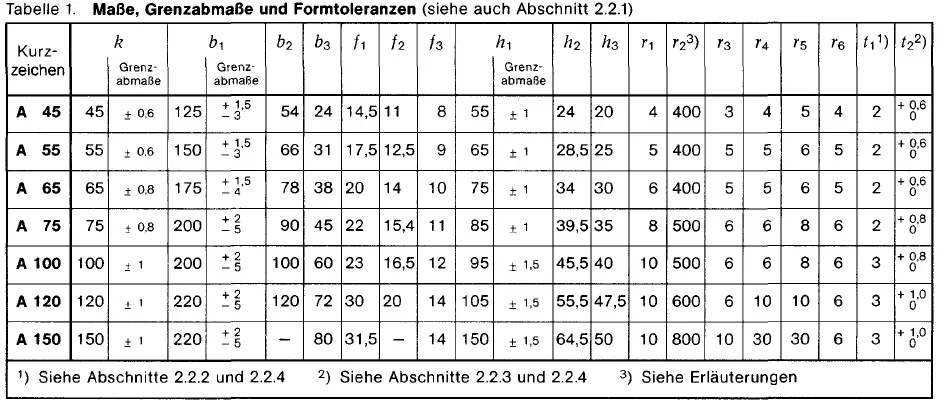
I am applying the uni en 13001-3:2015 to check the wheel with its track, specifically I have a flangeed wheel d.250 and a bourback wheel size a75.
the first verification that imposes the norm is that on the point contact or linear (see attachment), then saying that the point contacts are out of the field of application of the norm.
here arises the problem, i.e. if I admit the dimensional data of my rail and my wheel falls just in the case of dots, then it would not make sense to proceed with subsequent checks.
What seems strange to me is that the dimensional data is related to a wheel and a wagon rail, so I do not expect to fall in a particular case.

I also carry an extract of the din536 relative to the size of bourback profiles of form a.

thank you in advance to those who will answer.

yellow

1724836023499.webp1724836094442.webp1724836182057.webp
 
I do not have the norm in hand but for deduction if you have the curved track and the curve wheel you will have a dot contact. if the track is curved and the flat wheel idem. if you have flat wheel and flat track the contact is linear.
but this does not tell you the norm but the pressure of hertz in his classifications.
but also common sense.
you have attached all the cases....but what do you have? Are you crying? and a curvo burbank?
all this, under high loads and soft materials you get wider contacts and some dots become linear.
 
Bye!
I agree with what you write.
in my case I rotate flat and burback profile.
I don’t feel so much about the fact that the norm excludes all the time contact cases, since the burback coupling with flat wheel is punctual in any case, and is normally used as a solution for the carriageway and crane routes.
 
Bye!
I agree with what you write.
in my case I rotate flat and burback profile.
I don’t feel so much about the fact that the norm excludes all the time contact cases, since the burback coupling with flat wheel is punctual in any case, and is normally used as a solution for the carriageway and crane routes.
and is also used for heavy applications of steelworks and steelmaking.... places where hell of dirt and heat are masters. and not only.
It must be seen whether the norm is so or whether it has a wrong courier or whether it has any explanation about it.
 
Right...
However I tried to ask for a consult even to one, they accepted the request, we will see what they answer.
Maybe the solution is trivial...
 
Right...
However I tried to ask for a consult even to one, they accepted the request, we will see what they answer.
Maybe the solution is trivial...
You did well. They usually turn to some industry ing and let you know.
When I went to college, they gave me a hand with my demands.
 

Forum statistics

Threads
44,997
Messages
339,767
Members
4
Latest member
ibt

Members online

No members online now.
Back
Top