
• This forum is the machine-generated translation of www.cad3d.it/forum1 - the Italian design community. Several terms are not translated correctly.

cylinder filling

  • Thread starter Thread starter F_Ingrasciotta
  • Start date Start date

F_Ingrasciotta

Guest
Good evening to all,
I found myself having to perform an estimate of the time needed to fill a 15-litre cylinder.

Consider filling a volume v cylinder with air, initially under the conditions pi and ti, by means of a compressor with a capacity equal to q_in and t_in temperature. the final pressure is pf. the filling time of the cylinder is formed.

the starting data available are as follows:

  • v = 15 l
  • pi = 1 bar (initial pressure)
  • ti = 20°c (initial time)
  • q_in = 170 lt/min (shipport)
  • t_in = 20°c (temperatura in mandata)
  • pf = 147 bar (final pressure)
hypothesis:
  • isoentropic process
  • adiabatic process
  • air considered perfect gas
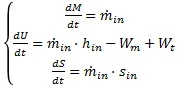
Now the first step has been to write to me the equations of mass budget, energy and entropy discretely discussing them in a delta time.1635423025441.png1635423042196.pngfrom the last equation I made the following consideration:1635423110881.pngAfter that I took a table that shows me the value of cp at the temperature range and I linearized between the points known so as to obtain a function of cp(t)

the next step was to calculate the value of t2 in an iterative way starting from the last equation, the process is reported below:
  1. I place a value of t2 said t2*
  2. calculation cp(t2*)
  3. echo t2 from the last equation of entropy using cp(t2*)
  4. If the percentage error between t2 and t2* is less than 5% I consider the correct calculation, otherwise I select a new value of t2
qui I come across the first problem, the value of t2 is about 458°c, it seems to me an excessive value.

therefore defined the temperature t2 and the pressure p2 it is possible to obtain the m2 mass of air inside the cylinder by means of the perfect gas eq.

the filling time obtained is therefore 3.6 minutes.

I ask your opinion on these considerations, I imagine that in order to have a much more realistic result and that it is not too influenced by the assumptions of departure I have to support a fem to solve the various differentials that are obtained from the budgets.

Should I also discuss the pressure leap to carry out accounts on smaller jumps so as to get more sensible values?

Thank you in advance.
 
Hi.

your is a typical 0d thermodynamic problem in conditions not stating that you can deal very easily with simulink or other similar software that solve your differential equations over time: on excel you have to argue.

Now I don't have much time and maybe I'll be back on the weekend, but in the meantime I'll make some remarks: Forgive me if I am discounted... but for my experience this kind of problem is very "exposed" to trivial errors.

in thermodynamic formulas pressures always come as absolute, so very important to clarify if your initial conditions are in bar at or bar g; even temperatures always come as absolute, expressed in k.
the flow rate expressed in liters/min can be misleading: it is necessary to understand what condition those "liters" are reported (normal, standard, other), in order to determine uniquely the density and therefore the mass flow that then enters the calculations.
it is better to bring you back into formulas to coherent units, so as not to insert conversion factors that then complicate the troubleshooting: then m3, pa, k, etc., which you will then revert into more practical units.
an isoentropic process is by definition also adiabatic: being the constant volume, I imagine you will have neglected the terms of labor exchange and heat in the second equation (the heat exchange in fact is often negligible).
is the flow constant or varies during filling? if it is constant the calculations simplify, but often in practice it is not so.

The basic equations (the left ones) are correct: I have doubts about the right ones (except the first one), but I have to think about it better.
 
Hi.

your is a typical 0d thermodynamic problem in conditions not stating that you can deal very easily with simulink or other similar software that solve your differential equations over time: on excel you have to argue.

Now I don't have much time and maybe I'll be back on the weekend, but in the meantime I'll make some remarks: Forgive me if I am discounted... but for my experience this kind of problem is very "exposed" to trivial errors.

in thermodynamic formulas pressures always come as absolute, so very important to clarify if your initial conditions are in bar at or bar g; even temperatures always come as absolute, expressed in k.
the flow rate expressed in liters/min can be misleading: it is necessary to understand what condition those "liters" are reported (normal, standard, other), in order to determine uniquely the density and therefore the mass flow that then enters the calculations.
it is better to bring you back into formulas to coherent units, so as not to insert conversion factors that then complicate the troubleshooting: then m3, pa, k, etc., which you will then revert into more practical units.
an isoentropic process is by definition also adiabatic: being the constant volume, I imagine you will have neglected the terms of labor exchange and heat in the second equation (the heat exchange in fact is often negligible).
is the flow constant or varies during filling? if it is constant the calculations simplify, but often in practice it is not so.

The basic equations (the left ones) are correct: I have doubts about the right ones (except the first one), but I have to think about it better.
Hello, first of all thank you for the answer.
I can tell you that they are absolute.
concerning the units of measurement I confirm that I have used those of the si (m,kg,s,pa,k)
 
I've been flying a simulation with my simulink model (I've used it for years, I think it's averagely reliable): the filling time is 460 s and the end temperature is about 150 °c, neglecting thermal exchanges and considering a constant flow rate of 170 nl/min = 10.2 nm3/h (12.2 kg/h). My model uses a real gas equation, but it is not attributable to this the difference with your result. tomorrow if I have time I try to look better.. I don't think it's necessary for you to use the budget. You should have the first two.
 
So, I checked and you don't really need the budget. for a very simple first estimate I would avoid the various iterations and do directly a calculation between the initial and final state, considering the constant specific calories: the latter actually vary with both pressure and temperature, but all in all variations are not so large (15-20%) in the range where you are (air - specific heat vs. temperature and constant pressure).

If you replace the first equation in the second, neglecting work and heat exchanges and therefore considering the constant specific heats, you can get an explicit expression of the final temperature according to the final pressure, cp and cv, and the initial conditions. I tried to calculate it, and I got about 147 °c against the 150 °c of my model for real gas (which takes into account the variation of the cp and cv with the temperature, and also of the coefficient of compressibility). as you see very little difference. . .
 

Forum statistics

Threads
44,997
Messages
339,767
Members
4
Latest member
ibt

Members online

No members online now.
Back
Top