• This forum is the machine-generated translation of www.cad3d.it/forum1 - the Italian design community. Several terms are not translated correctly.

design actuators.

  • Thread starter Thread starter ottoper
  • Start date Start date

ottoper

Guest
Hello, everyone! !
I'm a mechanical engineering student and I'm trying to design a hydraulic actuator for a medium earth movement (a digger) but I'm experiencing some problems.
First of all, I can't understand if there are high pressure cylinder reference standards for design. I found the iso 6020 but they're good for actuators up to 160 bars, while what I'm planning, for the forces that must generate, must be at least 550 bars.
second problem, I cannot find the materials used for the construction of such actuators. companies tend not to disclose information about "special" cylinder materials, so I don't know exactly what to refer to.
Thank you so much to all! !
 
but if we talk about special cylinders they are talking about enerpac rather than roemheld that comes to 500bar. that excavators arrive at those pressures seems a bit strange but it could be a base where to leave.

the cylinders iso 6020 work max 160 bar.
the cylinders iso 6022 work max 250bar.
Everything else is not in order.
could follow the standard asme b30.1–2004.

for the construction of cylinders there are the basic rules where tensions are studied on the shirt and on the thighs regardless of the actual operating pressure. of tubes calibrated with different thicknesses you will find a lot on the card even if you then provide dolo the most used ones and you will do a lot from hundreds of meters to have them of your size.
a wide choice you find qui.

Keep in mind that where we work for 30 years that we mount special cylinders on one of our machines and for 6 years we have been assembling cylinders with our design that work at 300bars nominal and do not follow any standard declared, even if they have the ce of the manufacturer of hydraulic cylinders, they do not follow proportions or standard dimensions, we have them in connection 200/250/300/350mm with stems or from 110 or 140 or 160mm.

a good guide find it on this manual that you find online on the author's website
 

Attachments

  • wp_ss_20180424_0001.webp
    wp_ss_20180424_0001.webp
    27.9 KB · Views: 30
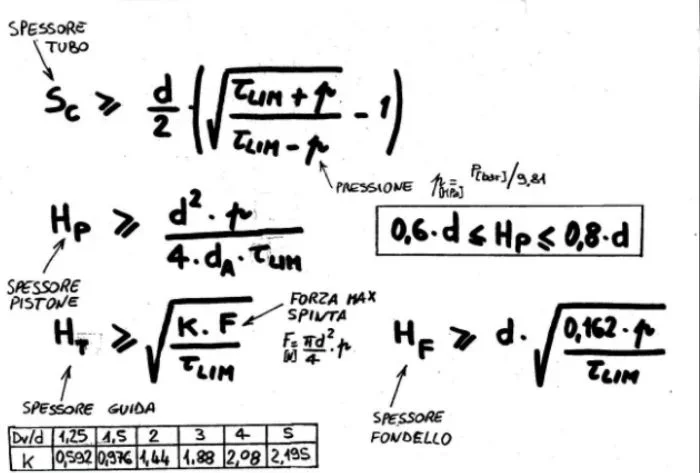
normally for the supported cylinders and that push vertically toduced these attached formulas.

as admissible sigma is used rm/k with k=1,4~1.8 and the admissible tau is 0.58•admissible puzzle.

as seals just look at angst+pfister that have so much stuff that holds high pressures.

then you can use to verify bolting and welding the uni en iso 1993-1-8 and 1993-1-9.

by = cylinder stem diameter
d = cylinder connection
dv = diameter screws front flange
 

Attachments

  • Fantasia Painting.webp
    Fantasia Painting.webp
    28.1 KB · Views: 24
Last edited:
the most used materials to make cylinders are:
- shirts in e355
- and test in s355jr
- stems in chromed c45
- 9smnpb28 pistons

no one forbids you to use mechanically nobler materials with higher mechanical characteristics.

example, if you need to make a 100mm aleage cylinder and 50mm stem that works at 550bar with safety coefficient greater than 1.5 on the materials described above you will get:
- thickness shirt sc=32mm then a tube 164/100
- thickness hf=30mm
- front head thickness ht=50mm
- thickness piston hp=60mm
- if not welded, the heads are bolted with 16 screws din912-m16x55-12.9
- filet stelo m48x1
- to respect the peak load I must check the various conditions of constraint and in this case the races are a few dozen mm otherwise eulero is not verified with factor 5.
 
Last edited:

Forum statistics

Threads
44,997
Messages
339,767
Members
4
Latest member
ibt

Members online

No members online now.
Back
Top