
• This forum is the machine-generated translation of www.cad3d.it/forum1 - the Italian design community. Several terms are not translated correctly.

die casting, definition of the corners of sform,

Smkn

Guest
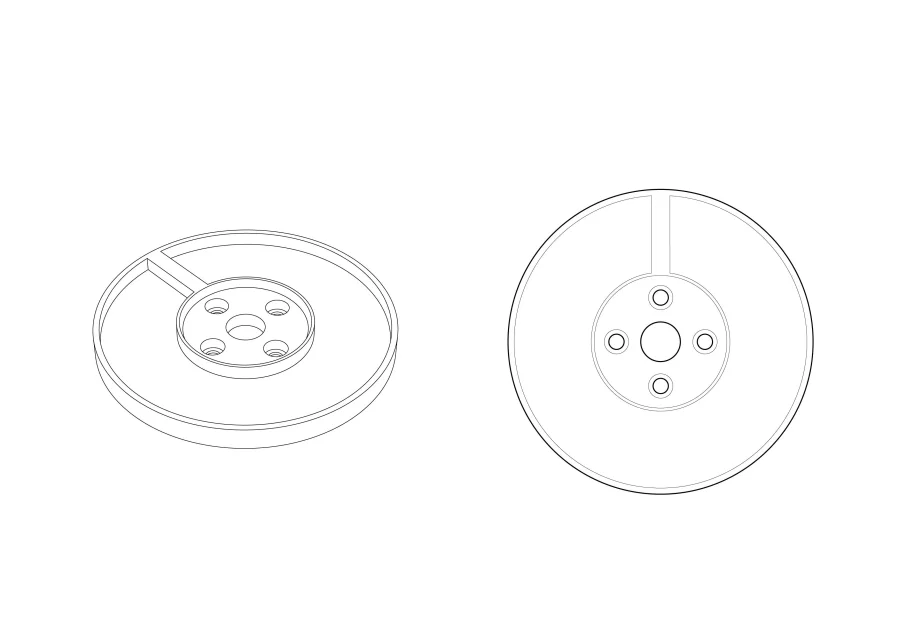
1-01.webphello to all, I hope you can give me some advice regarding the die casting process (steel) in the object that I have attached to you. How long have I understood if the shape remained unchanged I would have problems in the extraction of the die-cast object, right? would someone be so kind to give me some tips about it and recommend a possible modification on the piece to allow a correct extraction? It is important that the production process remains die casting. if he also had some references (texts/references) to recommend I thank you.
Thank you very much

I'm sorry.
 
There are a lot of books and manuals.
You don't have to have walls at 90 degrees and you don't have to have subsquadri. then it must become all half-degree conical down so as to extract the piece in the direction where you create conical air.
 
what I would like to understand is whether the object should be completely redesigned or with some insights I can manage to maintain this form!
As for manuals/references, can you tell me if I find something online? Thank you very much
There are a lot of books and manuals.
You don't have to have walls at 90 degrees and you don't have to have subsquadri. then it must become all half-degree conical down so as to extract the piece in the direction where you create conical air.
 
what I would like to understand is whether the object should be completely redesigned or with some insights I can manage to maintain this form!
As for manuals/references, can you tell me if I find something online? Thank you very much
here you find something already treated:
https://www.cad3d.it/forum1/threads/45007-angoli-sformo-fusione-in-ghisaI then attach a paint sketch where you can see that the sform is often determined more with the delta than with the angle, especially in metal die castings (the one that says the shiren at post 3 to understand us). this means that increasing the height decreases the deformed to equal delta.
so the sform is a need for molding and you have to verify that it is compatible with your design needs, whether they are resistance or assembly.
that is, suppose that the rib of your piece, the one that joins the two circumferences, has been calculated for a tot stiffness. If you the sform from the base you will get a printable piece but the rib will have a lower stiffness as it will be less thick, if you instead the sforms from the top you will go to add material and then the piece will be printable you will have a stiffness without any other. .

as you see the deform is not a trivial thing, it has very important implications and when I hear 'yes' the moldist' come to me the shivers. .

Hi.
 

Attachments

  • sformo.webp
    sformo.webp
    38.1 KB · Views: 27
View attachment 47426hello to all, I hope you can give me some advice regarding the die casting process (steel) in the object that I have attached to you. How long have I understood if the shape remained unchanged I would have problems in the extraction of the die-cast object, right? would someone be so kind to give me some tips about it and recommend a possible modification on the piece to allow a correct extraction? It is important that the production process remains die casting. if he also had some references (texts/references) to recommend I thank you.
Thank you very much

I'm sorry.
here you find something already treated:
https://www.cad3d.it/forum1/threads/45007-angoli-sformo-fusione-in-ghisaI then attach a paint sketch where you can see that the sform is often determined more with the delta than with the angle, especially in metal die castings (the one that says the shiren at post 3 to understand us). this means that increasing the height decreases the deformed to equal delta.
so the sform is a need for molding and you have to verify that it is compatible with your design needs, whether they are resistance or assembly.


as you see the deform is not a trivial thing, it has very important implications and when I hear 'yes' the moldist' come to me the shivers. .

Hi.
There are a lot of books and manuals.
You don't have to have walls at 90 degrees and you don't have to have subsquadri. then it must become all half-degree conical down so as to extract the piece in the direction where you create conical air.
[MENTION=74680]Smkn[/MENTION]hello to all in possible you should attach one or two sets of attached drawings
with relative dimensional quotas
Surely some more precise info we could give you
for quad regarding the dis. to remake depends on quanda experience you have in the management of the sw
or quanda operational dexterity can manage
the piece of sure must be sez in two half
in addition to the fact that metals have after casting or die casting or die casting pre gravitating a metallic retreat
that in the case of steels goes from 1.8% for "normal" steels
2% for stainless steel
2.2% for special steels
keeping in mind that there are some peculiarities
internal cavities make less withdrawal than external surfaces
Thank you very much
 
Thank you very much shizen. I searched for as much information as possible these days and came to 2 assumptions:

1- redesign the object with minimal corners;
2- draw the object with overmetal, considering the additional processing that I need to get to the desired finished form;

definitely the second hypothesis is more expensive but allows me to have the object as well as from project. Since the object has to have that shape only for aesthetic reasons I think the first hypothesis goes well.
confirm?
thanks for availability!


[MENTION=74680]Smkn[/MENTION]hello to all in possible you should attach one or two sets of attached drawings
with relative dimensional quotas
Surely some more precise info we could give you
for quad regarding the dis. to remake depends on quanda experience you have in the management of the sw
or quanda operational dexterity can manage
the piece of sure must be sez in two half
in addition to the fact that metals have after casting or die casting or die casting pre gravitating a metallic retreat
that in the case of steels goes from 1.8% for "normal" steels
2% for stainless steel
2.2% for special steels
keeping in mind that there are some peculiarities
internal cavities make less withdrawal than external surfaces
Thank you very much
 
Thank you very much shizen. I searched for as much information as possible these days and came to 2 assumptions:

1- redesign the object with minimal corners;
2- draw the object with overmetal, considering the additional processing that I need to get to the desired finished form;

definitely the second hypothesis is more expensive but allows me to have the object as well as from project. Since the object has to have that shape only for aesthetic reasons I think the first hypothesis goes well.
confirm?
thanks for availability!
[MENTION=74680]Smkn[/MENTION]Hi.
I always try to redesign everything
also because in 90% of cases who designed or designed a particular
of moulds and moulding (in the general sense) does not understand anything
drawing with minimal corners does not mean anything
instead of talking about corners of reform
you have to evaluate how many mm or tenths of it serves to obtain an easy extraction of the piece
if you have areas where you can exceed with the deformed in the sense that there are no dimensional or aesthetic constraints
abound
when inserting or adding overmetal tries to keep in mind
that after molding there is some chipboard that must eliminate with mechanical removal
or removal by production of chips overmetal
you have to put it in conditions of having an easy job
Thank you very much
 

Forum statistics

Threads
44,997
Messages
339,767
Members
4
Latest member
ibt

Members online

No members online now.
Back
Top