
• This forum is the machine-generated translation of www.cad3d.it/forum1 - the Italian design community. Several terms are not translated correctly.

die size for blowing

  • Thread starter Thread starter FB9
  • Start date Start date

FB9

Guest
Good evening to all,

Can someone tell me how to structurally size a mold for blowing plastics and what calculations to perform? I refer to the choice of mold material, press closing force, size and number of reaction plans etc.

Thank you.
 
Good evening to all,

Can someone tell me how to structurally size a mold for blowing plastics and what calculations to perform? I refer to the choice of mold material, press closing force, size and number of reaction plans etc.

Thank you.
more than a sizing this type of molds should be built according to the machine on which it has to work.
there are a series of dimensions "winned" from the machine itself, usually the maximum size of the bottle is indicated according to the number of cavities that are realized.
in this way the size of the mold "born" by itself.
the closing force is a specification of the machine, also this indicated in the technical sheet of the same.
What do you mean by reaction plans?
 
more than a sizing this type of molds should be built according to the machine on which it has to work.
there are a series of dimensions "winned" from the machine itself, usually the maximum size of the bottle is indicated according to the number of cavities that are realized.
in this way the size of the mold "born" by itself.
the closing force is a specification of the machine, also this indicated in the technical sheet of the same.
What do you mean by reaction plans?
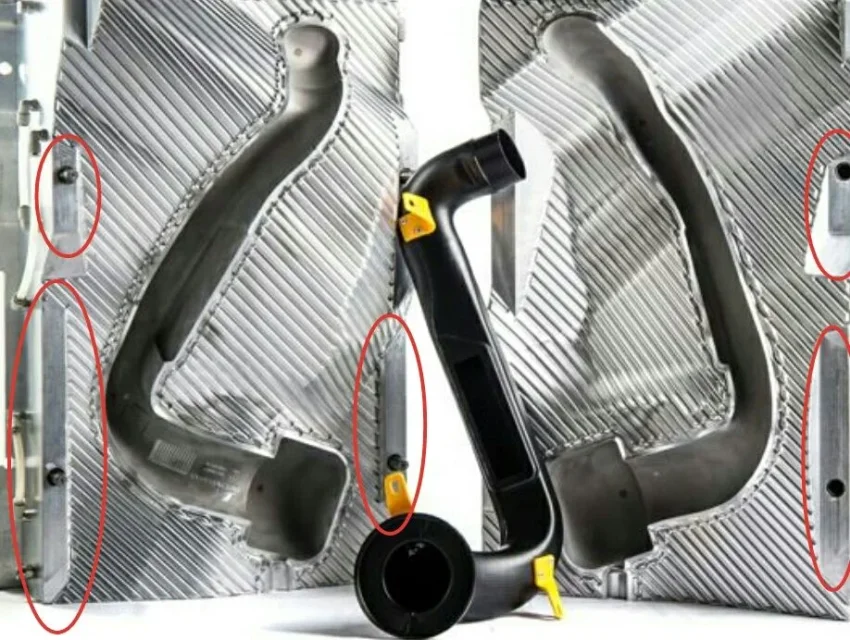
I refer in particular to blowing with extrusion and therefore mainly to monocavity molds. Generally this type of molds has a tracking surface for excess material no external reaction plans to prevent all closing force from unloading on the trancibave. Knowing the press closing force and the type of mold material, how do I know if the plans I entered are sufficient? I imagine that there is a calculation related to the "resistance" of the material, the closing force and the contact area of the two half moulds.
 
Do you mean molds that go in line with extrusion heads?
I design the heads or moulds for injection/iro/soffiaggio, the moulds that go "under" to our heads I do not know them but would interest me to deepen.
Do you have any pictures?
 
to avoid problems I uploaded a photo taken from the web, to closed mold will be in contact only the perimeter zone of the duct (tranciabava) and the plans I looked for in red. How do I know if closing the mold with 15 ton for example, my trancibava didn't collapse? If the mold was steel rather than aluminum could I reduce the planes? I would like to have in hand some calculation that according to this information you confirm that it's okay! S90710-134917(1).webp
 
Thanks for the photo, I didn't know they were made this way.
I make my guess that can be corrected or not, you could measure the contact area between the two semi-stamps, knowing the closing force you can get the applied load for mm2 and see if you are within the limits of the material or not.
 
Thanks for the photo, I didn't know they were made this way.
I make my guess that can be corrected or not, you could measure the contact area between the two semi-stamps, knowing the closing force you can get the applied load for mm2 and see if you are within the limits of the material or not.
I was looking for this, and I found this, since I'm theoretically stationed at my 2002 diploma:giggle: are the last three pages
https://www.docenti.unina.it/webdocenti-be/allegati/materiale-didattico/308130As for my practical experience, the channels break down when they are really critical (so when their three-dimensional geometry does not help), or when the molds between one injection and the other are not cleaned well (then they break for sure)
 
Thanks for the photo, I didn't know they were made this way.
I make my guess that can be corrected or not, you could measure the contact area between the two semi-stamps, knowing the closing force you can get the applied load for mm2 and see if you are within the limits of the material or not.
I thought of something like that, too! Whereas, however, as rp 260n/mm2 (I write numbers for example by considering an aluminum mold) and a closing force of 250000n I need an area of 960 mm2! practically with a 30mm square I did everything. correct me if I did something wrong.

Thank you.
 

Forum statistics

Threads
44,997
Messages
339,767
Members
4
Latest member
ibt

Members online

No members online now.
Back
Top