• This forum is the machine-generated translation of www.cad3d.it/forum1 - the Italian design community. Several terms are not translated correctly.

differences between block valves and overcenters

  • Thread starter Thread starter rizzifrizzi
  • Start date Start date

rizzifrizzi

Guest
I press that I am now approaching the world of oleodynamics and until recently I was convinced that pneunatic and oleodynamic followed the same logic, that the main diff was in the greater robustness of the components and in the recovery of oil. I am noticing that they are only vaguely similar and that they can often find logical or constructive nexes.

from a few days I find myself in great difficulty to choose the right component to be mounted on the cylinder to ensure the position of the cylinder itself and its load.

confusion is fueled mainly by the fact that wherever I look for information the description of these valves is always the same

. "valves whose function is to lock the cylinder even under load etc..etc"

All right, that's what I'm looking for.
but then why do so many types exist?
leaving aside the various subdifferences (flanged or not to simple or double effect.. types of mounted springs.. ) it seems to me that the two macrofamilies which can perform this function are reduced in:

-block valves
- overcenter valves

the first certainly less sophisticated and also the encumbrances and the price they say long.
the second ones instead more complex and bulky, already from the logical scheme vien to put his hands in the hair, have adjusting screws and the cost obviously is much higher.

I hope someone who knows them well can clarify substantial differences and therefore when you need to use a type rather than the other.
 
pilot lock valves[
I don't feel like these.
 

Attachments

  • Screenshot_20221030_215405.webp
    Screenshot_20221030_215405.webp
    27.9 KB · Views: 14
  • Screenshot_20221030_214835.webp
    Screenshot_20221030_214835.webp
    18.8 KB · Views: 12
the overcenter
what they will mean with fully balanced balances. .
 

Attachments

  • Screenshot_20221030_220040.webp
    Screenshot_20221030_220040.webp
    40.5 KB · Views: 14
  • Screenshot_20221030_220517.webp
    Screenshot_20221030_220517.webp
    21 KB · Views: 14
  • IMG_20221027_181053.webp
    IMG_20221027_181053.webp
    122.1 KB · Views: 13
the use of balance valves instead of normal blocking, becomes necessary in the presence of descending movement in presence of load; if you use the normal lock valves the movement is made of continuous opening and closing while with the counterbalanced valves is more fluid.

in practice are valves mounted in parallel with unidirectional valves to allow the passage of the free fluid in the opposite direction and being on the exhaust duct for example of an actuator has a counterpression that depends on
adjustment of the same valve and which is adjusted in order to balance the load.

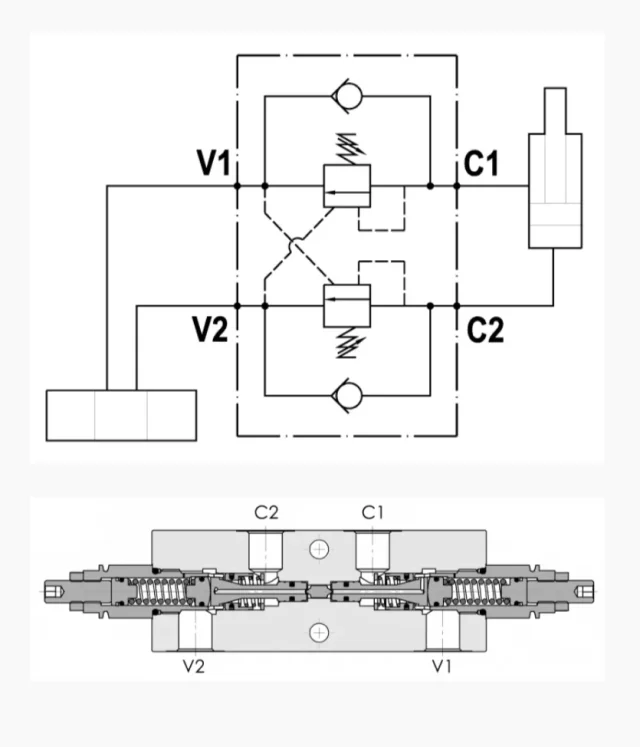
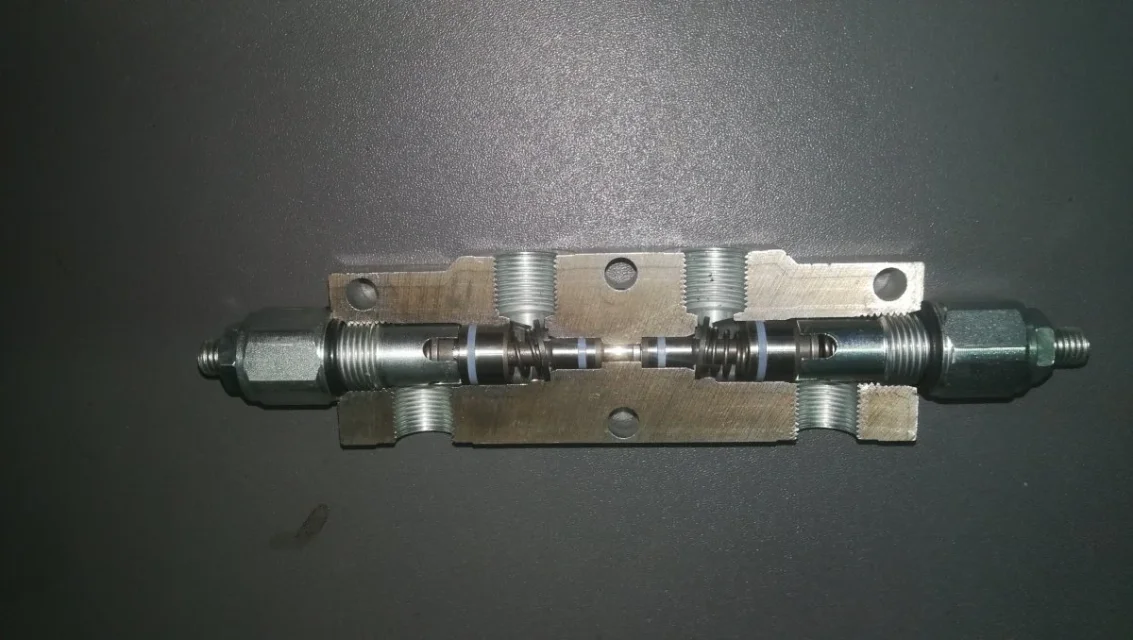
in the case in which to have better control of the load the balance valves have connected to the duct of the other chamber of the actuator a secondary piloting that acts together with the internal piloting are called overcenter
 
Thank you kaji I was afraid I won't receive any answer anymore.
I must say that, as a logic of operation, these valves are very brilliant that they counterbalance.
therefore those adjustment screws on the sides serve to establish the minimum operating threshold? a value below which the valve remains closed and above which it begins to open?
Am I right?
while on the contrary they would act a bit like overpressure valves. If, for one reason or another, the pressure inside one or other chamber of the actuator should rise beyond this value, would the valve automatically open the steps?
 
do you know if such a valve (obviously with wired valve through rigid pipes directly on the cylinder without flexible tubaz between overcenter and cylinder) would be enough for regulations to make sure and in order the action of a suspended load? or could an additional mechanical blocking system be indispensable?
 
do you know if such a valve (obviously with wired valve through rigid pipes directly on the cylinder without flexible tubaz between overcenter and cylinder) would be enough for regulations to make sure and in order the action of a suspended load? or could an additional mechanical blocking system be indispensable?
Given that I am a simple designer and I have no basic knowledge neither in tire nor in oleodynamics, I think the regulations can be more stringent than what my superficial logic can imagine.

said this in theory (but I don't know if it is so in the regulations) a "paracadute" valve may be sufficient in case your plant is oleodynamic, or in case you have to deal with spindles instead of using the classic three griffe powered by a single circuit that keeps the negative brakes down you may have two independent circuits one for one pair one for another.
the general principle of norms, however, usually prescribes that in the presence of rods that move vertically it is necessary a sort of "negative" brake also the more stringent ones require that the additional blocking principle is of different nature than that of blocking of the movement.
I try to explain myself better, if by chance you are in the presence of an hydraulic circuit the safety block should not be a negative oleodynamic brake because if by chance the temperature drops below -40°c the oil ceases to have its normal functionality for both circuits and therefore the redundancy of safety ceases.

Finally, if I can stay I attach an oleodynamic circuit extract with overcenter valve assembly, but the operation you have to try to guess it yourself because you definitely know the valves and their operation better than I know since physically I have never adjusted them etc.
 
from what I understood in qst days reading and talking here and there:
The piloted lock valves are prevented to lock in a load position. no adjustments, there are mainly 2 types.. simple or double effect based on whether you go to block a single branch or both of a double effect actuator.
operation is very simple. the load also due to the effect of gravity remains firm until it receives a handling pressure that simultaneously unlocks the check valve mounted on the opposite branch.
is not the system indicated to obtain smooth and constant movements, from what I read on off flow of oil makes everything very snappy, even if small shots are then amplified on the load, especially if it weighs as often happens on disadvantageous levers.
an es of their application is on tractors on what is called the 3rd point.. that I ignored until a few days ago.
In essence a 3rd anchoring point of the connected agricultural machinery which has the possibility to be raised or lowered to adjust for e.g. inclination in the case of an aratro or the cutting height of the grass. Of course, a "fixed" regulation does not require a fluid movement.
I would like to know if someone knows other es of application of the piloted lock valves.

the overcenter valves instead from what I understood while carrying out the same action of control and stabilization of position of a load, perhaps even more reliable and precise, can guarantee the fluidity of movement and thanks to the regulation of screws that compose of the springs, it goes to define with what safety value you decide to block the load. everywhere I found written to set a calibration pressure of 30% higher than the max pressure due to the applied load.
This means that:
-the pump will have to develop a pressure greater than 30% compared to that which would require the k system only to be able to circulate oil inside the valve.
- the load remains secured in position also against a sudden increase up to a 30%.
-This also means that that 30% is the maximum pressure threshold to which my actuator is able to work. with efforts that fan to reach pressures greater than that 30% involve the discharge of oil and the re-leveling of pressure around the calibration value.
this is done precisely because the intent at that point is no longer to guarantee the position of the load but to preserve the integrity of the cylinder or the mechanical arm etc..
below useful links
 

Forum statistics

Threads
44,997
Messages
339,767
Members
4
Latest member
ibt

Members online

No members online now.
Back
Top