• This forum is the machine-generated translation of www.cad3d.it/forum1 - the Italian design community. Several terms are not translated correctly.

different elements, different results?

  • Thread starter Thread starter John
  • Start date Start date

John

Guest
Hello everyone, I wanted to ask for information I have to calculate the pressure before arriving at plastic deformation (yielding point 260mpa) in this piece with the following data:

e = 200 gpa
poison's ratio=0.3
density =7860 kg/m^3
thickness = 10 mm

measurements in mmI created two models one with

solid>quad 8node 82

solidity

but the results obtained are different

in the first case arrive at 251e6 for a load of 2e7 pa

in the second case I arrive at 278e6 for a load of 2e7 pa

So I have doubts:

If I select different elements I get different results, I mean big differences (about 30 mpa)?

If I intensify mesh in critical points, i.e. in holes and fillet, should results change a lot?

thanks to those who will answer me:biggrin:
 
Hi, I tried to do a test with ansys wb11.
max stress is lower (141 mpa) than yours.
the mesh has been fixed (size elements 2 mm).

try to see if the constraints are correct.
Hello! !
 

Attachments

  • 1-impostazione analisi.webp
    1-impostazione analisi.webp
    33.6 KB · Views: 17
  • 2-von Mises.webp
    2-von Mises.webp
    28.6 KB · Views: 12
  • 3-Deformata lungo Z.webp
    3-Deformata lungo Z.webp
    28.7 KB · Views: 8
thanks, for the answer :d...
However I forgot to specify that the parts bound to move are the other two holes, so I think the simulation changes a little.
The importance of a good mesh is so important to me that it is fundamental, because if I break the effort, it changes clearly.
 
I created two models one with

solid>quad 8node 82

solidity

but the results obtained are different

in the first case arrive at 251e6 for a load of 2e7 pa

in the second case I arrive at 278e6 for a load of 2e7 pa

So I have doubts:
I once had made a simulation (apposed to check this thing) loading a bending bar, meshata with:

1) linear tetra elements
2) square tetra elements
3) Linear Exhaust Elements
4) square exaggerated elements

the difference of the sigma from 1 to 4 was also 30%. in general linear tetra elements are too rigid and should not be used for structural analysis, better tetra-quad or esa lin or quad. At least that's what my fem expert friend always tells me!
 
so the holes are only bound by the slots?? as in the image.
 

Attachments

  • 1-impostazione%20analisi.webp
    1-impostazione%20analisi.webp
    10.9 KB · Views: 5
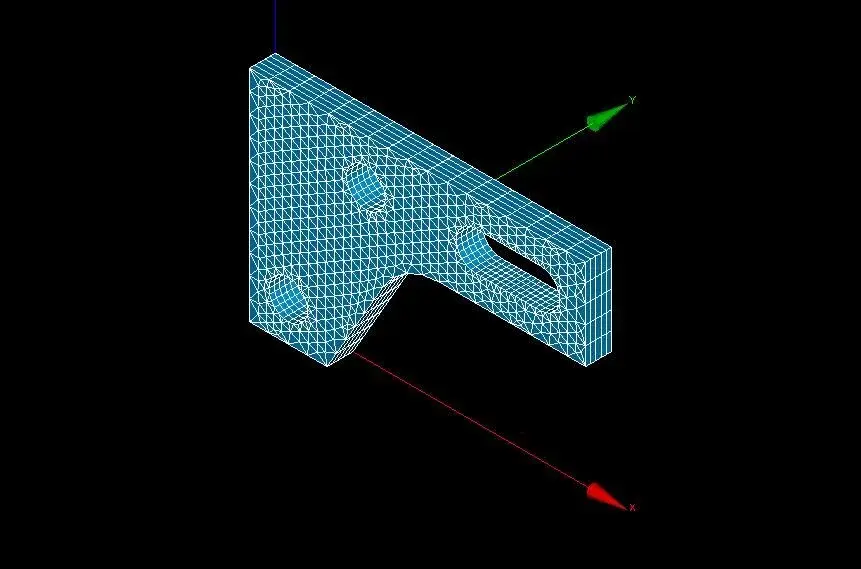
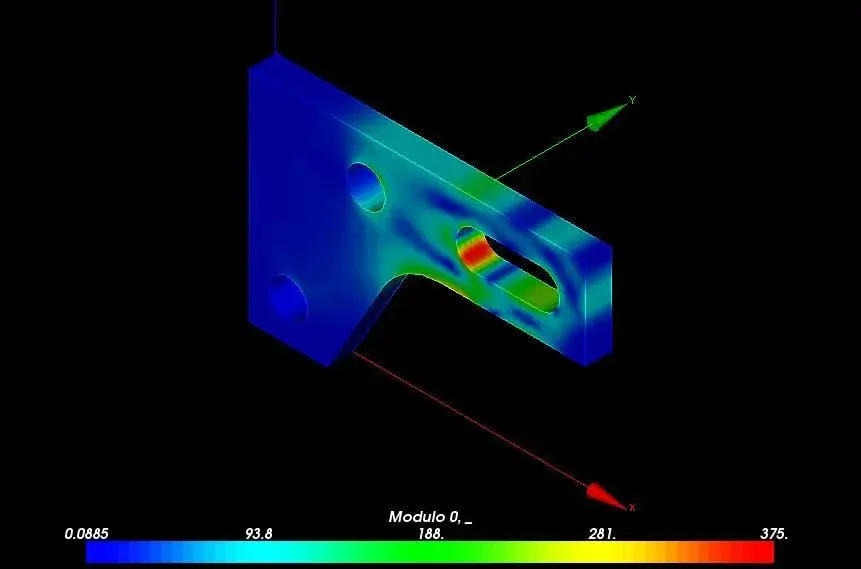
I have made a simulation with code_aster + salome, I attach the images with the results for linear mesh

Consider that I've put in the two holes, not cylindrical hinges.
 

Attachments

  • mesh.webp
    mesh.webp
    46 KB · Views: 10
  • modulo.webp
    modulo.webp
    19.5 KB · Views: 8
  • Von_Mises_segno.webp
    Von_Mises_segno.webp
    17 KB · Views: 8
questo invece per mesh quadratica
 

Attachments

  • modulo_quad.webp
    modulo_quad.webp
    15.7 KB · Views: 6
  • Von_Mises_segno_quad.webp
    Von_Mises_segno_quad.webp
    20.3 KB · Views: 9
I'll give you some advice again. in these cases, in reality it never forms as solid, but as plane or as shell. I suggest you do these 2 tests first and then check the values obtained from solid modeling.
 
I tried to perform the analysis of your meshandolo piece by plane82 elements in tension plane and assigning it the thickness 10 mm.

by infitting mesh I got the following results:
max size element --> voltage of von mises
5 mm-- 251 mpa
2.5 mm --> 269 mpa
1.25 mm --> 276 mpa
0.625 mm...> 279 mpa

I think convergence can be assumed
 

Forum statistics

Threads
44,997
Messages
339,767
Members
4
Latest member
ibt

Members online

No members online now.
Back
Top