
• This forum is the machine-generated translation of www.cad3d.it/forum1 - the Italian design community. Several terms are not translated correctly.

dimensional tolerance

  • Thread starter Thread starter Maury73
  • Start date Start date

Maury73

Guest
Good evening,
I need clarification:
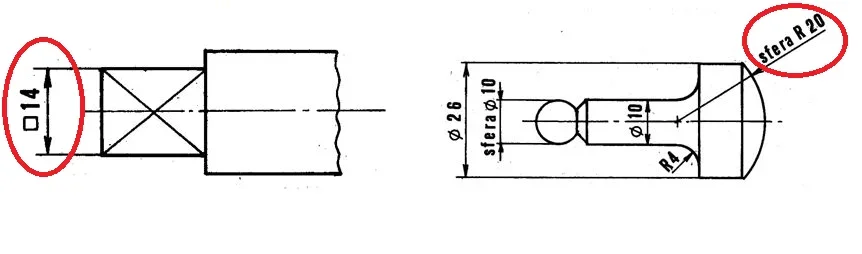
in a hole shaft mating, in which the shaft and hole are not round, but have a profile that resembles that of a stick, can I indicate the tolerances with the word h6/n5 ? or should I indicate only the numerical deviations?

sent by my sm-g950f using tapatalk
 
dimensional tolerances apply on any form
the term tree/hole should not be taken literally, but indicates the method of decision for the choice of tolerances according to a coupling.
in any case also h6/n5 indicates a numerical deviation
 
dimensional tolerances apply on any form
the term tree/hole should not be taken literally, but indicates the method of decision for the choice of tolerances according to a coupling.
in any case also h6/n5 indicates a numerical deviation
Thank you.
the discussion was born following the profile of the two details to be coupled, as some colleagues asserted that given their form, I should have indicated the tolerance in numerical way because, always according to them, the indication h.../n... is only applicable to rounds.

sent by my sm-g950f using tapatalk
 
conferred.. and I add that it can also be done for spherical geometrics (figure to the right) as well as for those with square section (left), thicknesses of sheets, width of gears and who more has it (in theory). . .
1525023321333.webpin practice many dimensions for convenience are quoted with the extremes of the tolerance range (e.g. 130 +- 0.5) ... the couplings serve to standardize the behavior of the coupled components so as to optimize the applications (see bearings).... good evening :giggle:; )
 
if you also put tolerance on those odds (I know that they are images taken from the internet) it was indisputable that you can do; put so instead you can always say that if there are no you can not put.
Let's say instead that if I write that a picture is 50 is +0.009/+0.025 is the same thing as writing that is 50m6.
the designation system by means of letters and numbers standardizes the deviations by measuring range, but always of numerical deviations it is.
a technician who doesn't know these things doesn't know how to do his job and he would be tied up by listing drawings for a long time.
 
each quota can be tolerated, which refers to a bevel, to a diameter, to a radius, to a length.... you put the letters with the numbers and then optional for convenience of those who have to work the pieces without taking the norms....ci net the numerical deviations.
but how can you fantasize about such an elementary thing?
But do they still teach you something?

I shouldn't be surprised. .. why the other day enters the technical office a cellarer and asks me and a designer to give him the tables of the meanings of roughness (3.2-6.3...to understand what and how to make the pieces??! he was justified by saying "that he was used to other tolerances." but roughness is not tolerances....the crisis has not cleaned enough. then I give him the table that shows for milling from 1.6 to 12.5...rectification from 0.4 to 1.6 etc and tells me: ah but I found this on the internet....bah who knows if he knows what a piece of iron is
 
Perhaps I explained badly:(...I meant that if on every tolerated quota I had to make reasonings related to what corresponds a certain range set in terms of language letters/number of units of tolerance on a design I would end up hospitalized urgently after a week...I think it is more convenient to quote a distance of a dig from a shoulder like 120+- 0.7 instead of 120 js15 ... for mating I mean e.g.h7/f6 or h7/n6, the experience recommends some because you know that by adopting those the coupled elements behave correctly (under certain load speed conditions etc.)..discussed if I was unclear:confused::giggle:
 
Last edited:
also a -0.1-0.2/+01+02 is a coupling.
What difference is there between listing a dig from a shouldering and listing the seat of a bearing? What difference is there between the two methods of tolerance if both indicate the same deviation?
no one obliges you to use the indications in letters and numbers, but when you make a 30h7 frenzy a few hundred millimeters long for those who will have to control it will certainly be more immediate to know that it can use a pass/nonpass swab rather than measure dozens of points with the micrometer.
and as it has written mechanicalmg it is good habit to indicate on the construction boards as well as the tolerance in letters also the numerical deviation so that the operator, who does not work in a smooth and clean office, should not go to browse rules to find the value to perform with the risk perhaps to mistaken for one of the many causes that can be there in a workshop.
the indications h7/f6 is indicated on the assembly drawings to make known to the coupling editor that will go to do, free or forced, and consequently to adopt the necessary procedures to carry out that they can go from the mazzuolo to the heating with the cannello to the cooling in liquid nitrogen
 
Perhaps I explained badly:(...I meant that if on every tolerated quota I had to make reasonings related to what corresponds a certain range set in terms of language letters/number of units of tolerance on a design I would end up hospitalized urgently after a week...I think it is more convenient to quote a distance of a dig from a shoulder like 120+- 0.7 instead of 120 js15 ... for mating I mean e.g.h7/f6 or h7/n6, the experience recommends some because you know that by adopting those the coupled elements behave correctly (under certain load speed conditions etc.)..discussed if I was unclear:confused::giggle:
the decent cads make themselves the indication of the shock by inserting letter and number of the iso system....I don't know what you use, maybe the tecnigraph
 

Forum statistics

Threads
44,997
Messages
339,767
Members
4
Latest member
ibt

Members online

No members online now.
Back
Top