• This forum is the machine-generated translation of www.cad3d.it/forum1 - the Italian design community. Several terms are not translated correctly.

doubt hopper

  • Thread starter Thread starter Geppetto82
  • Start date Start date

Geppetto82

Guest
Good morning to all,
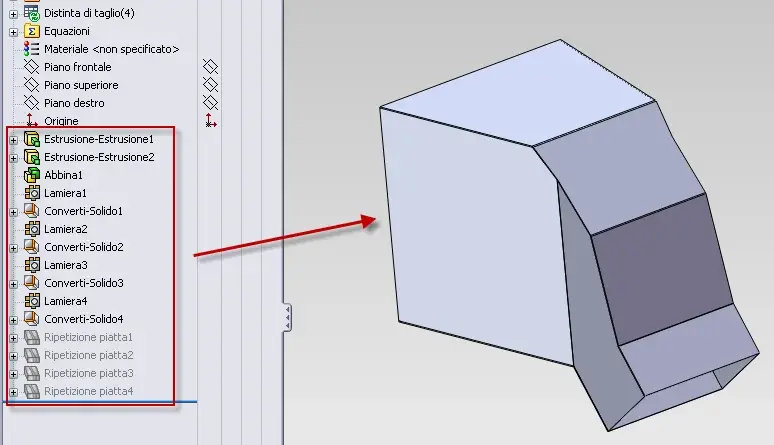
I have to make such a hopper to be used on our machine inside the company.
I press that our daily work is work on lathes and work centers, sometimes I happen to draw plates but for more flat or folded to "l", then of simple manufacturing... .
I read the discussion http://www.cad3d.it/forum1/showthread.php?t=20974&highlight=converti+lamiera.
I have more or less understood, but my doubt is that the hopper of the link develops "from the top to the bottom" while mine has the discharge at 50° regarding the starting plane (the one of the filling of the material mis 500x500).
to build the solid I used the loft function (rush 1--> input, sketch3--> output and sketch2--> guide curve) and consequently are created those two inclined walls that are not flat.
My professor of electrotechnics in the 4th higher during a question told me: "te paoli cundensador tan ve miga tant d'acord...." Well at a distance of several years I would add that I do not go so much in agreement with the plates! ! ! ! ! ! !
jokes aside, if some pious soul can give me some advice thank you!! !
greetings
geppetto82
 

Attachments

after 2 hours of fight.... .
et voilà....
or...

do not complicate your life with surfaces and thickenings, you think the tool
which you used later to do everything.
from one eye to the quotas (my) of the cutting-extrusion1 :rolleyes:
I've changed the aesthetics a bit.

ps: is the closure in the narrow part desired? the sagomi to the assembly?
in your part, in converts-solid6, take it off keep body.
cation
 

Attachments

I do not go into the design of the piece, but I just wanted to suggest a faster and more performing modeling method.
I'm using 2012 so I can't attach anything.
However, I attach an image.
 

Attachments

  • best practice.webp
    best practice.webp
    27.5 KB · Views: 25
I do not go into the design of the piece, but I just wanted to suggest a faster and more performing modeling method.
I'm using 2012 so I can't attach anything.
However, I attach an image.
What changes from my model?
take into account that I kept "good" his solid by changing
the cut making it coincide with a edge only for
aesthetics.
I turned into sheet metal.. like you did.
 

Attachments

  • Tram.webp
    Tram.webp
    110.5 KB · Views: 13
or...

do not complicate your life with surfaces and thickenings, you think the tool
which you used later to do everything.
from one eye to the quotas (my) of the cutting-extrusion1 :rolleyes:
I've changed the aesthetics a bit.

ps: is the closure in the narrow part desired? the sagomi to the assembly?
in your part, in converts-solid6, take it off keep body.
cation
Hi, mike.
Then:
1. I understand your method is very simple, without surfaces are useless steps in less!
2. closing in the narrow part was my mistake....
3. I made the hopper again, because we think that done this way can go better. I wanted to ask you a few questions: Why if I do it using the automatic surface method does the drains in the corners and if instead I do it as you told me it does not?
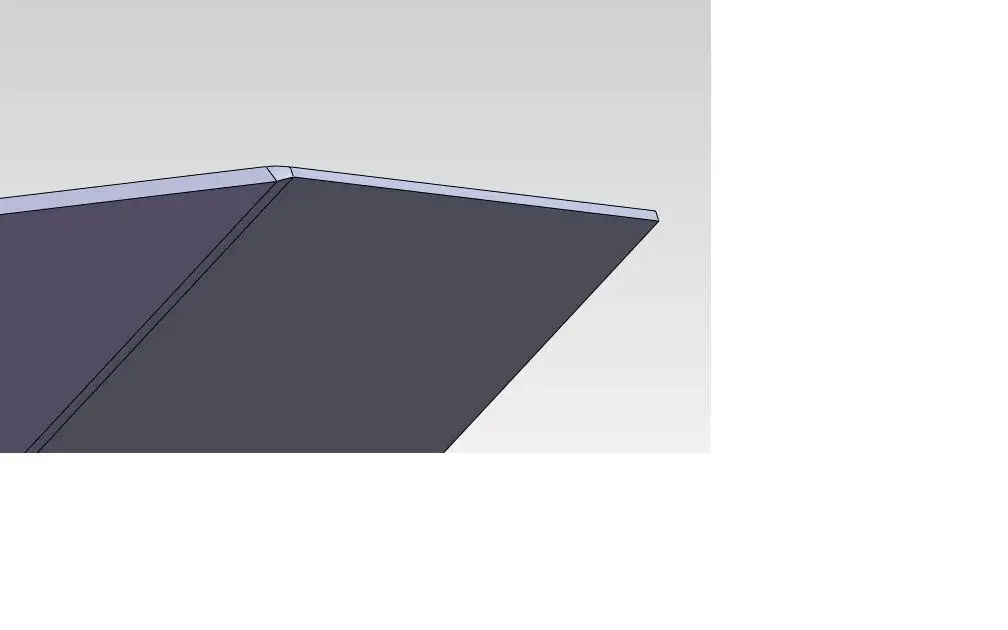
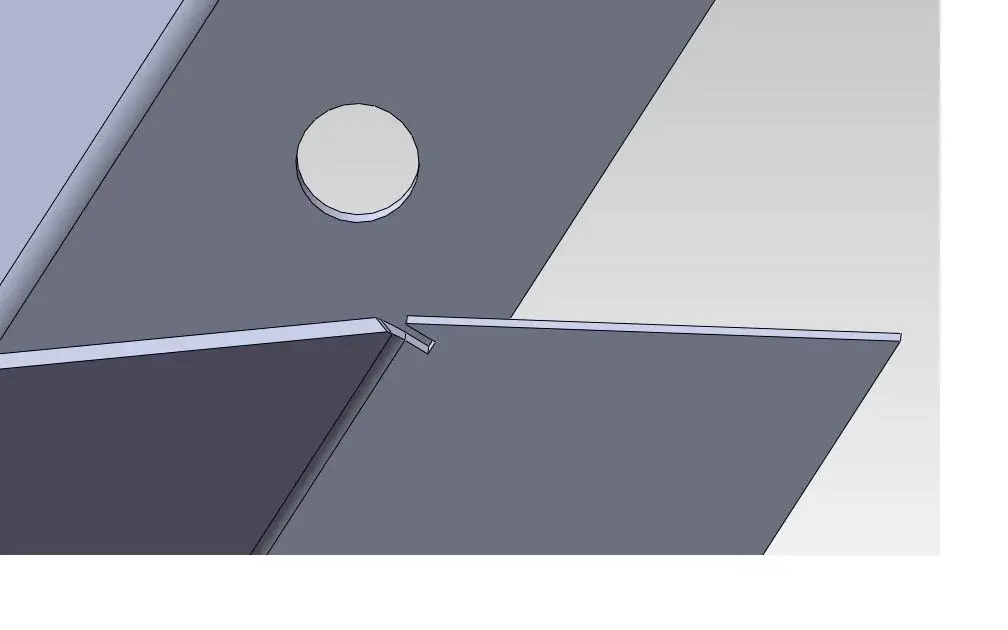
This other question is more technical on the plates: Shouldn't the sheets in the corners be shaped to fit and weld better? the angle left so will be filled with welding, I do not know the job exactly but it seems a little difficult to keep the plates firm exactly in that position. ...
attach files and images.
Thank you.
Hi.
geppetto82
 

Attachments

  • Angoli.webp
    Angoli.webp
    9.7 KB · Views: 13
  • No scasso funzioni lamiera.webp
    No scasso funzioni lamiera.webp
    8 KB · Views: 11
  • Scasso funzioni offset.webp
    Scasso funzioni offset.webp
    14.4 KB · Views: 13
  • Tramoggia caricatore cuscinetti prova3.rar
    Tramoggia caricatore cuscinetti prova3.rar
    219.5 KB · Views: 4
What changes from my model?
take into account that I kept "good" his solid by changing
the cut making it coincide with a edge only for
aesthetics.
I turned into sheet metal.. like you did.
the extrusion command and the combined command are more performing than cuts and sweeps.
I just suggested a less complicated modeling strategy and more responsive to changes.
I did two extrusions and used a boolean operation.
I don't want to get into controversy, we've already passed and then I'm accused that I suffer the heat and don't ragiono anymore, but try to use the best strategies during modeling and in the environment together, they improve global performance.
These strategies are felt especially when you start working with bodily assemblies.
That's all.
 
Hi, mike.
Then:
1. I understand your method is very simple, without surfaces are useless steps in less!
2. closing in the narrow part was my mistake....
3. I made the hopper again, because we think that done this way can go better. I wanted to ask you a few questions: Why if I do it using the automatic surface method does the drains in the corners and if instead I do it as you told me it does not?
This other question is more technical on the plates: Shouldn't the sheets in the corners be shaped to fit and weld better? the angle left so will be filled with welding, I do not know the job exactly but it seems a little difficult to keep the plates firm exactly in that position. ...
attach files and images.
Thank you.
Hi.
geppetto82
the corner so it makes you twist and bomb the carter.
I, as a metal constructor, prefer my method, basically make a slight bevel to the sheet creating a v for tig welding.
the edge/pigol only do it from 3 mm up.
Then it always depends on the purpose of the piece, if it is structural, if it has to be airtight, if I have to cure the aesthetic (ac stainless sat. for example).
for your domamde, I answer you lapalissianly. . I think it's the way to work solidworks...:biggrin:
the discharges in that hopper, do not need.
 
the extrusion command and the combined command are more performing than cuts and sweeps.
I just suggested a less complicated modeling strategy and more responsive to changes.
I did two extrusions and used a boolean operation.
I don't want to get into controversy, we've already passed and then I'm accused that I suffer the heat and don't ragiono anymore, but try to use the best strategies during modeling and in the environment together, they improve global performance.
These strategies are felt especially when you start working with bodily assemblies.
That's all.
but what controversy... Pass me the file I want to learn. . :finger:

Hi.
 
the corner so it makes you twist and bomb the carter.
I, as a metal constructor, prefer my method, basically make a slight bevel to the sheet creating a v for tig welding.
the edge/pigol only do it from 3 mm up.
Then it always depends on the purpose of the piece, if it is structural, if it has to be airtight, if I have to cure the aesthetic (ac stainless sat. for example).
for your domamde, I answer you lapalissianly. . I think it's the way to work solidworks...:biggrin:
the discharges in that hopper, do not need.
Let's say I understand....
How do I make sheets to cut?
 
you have to put the bodies on the table (one at a time) by selecting "flat repetition", exposing the dxf or dwg to "work" with the laser cam.
..with sheet metals you can also save in dwg/dxf directly from part 3d model. Starting from the finished bent automatically represents developments in 2d... save by name, choose dwg format and follow the screen instructions.

greetings
Marco:smile:
 
..with sheet metals you can also save in dwg/dxf directly from part 3d model. Starting from the finished bent automatically represents developments in 2d... save by name, choose dwg format and follow the screen instructions.

greetings
Marco:smile:
that is an operation I do for those jobs that will not repeat
and that they are simple to bend, if not I prefer to have the table
with odds and corners, in short, a clear document.
I never recommend rescue on the species side if it contains more bodies.
 
that is an operation I do for those jobs that will not repeat
and that they are simple to bend, if not I prefer to have the table
with odds and corners, in short, a clear document.
I never recommend rescue on the species side if it contains more bodies.
Yeah, I do that too. in "archive" the table drw with views, quotas, notes and indications for the construction... but if I need to fly the template to send to the cut in that way is soon done and immediately leave the email with the dwg (you do everything in the house, I send to the "cutter" and the notes do not interest him. in our workshop of course we follow the design "real").
and anyway it is good to know that in the program there is that function :biggrin:.

greetings
Mar
 
Moreover saving the dxf from the model is sure to have the profile in scale 1:1, which starting from the table is not always discounted. simply an incorrect option or a view scaled differently to wrong the profile.
I normally create tables and carry them in pdf and dwg for customers (who do not read natives) and then create dxf starting from the model.
 
thanks to all of these important tips.
let me keep the world of solidworks so slowly! :finger:
 

Forum statistics

Threads
44,997
Messages
339,767
Members
4
Latest member
ibt

Members online

No members online now.
Back
Top