
• This forum is the machine-generated translation of www.cad3d.it/forum1 - the Italian design community. Several terms are not translated correctly.

drawing bubbles together

  • Thread starter Thread starter tanticapelli
  • Start date Start date

tanticapelli

Guest
Bye to all,

I have seen that the subject has already been dealt with but I have not been able to find an answer to my question.

If I create a design of a father of other assemblies with maximum prodity "x", how do I create bubbles so that they read the properties of a part rather than a set?

I usually insert them manually by seizing on the edge or face of an object: but I can't grip the part rather than the assieme (usually fishing on the side and not from the assieme), therefore the value that returns me (fishing from the custom properties) is not always what I want.

thanks as always, you are very precious.

so many hairs
 
you must manage the separate management properties (hidden/show/promote) of the aid in which the part is contained; do it in the configuration
 
you must manage the separate management properties (hidden/show/promote) of the aid in which the part is contained; do it in the configuration
You've already told me about it in the context of separate materials, but this thing I think I haven't learned it yet.

I'll try again.

Thank you.
 
I make a little note that will charm you even more life...
the above discourse only applies to bubbles, which are related to a distinct material; if you enter a note from which to recall a property you do not need to change the properties of the configuration of any set because the note binds to the selected part
 
if you enter a note from which to recall a property you do not need to change the properties of the configuration of any set because the note binds to the selected part
Um... let's say that the question of this post seems more adhering to the second case you listed.
the discourse arises from the fact that the tables that generate various components of a project at times are related to a part, sometimes to a subaxieme, depends on the requirements of assembly.
which means that sometimes the nomenclature of the components can affect both parts and subaxis.
from here comes the need to bubble, on the table of the overall (generally the assieme father), a little bit parts and a little axiemi.
clearly in the parts or subsets that I do not care to identify in total I will not go to fill out the custom properties or configuration.
and here comes the pastry: As I insert the bubbles manually, I don't know how to do, gripping a edge or face, to let the custom property of the part or the together read from the bubble. if I add to this also the fact that in some cases, for production needs, both the custom properties of the part and the axieme of which the edge or the surface were part were compiled, the thing is further complicated.

So massive, from what you explained to me in your last intervention I assume that there is no way to brand the subaxieme but the bubble will always read and only the part. Am I right?
 
I would start by making the distinction that creates confusion in this post
bubble: refers to the homonymous annotation that is subordinate to the distinct materials and the like
Note: refers to the homonymous annotation that may link to the properties of the party to which it is bound; can not (that I know) be bound to a set.
clarified this, if you have to read even the asses you have to use the bubbles and the distinct, if you have to read the parts you can use the notes
 
ah because I was referring to the bubbles with round circles and the numeral inside. then if you click on the bubble you can call it different data from the box dialog. but how to make them read the properties, what possible also for the bubbles, of a part rather than of a frankly I did not understand it.
 
but how to make them read the properties, what possible also for the bubbles, of a part rather than of a frankly I did not understand it.
I don't understand. .
You didn't enter a distinct right?
therefore, without distinction, now that I am making known evidence that actually the bubble reads the properties, but does it parts and not of the assieme or subassieme; Instead, I don't know, without using a distinct one, how to make him read the properties of a set. . .
 
Here we go. @massivonweizen In fact, I often don't insert a distinct (if I don't need it is something that slows down the table update) and I go directly to the bubble.
then it will mean that I will insert fictitious fields into the properties of the various parts that I will go to grip with the bubbles in which I will indicate something like "reference aids".
I'm sure it's manual, but from what you tell me, I don't see any other way at the moment. . .

thank you anyway.

always, of the rest.
 
Believe me I'm not getting anything anymore. .
First write that you can't ball the parts and now instead of in the parts you will insert a property that indicates the origin assemblies. . .
What do you want to ball? or the parts?

However to transfer the membership to a part property without having to open and fill in by hand all the files you can do this:
open a design and enter the axieme you want to fill out the property of its parts
insert a separate cut with recess so that you read the name of the axieme and that of the parts
in a column impose the property membership to fill
do ctrl+c on the name of the assieme
ctrl+v on the cells concerning the parts (beware that if in the parts you have a separate cut there will be more entries for that specific part, I recommend you to unify a detailed numbering so you easily recognize the father)
a screen that asks whether or not to maintain the connection with the property, you give confirmation
the property is propagated

note in margin without controversy: using the bubble that way for me is wrong
 
Believe me I'm not getting anything anymore. .
First write that you can't ball the parts and now instead of in the parts you will insert a property that indicates the origin assemblies. . .
What do you want to ball? or the parts?

However to transfer the membership to a part property without having to open and fill in by hand all the files you can do this:
open a design and enter the axieme you want to fill out the property of its parts
insert a separate cut with recess so that you read the name of the axieme and that of the parts
in a column impose the property membership to fill
do ctrl+c on the name of the assieme
ctrl+v on the cells concerning the parts (beware that if in the parts you have a separate cut there will be more entries for that specific part, I recommend you to unify a detailed numbering so you easily recognize the father)
a screen that asks whether or not to maintain the connection with the property, you give confirmation
the property is propagated

note in margin without controversy: using the bubble that way for me is wrong
Thanks massive for the advice, it seems quite easy to pursue this road.
for the bubbles I have always a little arranged, let's say that in the last works my gaps have become more annoying because I use much more the subaxes than in the past (a part of the slowness I accused until recently was definitely due to this).

So, since you've been disturbed by now, would you kindly tell me what you think is the wisest way to brand the pieces (parts and parts) that appear in an assembly table?

I thank you very much, you do not know what great help you have/you have given me in these years of tribulation. . .

so many hairs
 
the wisest way (confucius docet) is the one that takes you wherever you want to get.
apart, I say I use the distinct materials, if it bothers you to see the hiding place.
then based on what you have to display games with configurations where I impose the status of the distinct; but if you already use configurations to vary the axioms can become complicated.
I'll give you a short example that they're on the phone.
you have a set with two sub-assiems, one you want to see the other's matches only the sub-assiem
in what you want to see the parts imposed in the configuration promote, in the other hide
in the table put the distinct and imposed as the first level and you will see the parts of the first together and not those of the other.
you have to make a table where you show the reverse; create a new configuration in the main axieme and subassiemi.
in the new configurations of subaxis reverse the properties
in the new configuration of the axieme, call back the new subassiemi
in the table, with the same settings as before, you will have the opposite result.

if I have time I make an example
 
the wisest way (confucius docet) is the one that takes you wherever you want to get.
apart, I say I use the distinct materials, if it bothers you to see the hiding place.
then based on what you have to display games with configurations where I impose the status of the distinct; but if you already use configurations to vary the axioms can become complicated.
I'll give you a short example that they're on the phone.
you have a set with two sub-assiems, one you want to see the other's matches only the sub-assiem
in what you want to see the parts imposed in the configuration promote, in the other hide
in the table put the distinct and imposed as the first level and you will see the parts of the first together and not those of the other.
you have to make a table where you show the reverse; create a new configuration in the main axieme and subassiemi.
in the new configurations of subaxis reverse the properties
in the new configuration of the axieme, call back the new subassiemi
in the table, with the same settings as before, you will have the opposite result.

if I have time I make an example
porcocan, with the first part I followed you but in the second example I struggle. . .
 
I imagine, for this an example or a pattern is better.
do this test
table of separate axieme first level
subassieme configuration promotes
back on the table and see the change
 
I imagine, for this an example or a pattern is better.
do this test
table of separate axieme first level
subassieme configuration promotes
back on the table and see the change
ok tomorrow I will have under my hands a beautiful branched set and I will try.

Thank you for the moment!
 
I'll give you an example where I've been playing with configurations.
I have inserted two equal assemblies to show you that managing the configurations you can see the parts of one or the other in a different way. Surely with more axious annidati the thing gets complicated, but with a good organization and if the work is not complex already of its (for example a set that already has 4 configurations of variants or positioning) you can get the desired result.
small notes:
It is important that the table recalls the correct configuration while for the axieme it is not necessary (if graphically equal as in the example)
the view must recall the correct table if there are more than one (as in this example)
 

Attachments

I'll give you an example where I've been playing with configurations.
I have inserted two equal assemblies to show you that managing the configurations you can see the parts of one or the other in a different way. Surely with more axious annidati the thing gets complicated, but with a good organization and if the work is not complex already of its (for example a set that already has 4 configurations of variants or positioning) you can get the desired result.
small notes:
It is important that the table recalls the correct configuration while for the axieme it is not necessary (if graphically equal as in the example)
the view must recall the correct table if there are more than one (as in this example)
Hi.
I finally found time to look calmly at your job.
I used to understand how to brand the bodies of multibody parts nested in sub-assistances.
Of course if I had to explain how I did I can say that I handed out (as you said about) in subaxis configuration properties to make the multibody parts "emerge".
However I do not know why I can not boil the parts by making recall the desired property: seems that the boiling grips the axieme of which it is part and not the part.. .

boh, I'll do more evidence, but I'm sure I've already done some progress with you.

good to make (maybe in 20 years? !

so many hairs
 
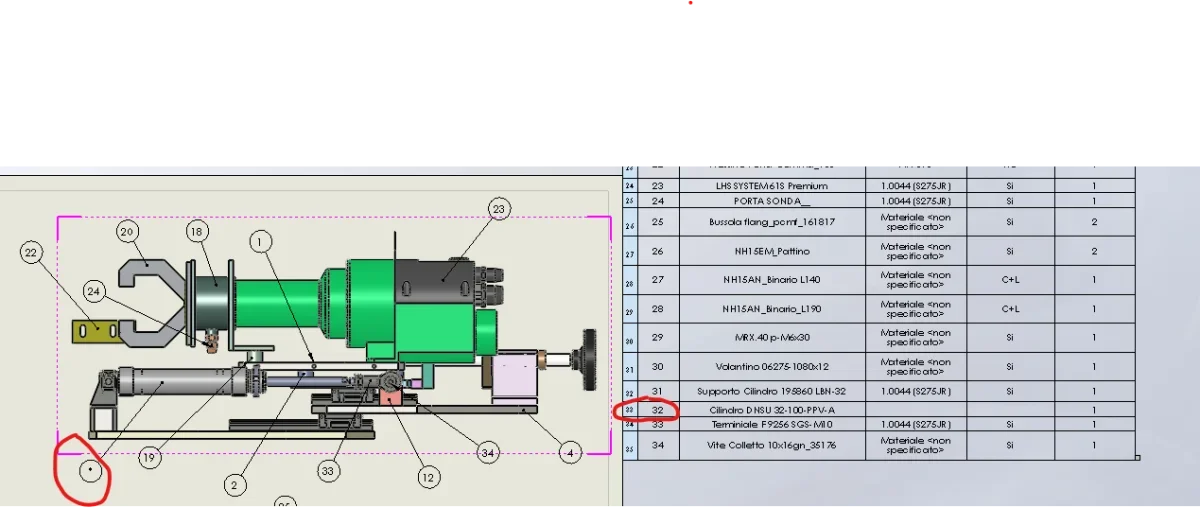
hi to everyone, I write here not to open another thread on the same themes. in this distinct material there is the number 32 which is a subaxieme to which I "hidden" the parts from the configurations so as to consider it a component. It's a thing I do often, but this time in its bubble, I don't get back to the number, as if it couldn't "put" the subaxieme1711105633497.webpHave you ever happened? if you need I attach the file of the slddrw, even though I don't know how useful it can be
 

Forum statistics

Threads
44,997
Messages
339,767
Members
4
Latest member
ibt

Members online

No members online now.
Back
Top