• This forum is the machine-generated translation of www.cad3d.it/forum1 - the Italian design community. Several terms are not translated correctly.

evaluation/dimensioning helical teeth gears and bearing choice.

  • Thread starter Thread starter cimece
  • Start date Start date

cimece

Guest
Bye to all,

are being evaluated/designed by a helical tooth gear system.
among these solutions, making various considerations, what would you choose?

solution to:
shaft with n.2 pairs of helical gears placed outside and n.2 bearings placed between the 2 transmissions.

b solution:
shaft with n.2 external bearings and n.2 pairs of helical gears placed between the 2 bearings.

c solution:
shaft with n.2 external bearings and n.1 pair of bielicoidal gears centrally placed to the shaft

p transmitted 510cv, rpm1500, i=3,65, z1=23
Could you give me a hand in the dimensioning of the wheels/shaft/shafts?

ps: Does any of you have a spreadsheet that I can turn?

Thank you very much.
 
Do they still smell the horses at the gates of 2024?
a technician should write less and use graphic representation.

much depends on the configuration of the carter ie of the gearbox.

First we have to understand whether we have to make a stage or two of reduction.

If you have no particular problems, you can do up to i=6 with a stadium.

if you need a longer reducer than wide then divide into two stages of reduction.

You could also make a coaxial so you are compact but long with axis input shaft with the output one.

We have given these directions many times in various posts.

you only know the project constraints.

Why do we have z1=23? Who says that? What form? What do you need to have? you can do so much of everything.... always with the limits they impose.

regardless I would not use bielicoidal gears if I don't have to transmit very high pairs at very low turns.

What indications do you want to give us more?

I don't understand a business reducer well?
 
a priori, if I had to do it with no limitation I would do:

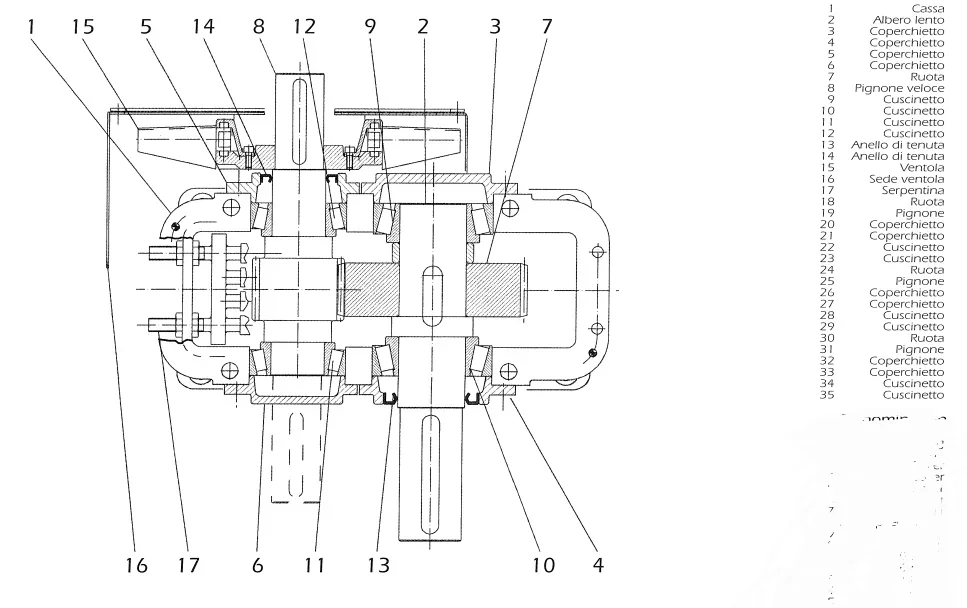
single-stage parallel axle reducer and bearings not the conical ones in the figure but I would opt for roller oscillators.
Screenshot_20230925_224532_OneDrive.jpga sensible interasse is around 220mm.

375kw-1500rpm transmission input data intermittent service s1 therefore continuously. if it is not so will be to be evaluated anyway in the heat exchange of the box.

The exact ratio with z1=23 is not 3,65 but 3,652...depends on what you want to do.

we get the first couple with duration of at least 20 thousand hours with iso 6336 as follows:Screenshot_20230925_225954_Samsung Notes.jpgfrom here you have the forces and reactions to the bearings as follows with gear hypotheses in the center of a tree supported 200mm long between the supports:Screenshot_20230925_230344_Samsung Notes.jpgfrom here choose a bearing and use the skf calculator to determine the duration.
the bearings you can mount them floating if there are no particular shock problems.
1695676019131.pngthen there are the verifications of the box, heat dissipation, choice seals, covers etc.

to make gearboxes you need experience and not just put two numbers in a computer.
If you have the money you take kisssoft. otherwise you can use guides and free online computer khk gear. study on volume two of niemann. use the free skf technical notebooks.
are all resources indicated a lot of times on the forum.
 
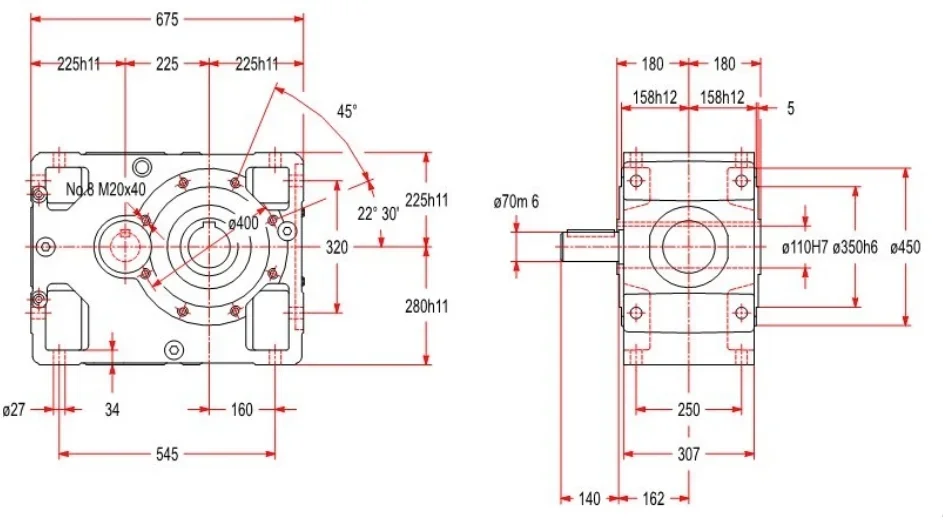
just not to go far, red gearboxes with 1,4 service factor... a stage ...
Screenshot_20230925_232421_Samsung Notes.webpthe sue dimensioni sono quest:Screenshot_20230925_232505_Samsung Notes.webpis it worth the project you without adequate experience?

Usually custom design is done when strictly necessary and especially when there is economic feedback vs special application.
 
just not to go far, red gearboxes with 1,4 service factor... a stage ...
View attachment 69209the sue dimensioni sono quest:View attachment 69210is it worth the project you without adequate experience?

Usually custom design is done when strictly necessary and especially when there is economic feedback vs special application.
thanks so many mechanicsmg for your answer!

to be a little more clear, I write which info more.

the transmission to be realized must belong to a building machine and will be placed inside a box where oil is present.
the lazy, they will be wet by oil, while the crown will be wet by oil for banging.

the proposed solutions have been outlined in the annex.

the best solution will have to be the most compact and possibly the least expensive.

the z23 value of the pinion is a value that has been imposed to me and from them I can not move, kw and rpm are the data present on datasheet of the thermal engine used.
the transmission ratio will have to be 3.65 or, in any case, it will be able to shake little by this value, for the proper operation of the machine.

the crown will be caletta on a tree with elbows, on which will be present a biella-manovella system.

Thank you so much,
Bye.
 

Attachments

  • PXL_20230926_094621240.webp
    PXL_20230926_094621240.webp
    65.2 KB · Views: 21
What does that mean? sprayed? Do you have a pump?
If you are not a gear designer I see it hard to prepare a series of trains and evaluate what is best.
Why don't you take a commercial reducer and throw the price? However if you have no purchasing power I see it hard to take away a reducer with 60% discount from the sporadic buyer list.
but also making ungrateful manufacturing is not cheap if you do not have the factory trust.

Can you explain why z1=23 is imposed? by whom? from your boss or client and why?
If you want to get out of bulk there is also to reduce the number of teeth.

do not tell me that they told you the story of the wizard....modulo 1 will have primitive 23mm and module 10 will have primitive 230mm. if the endothermic engine has a diameter of exit shaft....you have to give it in mm and know how to fuck.

the case there are integral biennial cytroen gears.
Screenshot_20230926_200038_Chrome.jpga and b why have two gears on the same axis?

what are your comments, feelings etc on the three solutions? What do you see good, bad....better....better?
 
Last edited:
i
What does that mean? sprayed? Do you have a pump?
If you are not a gear designer I see it hard to prepare a series of trains and evaluate what is best.
Why don't you take a commercial reducer and throw the price? However if you have no purchasing power I see it hard to take away a reducer with 60% discount from the sporadic buyer list.
but also making ungrateful manufacturing is not cheap if you do not have the factory trust.

Can you explain why z1=23 is imposed? by whom? from your boss or client and why?
If you want to get out of bulk there is also to reduce the number of teeth.

do not tell me that they told you the story of the wizard....modulo 1 will have primitive 23mm and module 10 will have primitive 230mm. if the endothermic engine has a diameter of exit shaft....you have to give it in mm and know how to fuck.

the case there are integral biennial cytroen gears.
View attachment 69218a and b why have two gears on the same axis?

what are your comments, feelings etc on the three solutions? What do you see good, bad....better....better?
I have a pump.
a commercial reducer, it's not good for my application.
a and b have the 2 gears on the same axis, for a matter of spaces.
In the case, there will be twins, and I would go to put the gears between them.
the solution c, would lead me to have a larger case and would not be well.
for a matter of compactness, agility of assembly, I would prefer the solution a.
c solution, I don't like it so much because of the spaces and probably more expensive, but I should make sure.

I don't know much about gears, but if you want, you could teach me, how to better manage these types of sizes.
Thanks again for the answers.
 
I'm sorry.

I have a pump.
a commercial reducer, it's not good for my application.
a and b have the 2 gears on the same axis, for a matter of spaces.
In the case, there will be twins, and I would go to put the gears between them.
the solution c, would lead me to have a larger case and would not be well.
for a matter of compactness, agility of assembly, I would prefer the solution a.
c solution, I don't like it so much because of the spaces and probably more expensive, but I should make sure.

I don't know much about gears, but if you want, you could teach me, how to better manage these types of sizes.
Thanks again for the answers.
a and b have gears on the same axis by question of spaces? What does that mean? It's hard to help you not explain.

a and b have on the pinion axis two identical gears but with opposite propeller. on the shaft they have mounted two identical wheels but with opposite propeller.

from how you schematized you have the annulment of the axial spins...that's because of two plus two. but are they indispensable? I doubt it.

each gear has half the band of what I have calculated and coupled carry twice as much as the timing error.

that it is a pair of biblical gears, or two pairs of helical gears with opposite propellers does not change anything in size or weight or performance. is in the technology of realization of the gears and the ability to make them accurately and the costs.

As for the bearings it is soon done: once you notice the three contact reactions of the gears, with ftool drawings the "tied beam", you put the forces and the constraints and you calculate the reaction to the bearings to the program. from there see which solution leads to small bearings.

Usually you have the gear close to the bearing to minimize the flexions leading to errors of ingration and premature wear, at the expense of the loads that are superior due to the bond.
However, all three solutions will not get very upset.

However you haven't told us yet because really z1 is worth 23 teeth.

Why shouldn't a commercial reducer be okay? engine, gearbox, pump. three separate objects, which can be easily replaced and cheaper if you need to manufacture more than one of these machines.

Why these choices?
 
Last edited:
As far as gears are concerned, I would say that you have to prefer the tree to elbows and leave the space for the biellas to rotate. certainly that if they have the whole tree in the middle can not make a spin of tree because it goes in interference.

so in my opinion you have to clarify the pump side and then it will fit the gear side.

If you have to look at this main aspect I would not go to invent anything different than the application of the cranck shaft of the cars.
 
Last edited:
summing up, returning to the initial request we have:

the solution could be preferred if it is necessary to minimize the length of the shaft and if the installation of the gears outside allows to facilitate accessibility for maintenance or replacement.

b solution could be chosen if greater gear protection is desirable within the external bearings. this can be particularly important in environments where there are powders or other particles that could damage the gears.

the c solution could be adapted if greater compactness of the entire transmission is required and the position of the gears in the middle of the shaft can be advantageous in terms of balance and reduction of vibrations.
 

Forum statistics

Threads
44,997
Messages
339,767
Members
4
Latest member
ibt

Members online

No members online now.
Back
Top