• This forum is the machine-generated translation of www.cad3d.it/forum1 - the Italian design community. Several terms are not translated correctly.

exercise cric to pantograph

  • Thread starter Thread starter Iason
  • Start date Start date

Iason

Guest
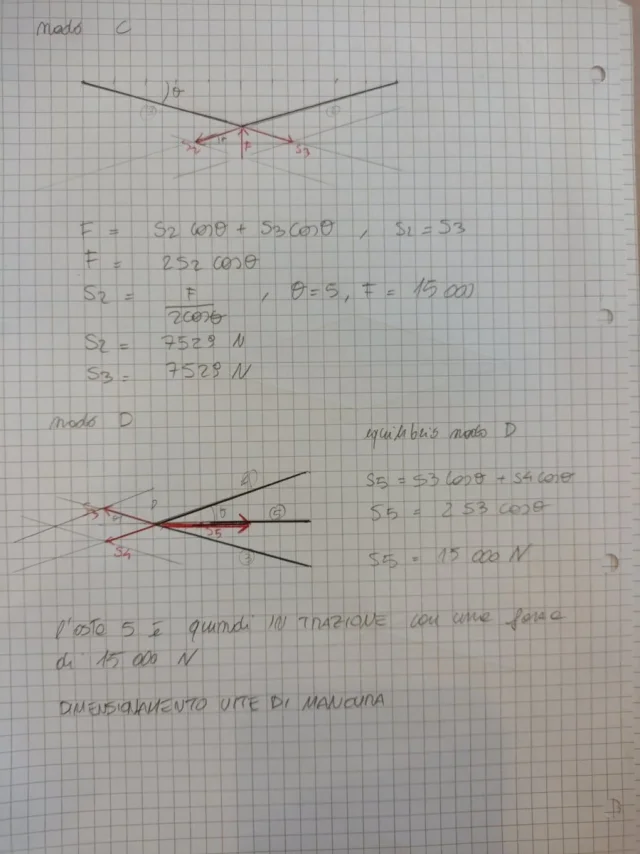
Good morning to all, I am trying to do this exercise for the examination of construction of machines, I attach the text and the procedure until I arrived. I schematized the jack as a reticular structure and made the balance of knots to find forces on the rods, treating the screw itself as an auction. my doubt is first of all if the procedure is correct and if it is plausible that the traction force on the screw is exactly equal to the load, and secondly on how I have to approach the sizing of the screw. I just tract it like a traction screw or as a maneuver screw? in case I cannot understand how to apply the formulas of the latter. Thank you very much in advance. IMG_20240618_115846.webpIMG_20240618_115811.webpIMG_20240618_115820.webp
 
Bye. if you are looking for on the forum there are similar exercises of crick.
Traction screw or maneuver screw?
The clamping screws are one thing, the ones that move objects.... well clearly cannot be assimilated to bolts.
you will certainly have to consider the reticular structure and disassemble the weight lifting force until you get the horizontal of the screw....to trapeze or triangular bread that will have to endure the load in balance in order not to close the pantograph.
If you want to be more confident of formulas you can draw in autocad or in 2d with a parametric cad in a position and draw the scale forces and break them directly....poi le misuri and if they are right you have no wrong formulas.
once you finish if you put in excel you made a spreadsheet for any type of lift and you will check if and when the force on the screw is maximum.

for the formulas of a screw of maneuver you need to search on any text of mechanical design or a manual.
need to check point load if there is, specific pressure, thread load capacity.
 
Bye. if you are looking for on the forum there are similar exercises of crick.
Traction screw or maneuver screw?
The clamping screws are one thing, the ones that move objects.... well clearly cannot be assimilated to bolts.
you will certainly have to consider the reticular structure and disassemble the weight lifting force until you get the horizontal of the screw....to trapeze or triangular bread that will have to endure the load in balance in order not to close the pantograph.
If you want to be more confident of formulas you can draw in autocad or in 2d with a parametric cad in a position and draw the scale forces and break them directly....poi le misuri and if they are right you have no wrong formulas.
once you finish if you put in excel you made a spreadsheet for any type of lift and you will check if and when the force on the screw is maximum.

for the formulas of a screw of maneuver you need to search on any text of mechanical design or a manual.
need to check point load if there is, specific pressure, thread load capacity.
I thank you, I looked at the formulas of the screws of maneuver and it should be possible to hypothesize the pressure on the thread hypothesize an admissible pressure, to find the diameter of the hazel of the screw I would still make a reasoning on a tensile screw speculating the class of resistance and finding the durable section, do you think it can be correct?
 
regarding the distribution of force on the number of threads you can look at this image taken by niemann.1718827621053.webpAs you can notice, a standard threaded nut or tronchetto does not distribute the uniform inode load....so make assumptions or model the nut in an improved way since it is a particular piece.
I'll tie the shigley formulas... However, of course, you must have an admissible sigma and an area to have a first attempt sizing.... then you have to make further checks.
 

Attachments

regarding the distribution of force on the number of threads you can look at this image taken by niemann.View attachment 71492As you can notice, a standard threaded nut or tronchetto does not distribute the uniform inode load....so make assumptions or model the nut in an improved way since it is a particular piece.
I'll tie the shigley formulas... However, of course, you must have an admissible sigma and an area to have a first attempt sizing.... then you have to make further checks.
I thank you again, I will try to apply the formulas by making the appropriate assumptions, hoping to arrive at a plausible risutato.
 

Forum statistics

Threads
44,997
Messages
339,767
Members
4
Latest member
ibt

Members online

No members online now.
Back
Top