• This forum is the machine-generated translation of www.cad3d.it/forum1 - the Italian design community. Several terms are not translated correctly.

fem benchmark

  • Thread starter Thread starter exxon
  • Start date Start date
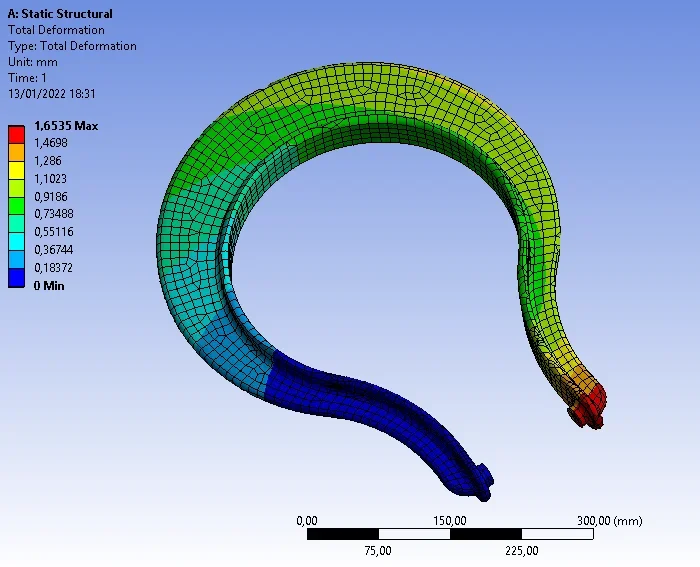
made with inventor: 1.96mm max displacement (which since interpreter is not between the two circular faces but on the most extreme point of the piece, precisely where the maximum shift takes place).
In fact. if you look at the max point, the result is greater. and even if you use the module instead of the vertical component.
If you have the warning to make equivalent steps in all software, there will hardly be any difference greater than 0.2%.
on stress is fair to expect greater differences, but on this model not so much.
 
0.2% seems to me a very optimistic forecast: I'd like to check it out. Who knows if who lost time before, wants to do it again.. .

p.s. the variation between module and vertical component is insignificant.
 
0.2% is what I expect: (1) on this model, where there are no connectors, creeping contacts, the solid is massive and does not require abstractions, etc. (2) limited to software implementation differences.
It is clear that the user can introduce a greater error, but in this case I would write it to "errors / bad practices", such as looking at the bottom scale instead of measuring the move to the point and in the correct way.
the geometry cad here is practically equal in all systems and the sensitivity of the field of shifts compared to the mesh (if a minimum decent) is really low. the load and the bond have no interpretative ambiguity and the elastic module must be identical for all.
If you want to "divert" seriously, you must go on the determination of the stresses:-)
 
I tried, too.
I don't know if I set the analysis well.
Anyway:
 

Attachments

  • 1642095288985.webp
    1642095288985.webp
    49.6 KB · Views: 24
Bye to all,

I've done a test myself with salomeca / asterstudy.

I make a premise, it's important to indicate which units you exported the step file. I think it was in m, right? with mm everything came out of scale.
where the load is 12.5mm? This is because if I do not go to make a well controlled mesh (and therefore symmetrical) on the surface where I apply the loads you create moments due to the unbalance of the knots (try, but I think you know it, a beam subjected to traction with knot forces and a mesh mediumly dense 'casual'. then look at the deformed).

solutor: codeaster (15.4.0) used via meca salome
material: e=168gpa, poisson=0.29
measurement performed in the central node of the circular face
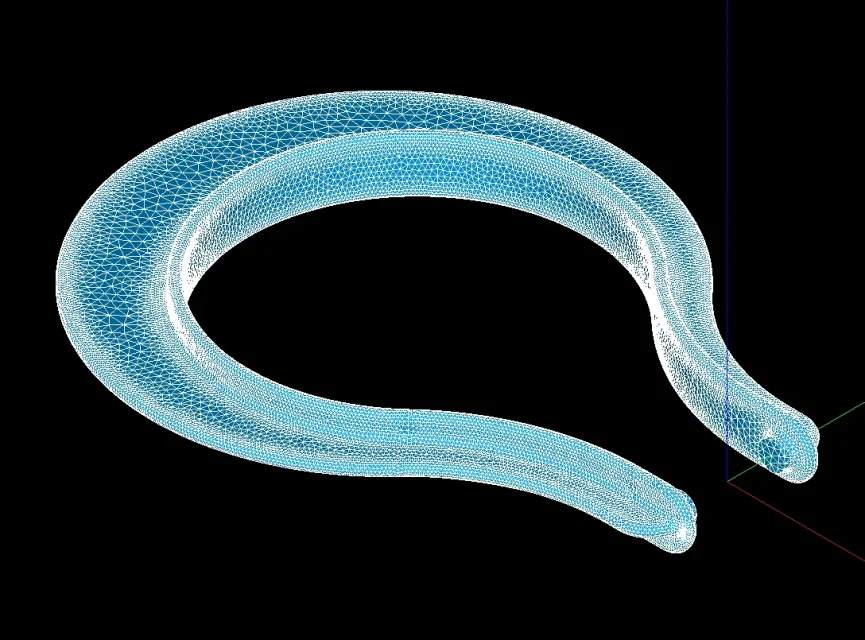
first attemptmesh tetra linear 1-10mm, moderate elements tetra4 128k about
force on surface, being a bit approximate I have 972n, I will go to normalize
shift 1.658mm, normalized to 1000n corresponds to 1.706mm
considerationon the fact that being linear is true the hypothesis of being able to normalize on e=200gpa I have strong doubts. I don't think the error is so wide, for charity, but I think it only applies to mesh equality because it is clear that the rigidity of the model is a function of e, of the element (form function) and of discretization.
1691416919892.pngps: I'm studying a little meca salome - code aster so for convenience I will try to make it others with different mesh, but at the moment I have some difficulties when I modify the mesh that goes wrong with the simulation and I don't understand from what it depends.. .

Andrea
 
read the output file
I thought it was related to the partition issue: I tried to put a point in the center of the face. with no-problem linears, with squares a mess.

I said that I made a second attempt. apparently unsuccessful (red) but does not provide errors and results there are:
second attemptsquare mesh tetra 1-10mm, moderate elements tetra10 128k about
force on surface, being a bit approximate I have 1030n, I will go to normalize
1.78mm shift, normalized to 1000n corresponds to 1.73mm

therefore apparently between linear and square mesh tetra there is no great difference, as long as this is quite dense.

the delta found is 1.7%-2% depending on what you want to feel correct of the two.
 
I did a second test with the software I use at work.
I create simulated both in full version and live simulation (which works 'without mesh').

the results were all between 1.73 and 1.76mm with e=168gpa, poisson=0.29

I tried in the following ways:
simulate quick check with mesh made automatically
simulate single pass adaptive with automatic mesh (increase p-level to 5 in a very small area at maximum voltages)
simulate single pass adaptive with mesh set 5mm
live simulated (here the measurement is done with the manual probe) with three quality settings: maximum speed, medium, maximum quality

Andrea
 

Forum statistics

Threads
44,997
Messages
339,767
Members
4
Latest member
ibt

Members online

No members online now.
Back
Top