
• This forum is the machine-generated translation of www.cad3d.it/forum1 - the Italian design community. Several terms are not translated correctly.

fem plastic tubolare amutooo!!

  • Thread starter Thread starter paolobaga
  • Start date Start date

paolobaga

Guest
Good morning to all the forumists and to the moderator my tributes.
my name is paolo and work with inventor for several years
now adopero inventor simulation 2011.

now I go to the therefore =!!

I created a new material (plastic covered with woven filament)
in publisher styles and standards. inserting the values of the material that requires inventor.
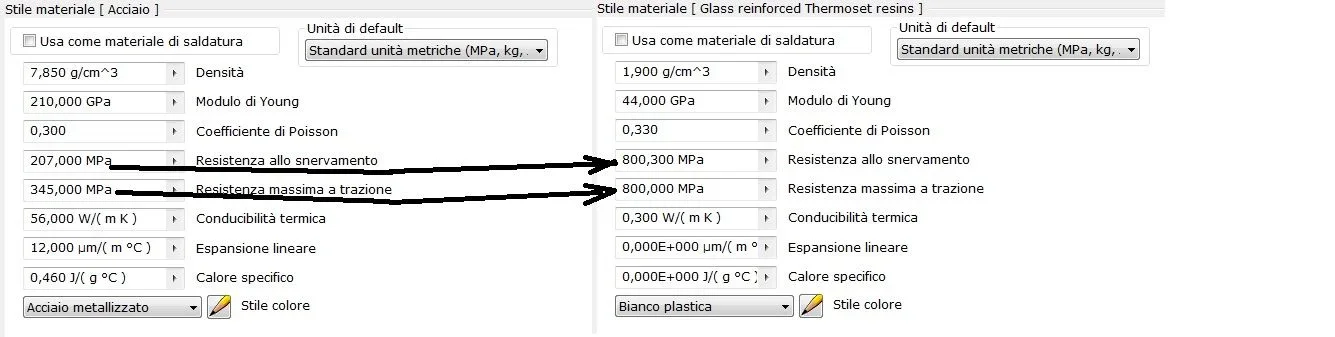
Confronto materiali.webpit is possible to slice a plastic tubular inserting as
values instead of data required by inventor other values such as
resistance to bending or other? !

Thank you in advance.
I hope it was clear but it is difficult to explain!

Thank you.

paolo b.
 
I don't understand, if you have completely defined a new material, by filling out all the fields-characteristic. .

once assigned the custom material to the model, inventor, but like any other category program, go to learn those values for analysis.

The answer is so stupid that I fear I have not understood the question :)
 
Hello c3kkos, then thank you for the interest in the meantime.
as you said, I initially created a new material.
then I set the various components with that material and started the analysis process.
My problem, indeed no, my question is this. you can set inventor in a way
that requires other values of the material and not those that ask? for example I have the following values
can you set these and not those required by inventor?View attachment 378
- - - updated - - - -some data are common, such as density etc... But others differ.
Thanks again!!!
 
then, I still couldn't understand if your problem is that the default values of material feature don't suit you and/or would like to add others. .

i.e. absurd, if inventor didn't ask to specify in the new material its density, you would like to insert it. .

This seems to me not impossible but unlikely, since the fem software included in inventor certainly accepts fixed input parameters, which will use in its intricate calculations. . .
 
I add:

I use solidworks.. .

and the parameters to be inserted are forced into a fixed table.. .
Code:
<physicalproperties>
<ex displayname="modulo elastico in x" usepropertycurve="0" value="2e+011"></ex>
<nuxy displayname="rapporto di poisson in xy" usepropertycurve="0" value="0.28"></nuxy>
<gxy displayname="modulo di taglio in xy" usepropertycurve="0" value="7.9e+010"></gxy>
<alpx displayname="coefficiente di espansione termica in x" usepropertycurve="0" value="1.1e-005"></alpx>
<dens displayname="densità di massa" usepropertycurve="0" value="7900"></dens>
<kx displayname="conducibilità termica in x" usepropertycurve="0" value="14"></kx>
<c displayname="calore specifico" usepropertycurve="0" value="440"></c>
<sigxt displayname="resistenza alla trazione in x" usepropertycurve="0" value="600000000"></sigxt>
<sigyld displayname="snervamento" usepropertycurve="0" value="400000000"></sigyld>
</physicalproperties>
"flexural resistance" is not elastic module? ?
 
Let's start with important things. What do you want to calculate?
in order to obtain the results that the fem inventor generates the required parameters are sufficient and do not need others. The calculated results are remarkable, are you sure you need more? What is that?

if you need to calculate additional values to the expected ones, I doubt it is possible, because the calculation codes are inserted into the software. but not completely excluding the possibility, I do not know just how to add additional forums to the fem analysis.
 
also.. given the plastic nature of the component, what else should you calculate, if not the mechanical seal?

I don't think of anything.
 
Forgive me if I didn't answer immediately! but we were really messed up, then I was unclear and apologized.
I created a plastic material. I set the fixed data that inventor requires, such as: density, maximum tensile strength, yield resistance, etc...
I had performed a first analysis but it is not true in the sense that, the material created is suitable for traction uses thanks to its high tensile strength; but it is not suitable for uses that provide flexo-torsional efforts. I'm going for an example.
 
I created a loading platform for an electric vehicle. This floor consists of the tubular of the plastic material I created. I loaded it with a remote force of 6000n (about 600 kg distributed on the surface of the floor. I tried to break it and I got that the floor doesn't feel a bit of effort! I would have liked to add other values to the fem as the traction reistency (senso: transverse) compression resistance (transverse) flexural moduls (transverse) etc...
 
to get perhaps a more truthful value, as the plastic material I created I am sure that would not resist the above use I wrote (of the dish) as the structure would be loaded to flexional forces and not traction forces. I will now try to compare the results both with tubular plastic material and with tubular steel to verify the calculations. thanks to everyone for the interest!
 
If I do not remember badly from my mechanical notes, the basis of all efforts is tensile strength (compression), then (always if I do not remember badly) you should not need bending resistance as it is the same of tensile strength but "modified" with a multiplication factor or division. . Am I right?
If what I said is correct, then perhaps you may have mistaken in setting forces or units of measurement, can it be?
 
I did a research and I think I said right, big lines.
the values that should interest you and that however are found for all materials are the tensile/compression resistance (breaking) and the young module (normal elasticity module). with these material values you should be fine for any kind of effort... .
 
if the material is isotropic... If so not (such as carbon where fibers can be placed in a non-symmetrical way) this is not true.

means plastic means everything and nothing

Hi.
 
Excuse me, but if there are sw fems that do not linear analysis and still cost a lot of money, there will be a why, or not?
the fem module of inventor is something entry level, which helps a lot in the preliminary phase, when you have to choose sections and/or materials (typically metallic) but not much more; but above all it is necessary to emphasize that this fem does only linear analysis, so it offers reliable results only if the analysis is made on isotropic materials.
to do analysis on anisotropic materials, you need evolved sw and from what I understand, the plastic tubular you want to analyze is made with an anisotropic material, therefore it is useless that you seek comfort from the fem module present in inventor.
Hi.
 

Forum statistics

Threads
44,997
Messages
339,767
Members
4
Latest member
ibt

Members online

No members online now.
Back
Top