
• This forum is the machine-generated translation of www.cad3d.it/forum1 - the Italian design community. Several terms are not translated correctly.

help device implementation

  • Thread starter Thread starter Micius88
  • Start date Start date
Of course they are connected as you say but, from a rotating hand crank connected to another crank with a tie, you will never be able to have a regular motion transmission.
As soon as the uncertainty of the movement arrives at the dead point, it becomes absolute.
Moreover the speed is for a moment nothing, so you can't even put a flywheel that helps you overcome the stall.
the attached figure, taken from this link: http://it.wikipedia.org/wiki/file:walschaerts_motion.gif It is what I thought about the flight when I saw the two handles connected by a biella, because they were the means of locomotion of my times, when the president was already ahead with the years but not overwhelmed:
said this, on the locomotive the system works because the wheels are synchronous because of the contact with the tracks?
the wheels of the locomotive, lifted from the ground, despite the masses in rotation not indifferent, wouldn't it work?
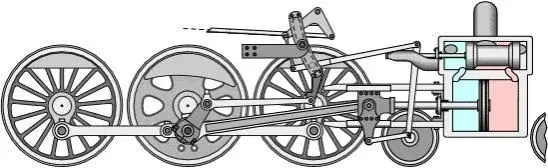
 

Attachments

  • Walschaerts_motion.webp
    Walschaerts_motion.webp
    22.2 KB · Views: 21
said this, on the locomotive the system works because the wheels are synchronous because of the contact with the tracks?
the wheels of the locomotive, lifted from the ground, despite the masses in rotation not indifferent, wouldn't it work?
It is not said, they may also work. Once you start, they fly, they will work.. at the "first lap" you may have that the wheel led to the dead point reverses the bike if there is no extreme dimensional accuracy and alignment. it is difficult because the biella motrice pulls in a direction (high or low) and the crank "dovÃ" conduct would follow it; if however the dead point has not yet arrived/aligned to the maximum diametric extreme point (please see me :biggrin:) the wheel can go back.

the substantial difference (and that makes you understand that cinematism in the subject) are the tampering rays and the length of the biella. in your locomotive (cit..."between buffalo and locomotive the difference jumps in the eyes"..:biggrin:) the cranks are all the same and the biella has length equal to the wheel strap.
here instead we have extremely different cranks and biella much longer than the chopper: the 2 trees is physically impossible that they roar completely in unison dragged each other.. make a certain angle and then "until". you can only use the short crank as a motor/continuing and the long as conducting/obscillating.
try to schematize it (maybe a lay out in swx and move it) and see it immediately.

the principle however is that, only with different measures get different results.

greetings
Mar
 
said this, on the locomotive the system works because the wheels are synchronous because of the contact with the tracks?
the wheels of the locomotive, lifted from the ground, despite the masses in rotation not indifferent, wouldn't it work?
it works because the wheels connected by the biella are three, so the same biella cannot assume ambiguous positions.
try to make a model with the lego and you will have the test: scentbiggrin:

Bye.
 
it works because the wheels connected by the biella are three, so the same biella cannot assume ambiguous positions.
try to make a model with the lego and you will have the test: scentbiggrin:

Bye.
Actually, I think it works because the right and left wheels of the locomotive are 90° blurred, so when a crank is at the dead point, the other one is on the move.

Bye.
 
Actually, I think it works because the right and left wheels of the locomotive are 90° blurred, so when a crank is at the dead point, the other one is on the move.

Bye.
This is very likely.
but it was hypothesized of a "train" of wheels "unifilare".

greetings
Marco:smile:
 
it works because the wheels connected by the biella are three, so the same biella cannot assume ambiguous positions.
Bye.
premises: I had not observed the quotas in that scheme but only "the figures" (not excluding, however, that, even if I observed the quotas, I could not have discarded bad :redface:)
That's what I'm taking as a personal fact, and I'm studying a historical treatise on locomotives to see if they're with the pairing rod on two wheels.
said this, in purely academic discussion, I am convinced "to feeling" that with two handles of equal length if on the shaft led there is a flywheel and the departure happens with the handle at 90° from the dead point the movement of the duct is rotary and not alternating.
Don't force me to build a demonstration that I don't have time... :smile:
 
said this, in purely academic discussion, I am convinced "to feeling" that with two handles of equal length if on the shaft led there is a flywheel and the departure happens with the handle at 90° from the dead point the movement of the duct is rotary and not alternating.
But if the driver is unlucky and the vapour stops with the plungers to the dead end what he does? asks travelers to get off and push the train until the biellas place orthogonal?
http://it.wikipedia.org/wiki/distribuzione_walschaertshere is expressly mentioned above, concerning the displacement of 90° between the right and left side of the locomotive.
 
premises: I had not observed the quotas in that scheme but only "the figures" (not excluding, however, that, even if I observed the quotas, I could not have discarded bad :redface:)
That's what I'm taking as a personal fact, and I'm studying a historical treatise on locomotives to see if they're with the pairing rod on two wheels.
said this, in purely academic discussion, I am convinced "to feeling" that with two handles of equal length if on the shaft led there is a flywheel and the departure happens with the handle at 90° from the dead point the movement of the duct is rotary and not alternating.
Don't force me to build a demonstration that I don't have time... :smile:
I was almost about to withdraw the offer, but then...

Well, I decided to demolish him, but nobody bought it.
:biggrin:
 
said this, in purely academic discussion, I am convinced "to feeling" that with two handles of equal length if on the shaft led there is a flywheel and the departure happens with the handle at 90° from the dead point the movement of the duct is rotary and not alternating.
Don't force me to build a demonstration that I don't have time... :smile:
But if the driver is unlucky and the vapour stops with the plungers to the dead end what he does? asks travelers to get off and push the train until the biellas place orthogonal?
you are doing the smart and out of the question!:rolleyes:
I wrote "in a purely academic discussion", that scheme at the beginning of the thread, with a flywheel on the shaft led and started at 90° (but perhaps even a little less, depending on the mass of the flywheel) from the dead point puts in continuous rotation the shaft led or not?
I'm going to make wood to start the crusher... :tongue:
 
you are doing the tricks and getting out of the question!
..does the shaft continuous rotation or not?
Surely not.
Maybe a few rounds can make it, but only by chance and only if the cranks are of equal measure, not as in the scheme of the theme.
 
you are doing the smart and out of the question!:rolleyes:
I wrote "in a purely academic discussion", that scheme at the beginning of the thread, with a flywheel on the shaft led and started at 90° (but perhaps even a little less, depending on the mass of the flywheel) from the dead point puts in continuous rotation the shaft led or not?
I'm going to make wood to start the crusher... :tongue:
Let's throw it like that...
in theory yes..
in practice, you do it only if you spot it at pms outdated and if inertia is such as to make sure that the shaft led passes alone the pmi.
 
I was almost about to withdraw the offer, but then...

Well, I decided to demolish him, but nobody bought it.
:biggrin:
I crush him, the one of the avatars, it's mine and I don't move him to anyone and I'm not going to change my profession! :smile:
 
Yes but no one has yet solved my problem of bearing bond....
to me it seemed so and also brilliantly.
you could buy a mechanical drawing book of theitis, usually these topics are treated very well and extensively.

Anyway, I'd like to tell you, since you're a student, to put down a solution and propose it on the forum, and then you'll see that you'll be given advice on how to improve it and make it acceptable. the best way to become a good technician is to learn from their mistakes thanks to the comparison with experienced technicians, instead copying the solutions proposed by others is a work not useful in future.
 

Forum statistics

Threads
44,997
Messages
339,767
Members
4
Latest member
ibt

Members online

No members online now.
Back
Top