s.melotto
Guest
Hello everyone,
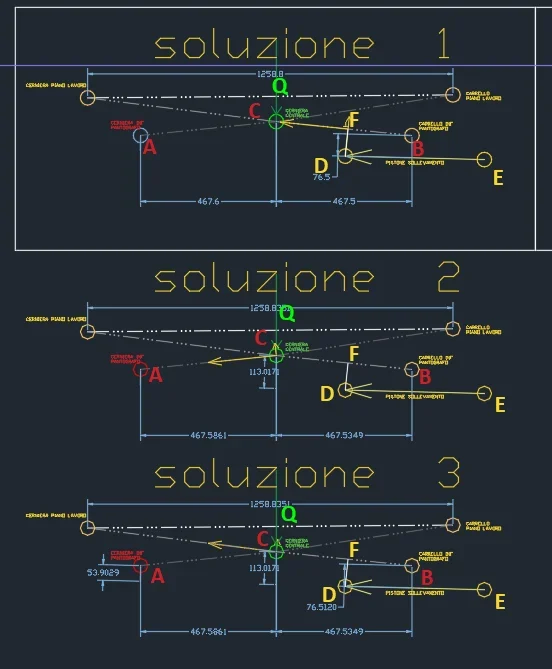
I should calculate the effort required to a simple cylinder effect controlled by a hand pump, to lift a pantograph frame with a total of 300kg weight force, centered on the upper floor (for now we leave any friction or other forces in play).
I'm inflating in the balance of forces, I'm not sure I took the right arm for the cylinder. I must say that I have to use all the force generated by the cylinder without breaking it (but I have serious doubts) multiplied by the perpendicular distance to its axis until the straight parallel to the axis and passing through the zipper of the pantograph.
I have two doubts:
Do I have to take all my strength or just a component?? ? I can think of taking it all, but I can think of it, xe I think that, at least in this position, the vertical component does not have effect (it has open pantograph), the horizontal one seems to open the scissor but that has no effect once opened....that is, from wherever I look I am doubted.... I hope to have explained myself sufficiently well.
- the arm is correct taken perpendicular to the axis of the cylinder, or should I take the quota vertically from the ground? ?
igo image I hope you can help me!! ! !
thanks for the courteous attention
I should calculate the effort required to a simple cylinder effect controlled by a hand pump, to lift a pantograph frame with a total of 300kg weight force, centered on the upper floor (for now we leave any friction or other forces in play).
I'm inflating in the balance of forces, I'm not sure I took the right arm for the cylinder. I must say that I have to use all the force generated by the cylinder without breaking it (but I have serious doubts) multiplied by the perpendicular distance to its axis until the straight parallel to the axis and passing through the zipper of the pantograph.
I have two doubts:
Do I have to take all my strength or just a component?? ? I can think of taking it all, but I can think of it, xe I think that, at least in this position, the vertical component does not have effect (it has open pantograph), the horizontal one seems to open the scissor but that has no effect once opened....that is, from wherever I look I am doubted.... I hope to have explained myself sufficiently well.
- the arm is correct taken perpendicular to the axis of the cylinder, or should I take the quota vertically from the ground? ?
igo image
I hope you can help me!! ! !thanks for the courteous attention