• This forum is the machine-generated translation of www.cad3d.it/forum1 - the Italian design community. Several terms are not translated correctly.

hertz theory applied to a pair of teeth

  • Thread starter Thread starter utente6
  • Start date Start date

utente6

Guest
Good morning, everyone.
I would like to ask for help with a problem that I am experiencing with ansys student (it is the first time I use it so I am still a beginner). I have to study the contact between two teeth with hertz theory, in particular the maximum pressure that is exerted on the contact ellipse, the problem is that between simulation and analytical calculation the results are too different (theoretical analytical calculation pmax=664 mpa, ansys:pmax=26mpa), but I can't well understand why. in the simulation, in 2d, I'm assuming I have only one tooth in the socket. I hope someone can help me, please.
 

Attachments

  • foto 1.webp
    foto 1.webp
    68.6 KB · Views: 35
  • foto 2.webp
    foto 2.webp
    67.9 KB · Views: 20
  • foto 3.webp
    foto 3.webp
    83.8 KB · Views: 18
  • foto 4.webp
    foto 4.webp
    50.7 KB · Views: 19
  • foto 5.webp
    foto 5.webp
    31.4 KB · Views: 22
ciao @utente6.
first, check that you have set the values/calculations/greats with the right measurement units.
I think in photo 5 the maximum value is indicated as 26,595 max (In the lower left boxes you will already correctly set the values in n/mm^2 or mpa). I tell you this because the colored scale on the top left, tells you the maximum value 26,595 and the minimum value 0 (not telling you its unit of measurement. )
other thing, you should meshare better your body(photo 3) and use certain models ,type plane42 and/or plane82.
 
the unit of measurement is the same therefore are 26,565mpa.
excuse ignorance but what and how do you use these models that you suggested to me? I made the model on solidworks and then imported it as an iges file.
at mesh level I attach the photo of how I made it.
 

Attachments

  • foto 4.webp
    foto 4.webp
    38.3 KB · Views: 15
  • foto 3.webp
    foto 3.webp
    108.8 KB · Views: 15
please is the subject of my thesis but I can’t really solve this problem, I ask for help
 
@utente6 Don't apologize for ignorance.
I admit it's a bit of time that I don't take ansys anymore (and I'd like to go back on this program).
therefore the problem is not in the units of measurement.
the unit of measurement is the same therefore are 26,565mpa.
excuse ignorance but what and how do you use these models that you suggested to me? I made the model on solidworks and then imported it as an iges file.at mesh level I attach the photo of how I made it.
First, you did well to convert it to iges.
with ansys you can convert areas/curves into many knots and track/create lines and areas.
from here, you will have to:
  • give him physical properties to your "body" (eg: will the two wheels be steel? you will create constants that represent the module of young, polka dot, the density of the material, etc... related to that material);
  • meshare/discretize the model of your toothed wheel, that is what you would have done in foto 3 and how you could do it (e.g. the image below). the part of discretization is important as it allows you to achieve more truthful results and to shorten the calculation times of the processor.x discussione ansys.webp
  • Do you need to use mathematical models that describe your mechanical behavior (eg: do I have a simple traction/compression auction? do I have a flexible traves? Could I use beam4.I have a circular tube? use as a model pipe16. Do I have a flat simulation? I will use plane42 and plane82 models.)
  • you have to set the constraints in knots and forces/loads in as many knots if you want to make a static simulation (because if not, the resolver doesn't calculate you anything).
your case may treat it as a planar case (do not consider the depth for the moment).
as a book, for a better understanding of the fem, I recommend the zienkiewicz.
on the internet you will find interesting thesis on the fem and slides where they explain the use of plane42 and plane82 models.
As soon as I have some time, I'm looking for some examples.
 
please is the subject of my thesis but I cannot really solve this problem, I ask
meshare/discretize the model of your toothed wheel, that is what you would have done in foto 3 and how you could do it (e.g. the image below). the part of discretization is important as it allows you to achieve more truthful results and to shorten the calculation times of the processor.View attachment 71206
  • Do you need to use mathematical models that describe your mechanical behavior (eg: do I have a simple traction/compression auction? do I have a flexible traves? Could I use beam4.I have a circular tube? use as a model pipe16. Do I have a flat simulation? I will use plane42 and plane82 models.)
  • you have to set the constraints in knots and forces/loads in as many knots if you want to make a static simulation (because if not, the resolver doesn't calculate you anything).
In my sketch I represented you two cases where you could play simulation with:
  • a force concentrated in a knot (with an appropriate orientation);
  • a distributed load along a line.
in the design I did not represent the constraints you have to apply to the nodes (you should add them to the nodes present at the tooth base).
 
First of all, I thank you very much for the time you're giving me, you're helping me a lot.
I fixed a little 9 things:
1- stupidly I had not considered the thickness of the two bodies, so I set it 38mm (as an analytical model);
2- I applied the force on a series of knots (which I chose manually, I do not know if it is ideal) as you told me;
with these shortcomings I get a maximum pressure of 655mpa, which is within 2% error compared to 644mpa of analytically calculated pressure.
I attach the picture of the nodes considered (the force is distributed in such knots)

You think it's okay as a solution? or select the knots so manually is one thing you usually don't do?
 

Attachments

  • foto 8.webp
    foto 8.webp
    72.9 KB · Views: 17
Good morning, everyone.
I would like to ask for help with a problem that I am experiencing with ansys student (it is the first time I use it so I am still a beginner). I have to study the contact between two teeth with hertz theory, in particular the maximum pressure that is exerted on the contact ellipse, the problem is that between simulation and analytical calculation the results are too different (theoretical analytical calculation pmax=664 mpa, ansys:pmax=26mpa), but I can't well understand why. in the simulation, in 2d, I'm assuming I have only one tooth in the socket. I hope someone can help me, please.
hi, looking at the model you uploaded I recommend you, as told by doctorbomber90 to use 3d models and not 2d providing also a thickness and indicating the materials, also the contact you choose "frictionless" is non-linear type, so you have to intervene in the settings "analysis settings" and tell him to make more calculation step.

regarding the units of measurement seem well set because the result that came out of you of 26mpa had already the unit of measurement only that the screenshot cut the information.
 
I unfortunately remained in linear static simulation, both for single-dimensional elements (such as rods or beams) bidirectional and three-dimensional; and fashionable simulation (without and with damping) to estimate the natural frequencies and ways of vibrating.
the part linked to non-linear simulation, contact between two bodies, fatigue, expansion due to thermal action or centrifugal action, never touched/studied (ahimè).
therefore @utente6 The best I could do is what I explained to you in the first post.
the rest you have to ask your prof/relator.
 
I tried to set an analysis similar to yours, but not knowing geometries and loads. I'll take you back as I set it so you can try it.

I press that I have not made any analytical calculations, I only tried to load everything on ansys, so the results should be validated, but in the meantime I hope that these info are better than nothing.

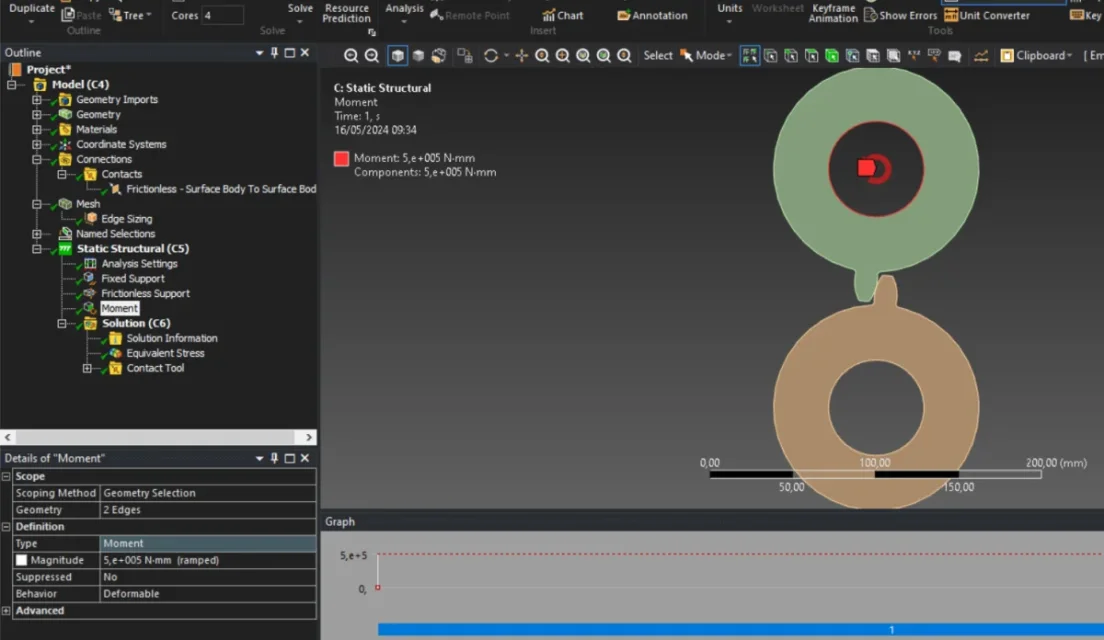
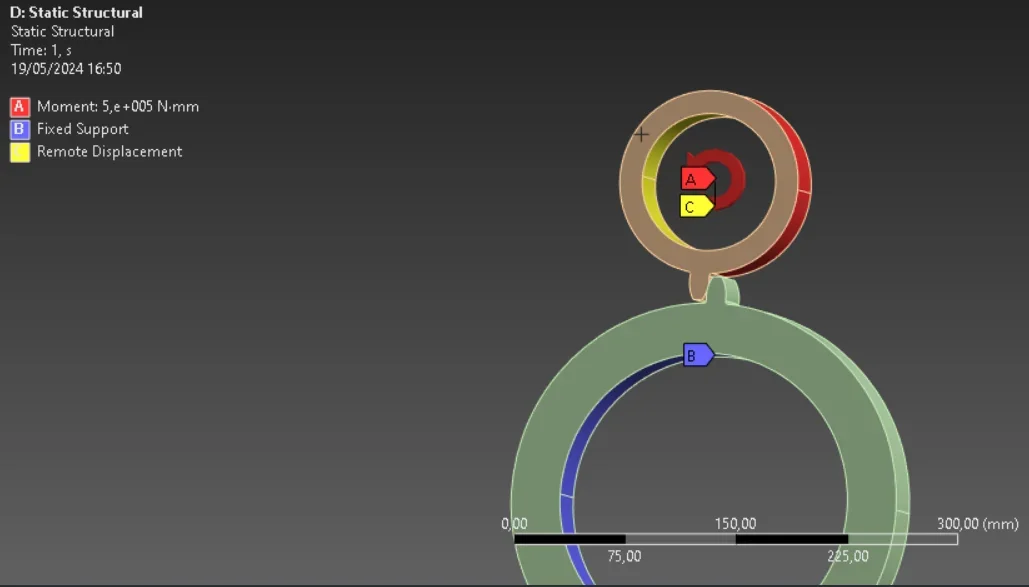
moment: 500 nm
primitive diameter 110 mm
tooth thickness: 10mm

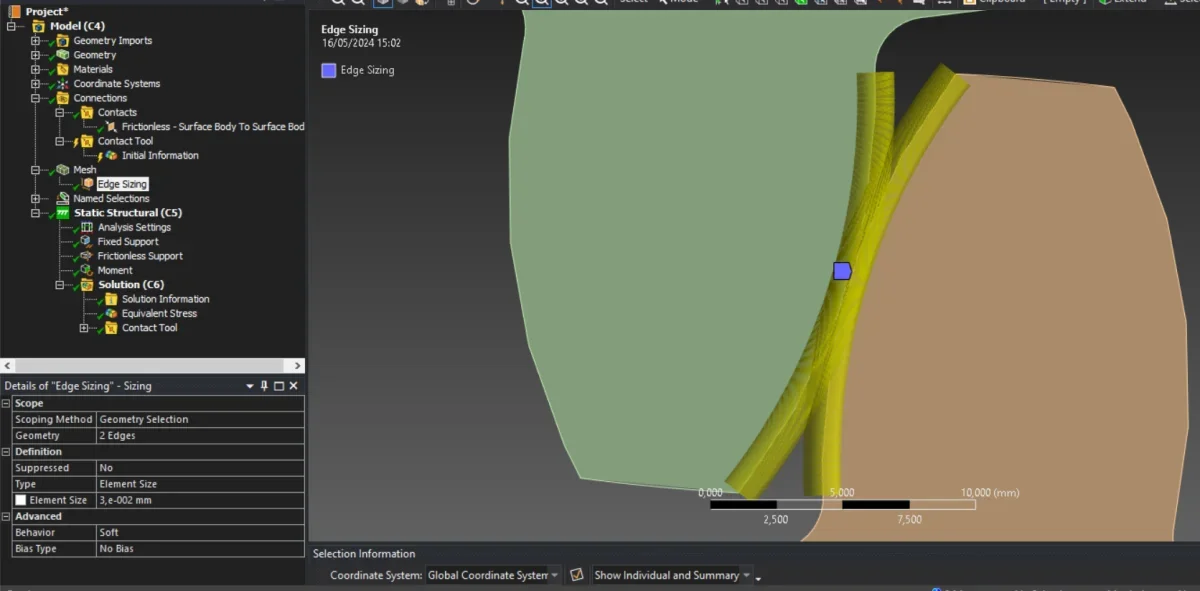
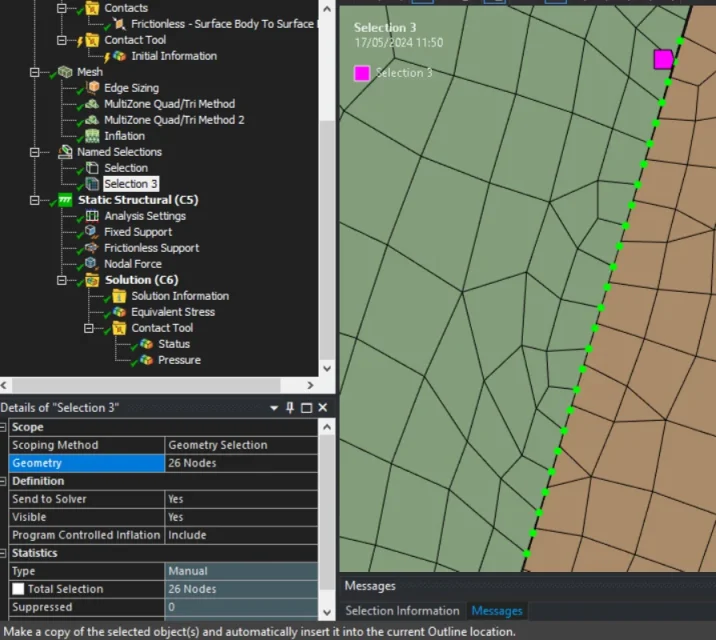
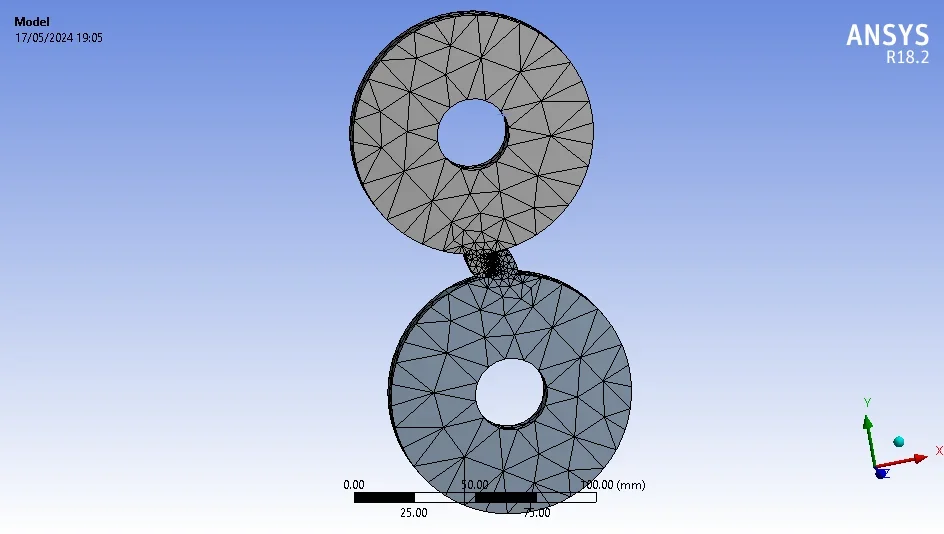
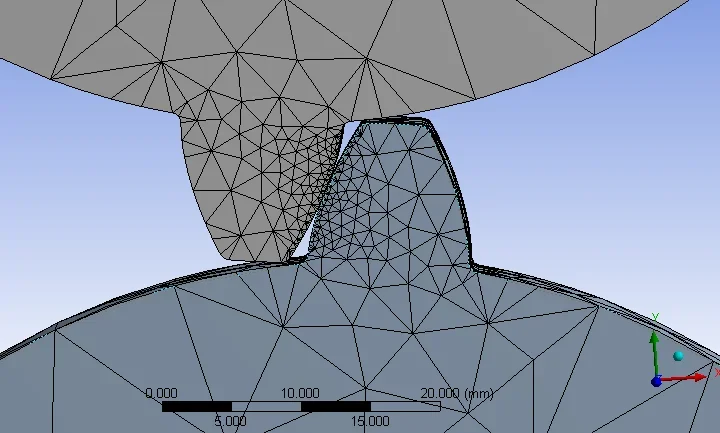
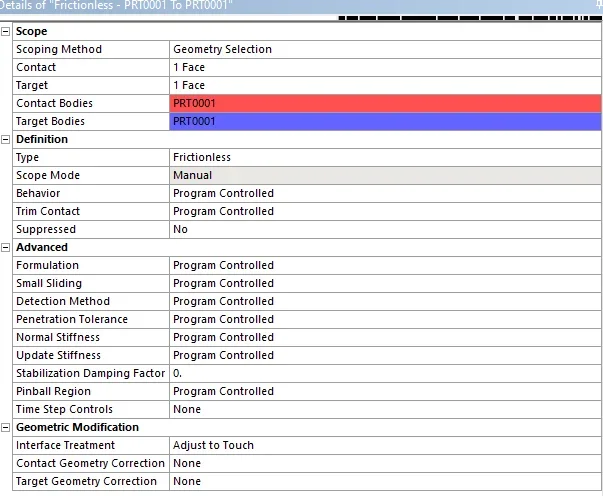
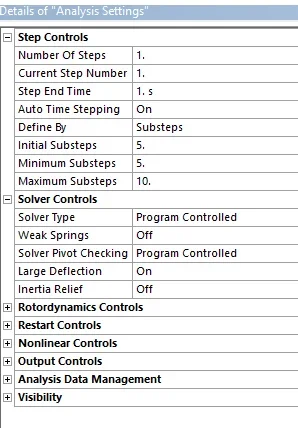
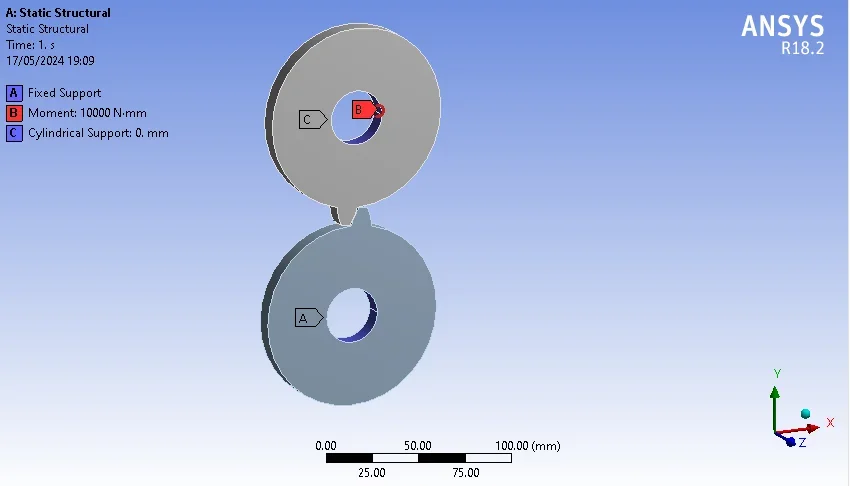
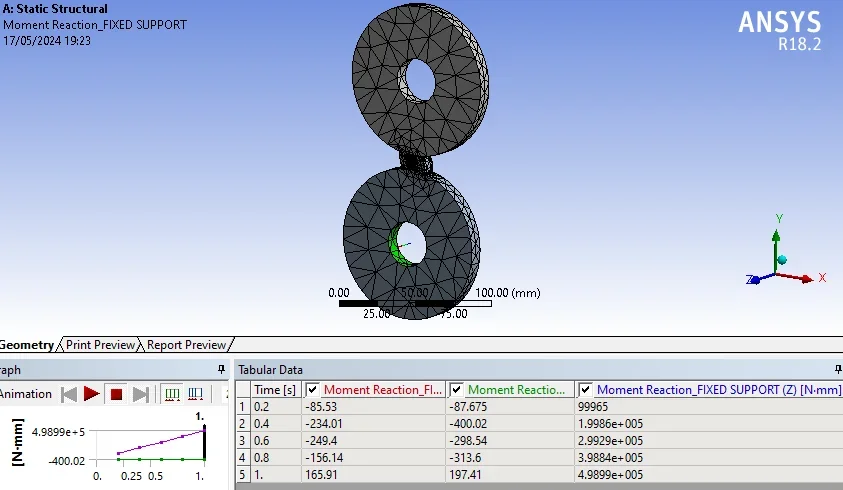
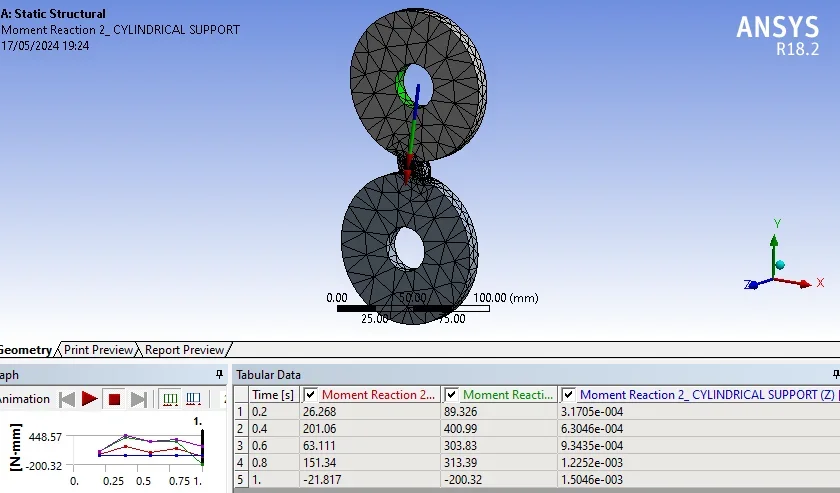
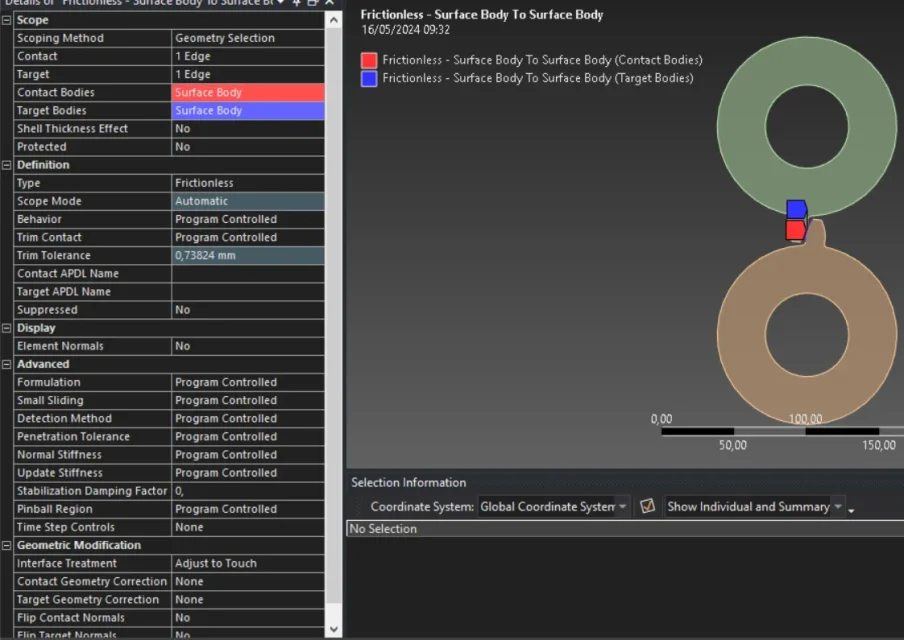
model and mesh:1715965535122.png1715966734480.pngcontact frictionless (for parameters set the "adjust to touch" that solves you possible not contact in the initial phase due to mesh tolerances):1715965610832.pngsetting "analysis settings" (in the case of an analysis of up and load values very high, tends to greatly increase the substep number, I limited myself to a maximum of 10 for time issues):1715965699083.pngconstraints and loads (the "cylindrical support" bond only use it to stabilize the model):1715965768036.pngcontact pressure via the "contact tool --> pressure":1715966512937.pngprobe on the two constraints where it is seen that all the moment is absorbed by the "fixed" and the "cylindrical support" practically is unloaded:1715966619770.png1715966672051.pngLet me know if by changing these settings you get a close value to what you do in the analytical model.
 
Thanks for your advice, I'm trying to replicate your model though I can't set the "cylindrical support", I don't understand why.
You think the solution I found and described a few messages earlier could be okay?
 

Attachments

  • foto 9.webp
    foto 9.webp
    44.2 KB · Views: 14
Thanks for your advice, I'm trying to replicate your model though I can't set the "cylindrical support", I don't understand why.
You think the solution I found and described a few messages earlier could be okay?
for cylindrical support you have to give the only riadial and axial but not tangential.

set the “free” tangential

But in the screen you put you have 3 constraints:
- 1 fixed support
-1 cylindrical support
-1 frictionless support

I would tell you to remove the latter because of too much
 
ok done, the problem is that it doesn't make me select the faces so I can't set the bond.
(I took off the frictionless support as you told me)
 
you do not need to use a cylindrical support, you can also use a remote desplacement.
Let me know if you can unlock the situation.
 
ho provato ad usare remote desplacement in questo modeView attachment 71220

però mi continua a dare questo errore:
"an internal solution magnitude limit was exceeded. please check your environment for inappropriate load values or insufficient supports. please see the troubleshooting section of the help system for more information."

sapete come può essere risolto?
 
I noticed that you do not see the attachment so I send it back
 

Attachments

  • foto 10.webp
    foto 10.webp
    18.4 KB · Views: 6
ho provato ad usare remote desplacement in questo modeView attachment 71220

però mi continua a dare questo errore:
"an internal solution magnitude limit was exceeded. please check your environment for inappropriate load values or insufficient supports. please see the troubleshooting section of the help system for more information."

sapete come può essere risolto?
The system is telling you that you are under bound and you have great moves.

sets the remote desplacement with a cylindrical reference system and blocks the whole radially and axially leaving free the circumferential component
 

Forum statistics

Threads
44,997
Messages
339,767
Members
4
Latest member
ibt

Members online

No members online now.
Back
Top