• This forum is the machine-generated translation of www.cad3d.it/forum1 - the Italian design community. Several terms are not translated correctly.

inertia calculation related to the motor shaft

  • Thread starter Thread starter ilyanor
  • Start date Start date

ilyanor

Guest
Hello everyone, I've been banging my head on this application for two days.
a customer must rotate a 2.5kg heavy disk radius 0.25 m of 15°, after which, the disk must return to its initial position.
This must be done as soon as possible.
the engine I have available has an inertia of 40 kgmm^2.
load inertia is 78125kgm^2
I have an epicloidal gearbox with transmission ratio 25.
My questions are two:
1- by applying a transmission ratio of 25 the relationship between motor inertia and total inertia reflected on the motor falls between 3-5 values?
2- how do I calculate the total inertia moement that will then serve me to find the angular acceleration?

thanking you in advance and hoping for your help I wish everyone a good weekend!
 
total inertia moment referred to the motor = jmotor + jdisco/i^2.

...as mentioned several times and also in other sites you must sum motor inertia and the inertia of the load divided the ratio do reduction to the square. This is what the engine sees to move the system.
 
thanks for the right mechanicmg, it was what I had in mind too, the formula that I remember is this:
jm* = (jm + ji) + τ^2 jr where m is per motor, i for gearbox and r for load.
I miss the inertia of the epicloidal reducer, can I estimate it?

then once found the jm*, to find ,, I use the formula: ♪
In this case I should place the nominal torque of the engine, not the one amplified by the epicycloidal, right?
v
 
the inertia of the reducer is found on the catalog and is usually referred to the input shaft.
 
We do a moment of clarity, because documents in Italian are hard to find them explained well, so I attach a document the English language and I write briefly the reasoning.

we indicate with:i = reduction ratiojm = engine inertia momentjc = load inertia moment, load sideI = jc/i2 = reflex inertia moment of the reduced load to the motor
k = j′/jm = inertia ratio to be used for industrial applications between 5 and 10 with servo motors. go to higher values creates dynamic adjustment instability.

ideal, without reducer (i=1) would be to have jm = jc
 

Attachments

in Italian I recommend the mechanical book of the drives of g. wood that treats well the topic coupling motor load.
on the inertia report the servomotor brand drivers give an inertia report up to 30, personally never tried to such relationships so I do not know how they really go in such circumstances, someone has experience?
 
We do a moment of clarity, because documents in Italian are hard to find them explained well, so I attach a document the English language and I write briefly the reasoning.

we indicate with:i = reduction ratiojm = engine inertia momentjc = load inertia moment, load sideI = jc/i2 = reflex inertia moment of the reduced load to the motor
k = j′/jm = inertia ratio to be used for industrial applications between 5 and 10 with servo motors. go to higher values creates dynamic adjustment instability.

ideal, without reducer (i=1) would be to have jm = jc
hi mechanicalmg, I have to resume in hand some concepts of mechanics in transients given my little practicality and experience.
Ultimately I have a system moved by a servo motor through belt with 1/2.tale ratio motor moves a shaft at whose end a disk is installed.
during testing the pairs are accurate and the system turns perfectly. the problem arises in the difficulty in correctly positioning the piece and in the non-precision in arrivals and departures. I think it's because I didn't consider the inertias.
some data:
j mast = 0.003 kgm^2; jflangia = 0.003 kgm^2; jmotor(from catalog) = 0.00012 kgm^2.
jtot = jalbero+jflangia= 0.006 kgm^2
the jtot I must divide it by the reduction ratio square = 0.006/2^2= 0.0015 kgm^2
therefore k = 0.0015/0.00012 = 12.5 (we are at the limit of what is said 5<k<10image0.webp )
Is the approach correct?
 
hi mechanicalmg, I have to resume in hand some concepts of mechanics in transients given my little practicality and experience.
Ultimately I have a system moved by a servo motor through belt with 1/2.tale ratio motor moves a shaft at whose end a disk is installed.
during testing the pairs are accurate and the system turns perfectly. the problem arises in the difficulty in correctly positioning the piece and in the non-precision in arrivals and departures. I think it's because I didn't consider the inertias.
some data:
j mast = 0.003 kgm^2; jflangia = 0.003 kgm^2; jmotor(from catalog) = 0.00012 kgm^2.
jtot = jalbero+jflangia= 0.006 kgm^2
the jtot I must divide it by the reduction ratio square = 0.006/2^2= 0.0015 kgm^2
therefore k = 0.0015/0.00012 = 12.5 (we are at the limit of what is said 5<k<10View attachment 57448 )
Is the approach correct?
Certainly, the approach is correct and reflects the calculation scheme we have indicated several times.
 
Certainly, the approach is correct and reflects the calculation scheme we have indicated several times.
Could you please clarify something to me? Is that the engine's internal, is that indicated by the engine and not that on the gearbox or bad memory?
that is the "reduce" reducer of the square the right j load?
I hope I've been clear.
Thank you.
 
I'm sorry, we could explain something. Is that the engine's internal, is that indicated by the engine and not that on the gearbox or bad memory?
that is the "reduce" reducer of the square the right j load?
I hope I've been clear.
Thank you.
It looks like a slap.
the moment of inertia of the engine copper winding is that.
all that is out of a mechanical reducer should be divided by the square of the reduction ratio and sum it at the moment of inertia of the motor to have the moment of total inertia to manage with the torque of the motor.
already written a tide of times....forms etc....read to read.
 
It looks like a slap.
the moment of inertia of the engine copper winding is that.
all that is out of a mechanical reducer should be divided by the square of the reduction ratio and sum it at the moment of inertia of the motor to have the moment of total inertia to manage with the torque of the motor.
already written a tide of times....forms etc....read to read.
I'm sorry but I'm not Italian I'm talking like I can. Anyway thank you
 
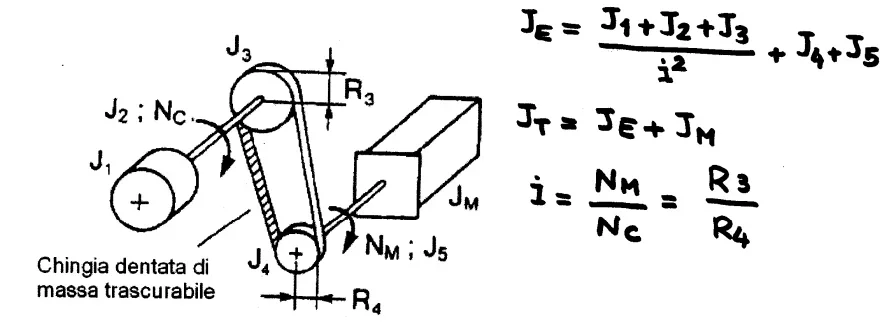
good evening, I continue implementing with another case, all right until I have a motor and a single gearbox (or any organ that creates an i1 relationship.

but in case (as in the attached image I also had a second i2 created by belt how do you proceed?

substantially having noticed the mass to be moved on a conveyor belt of m=100 kg with an acceleration of 3 mm/sec and fixed the dimensions of the wheels of the belt (i2= 1/3).

how do I choose the engine and the gearbox ratio?

Thank you.
 

Attachments

  • IMG_20201014_225029564~2.webp
    IMG_20201014_225029564~2.webp
    26.7 KB · Views: 89
with mass to be transported, acceleration and coefficient of friction calculations the necessary torque for handling (net of yields).
you also need the speed of transport so you can calculate inertia of the conveyor belt pulley.
then in cascade reduces everything until the engine, conceptually the process does not vary
 
it has already been schematized in other my posts the cinematism just proposed....and with it how the inertias are calculated.
clearly serve friction, acceleration and speed.
 
good evening, I continue implementing with another case, all right until I have a motor and a single gearbox (or any organ that creates an i1 relationship.

but in case (as in the attached image I also had a second i2 created by belt how do you proceed?

substantially having noticed the mass to be moved on a conveyor belt of m=100 kg with an acceleration of 3 mm/sec and fixed the dimensions of the wheels of the belt (i2= 1/3).

how do I choose the engine and the gearbox ratio?

Thank you.
is the composition of1602791157524.webpregarding the weight, the carpet and what happens to the tree up to what would be the engine of this box.
what you find, you have to apply it to the other scheme:1602791240209.webpwhere instead of this engine there is again a scheme:1602791294407.webp
 
Excuse me, could someone help me with the calculation of the inertia of these components?
 

Attachments

  • spazzolin.webp
    spazzolin.webp
    24 KB · Views: 89
Excuse me, could someone help me with the calculation of the inertia of these components?
the cone gears of the cylinders with mass...so it is easy. for the other ten make the mass composition centered and decentralized mass.
definitely with a 3d cad is much easier.
 
We do a moment of clarity, because documents in Italian are hard to find them explained well, so I attach a document the English language and I write briefly the reasoning.

we indicate with:i = reduction ratiojm = engine inertia momentjc = load inertia moment, load sideI = jc/i2 = reflex inertia moment of the reduced load to the motor
k = j′/jm = inertia ratio to be used for industrial applications between 5 and 10 with servo motors. go to higher values creates dynamic adjustment instability.

ideal, without reducer (i=1) would be to have jm = jc
Thanks, at work I'm finding myself a similar problem about engine size for a robot and some things I didn't remember, not seeing them from the times of one '
 
Good morning I attack this discussion to ask for theoretical clarifications in the topic soaking. Whereas a situation similar to that proposed in the first question of the forum,
When I go to consider the total inertia in play, loaded side and engine side, in order to calculate the inertia ratio, where do I insert the inertia of the reducer? Why?

waiting for friendly response
 

Forum statistics

Threads
44,997
Messages
339,767
Members
4
Latest member
ibt

Members online

No members online now.
Back
Top