
• This forum is the machine-generated translation of www.cad3d.it/forum1 - the Italian design community. Several terms are not translated correctly.

leg development with folding with loft

  • Thread starter Thread starter Stefano-81
  • Start date Start date

Stefano-81

Guest
Hi, guys.
Since I often develop in 2d of the pyramidal trunk legs supporting reservoirs.
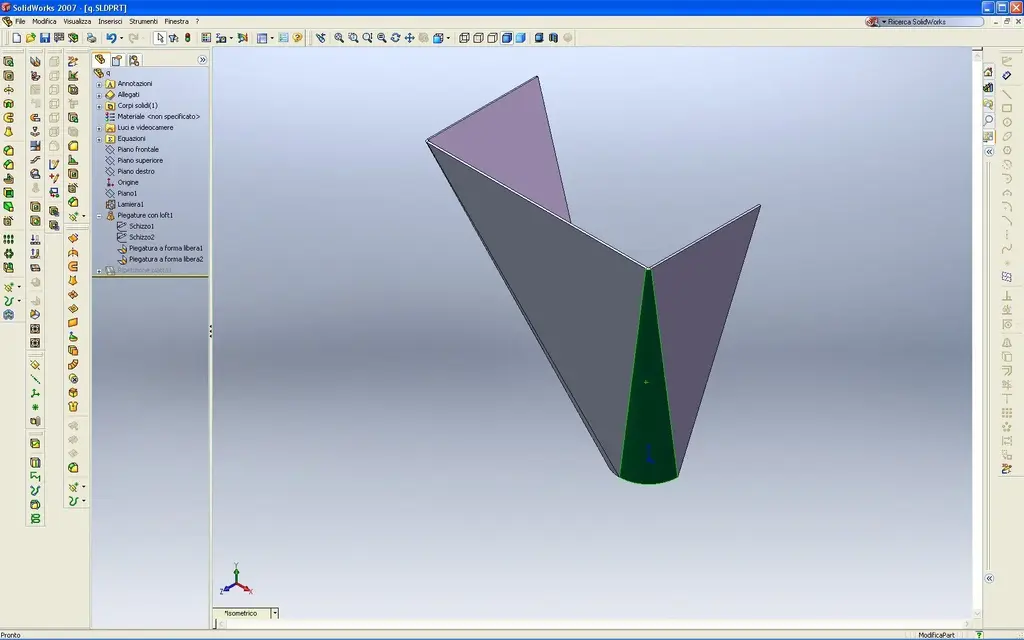
in free time I was trying to create 1 parametric model in 3d with solid work 2007 (see attachment)
I can't understand where I'm wrong.
I created my bending with loft
solid creates me solid
I don't know.

Is development right at this point?

thanks for the collaboration
 

Attachments

  • Gamba.zip
    Gamba.zip
    668.7 KB · Views: 19
  • Gamba.webp
    Gamba.webp
    98.6 KB · Views: 48
the leg I saw in the 3d file is always the same or changes size? If it is always the same you can make the same a bookcase model so that you can take it in any design. Moreover this also serves to manage the assemblies, when you combine tanks and feet, to have the correct d.b. with sheets, weights and number of components.
 
Hi, guys.
Since I often develop in 2d of the pyramidal trunk legs supporting reservoirs.
in free time I was trying to create 1 parametric model in 3d with solid work 2007 (see attachment)
I can't understand where I'm wrong.
I created my bending with loft
solid creates me solid
I don't know.

Is development right at this point?

thanks for the collaboration
Sorry, but I don't understand the question. .
Where are you wrong? The program shapes you and develops without giving you mistakes, so you're obviously not wrong.. if that's what you wanted to get (but you only know it). development for that "drawing" leg is right, which then realize it from the real can be problematic is another speech.. but if you say that you already build it so the question does not arise.

better explain what your doubt is.

greetings
Mar
 
to answer
Sebastiano71 I'm trying to create 1 parametric model for me to change:

the tank diameter
the tank cone angle
the size of both the upper base
which lower base
and the height of the leg

to answer sampon my doubt is:
as seen from the 1st solid attached image when it creates the solid me joins more faces together.
unlike 1 simple bending with loft (e.g. 1 reduction from painting to round)
that if I click on 1 single face he only highlights me that
 

Attachments

  • PiegaturaConLoft.webp
    PiegaturaConLoft.webp
    92.7 KB · Views: 21
to answer sampon my doubt is:
as seen from the 1st solid attached image when it creates the solid me joins more faces together.
unlike 1 simple bending with loft (e.g. 1 reduction from painting to round)
that if I click on 1 single face he only highlights me that
this image already has different shape from the previous example; How do you want it?
I keep not seeing the problem, the design is right and development as well: do you like it? Can you build it? Then it's okay.

It is normal that when you click on a face, only that is highlighted; is one of the faces that make up the surface.. But what can't you do?
(... will I be quite touchy?:biggrin:)

greetings
Marco:smile:
 
Maybe I can't explain.
the second image is as an example to explain the difference by always using the same bending command with loft.
In one case, it shows me one face alone. In the other case, it shows me more faces.
The leg model that happens to me is the first one I attached.
if I am in my model and have to insert other functions by clicking on 1 side face to insert 1 sketch I can not.
 
Maybe I can't explain.
the second image is as an example to explain the difference by always using the same bending command with loft.
In one case, it shows me one face alone. In the other case, it shows me more faces.
The leg model that happens to me is the first one I attached.
if I am in my model and have to insert other functions by clicking on 1 side face to insert 1 sketch I can not.
This depends on how you sketched/modeled.
in the first case the upper sketch is formed by spline (also "sweet" and not in tangency, and from this the division in different faces) that once extruded originate a unique face even if the surface "looks like" bent. You would've done some sort of blasting and not a fold. on curved faces you can not create a sketch directly.
in the image of the second example instead the upper sketch is (shade) formed by straight lines and arches, then the extrusion will result a face for each line or arc (plate in the case of lines, and here you can sketch).
In short, you have to decide how you want legs (with flat faces, curves, arches etc.) and shape accordingly. as you have seen the program responds correctly to what you ask and provides you with the right developments. management is up to you.

greetings
Mar
 
I realized that the variables are many, but you should do some clarity because to combine all these variables together is a case. If I understand correctly, a main variable is the width of the tank, that is according to this the foot changes size. I have worked in the enological field, where tanks were built and I can tell you that in order to reach a conclusion, I had made a standard foot for pio to create configurations that were set according to the diameter of the herbatonio. In this way when I was together, I took the foot I needed. In addition to configurations, you can also create an excel sheet with various parameters to control, so as to manage angle, height and upper and lower foot always. I suggest you manage it in this way or with configurations or with the electronic sheet, because you will have advantages in the future.
 
I think it is confused by the fact that there are no tangent lines that, in cases like these, are not displayed.
after careful observation you notice how the faces are easily identifiable, so the solid body other is that the result of the loft executed.
among other things is beautiful the 3d sketch solution to use as loft profiles.

my advice is to eliminate the line stretch 1 mm long
of the upper sketch, you will have a more regular loft.


at the level of reliability, after 8 years of almost exclusive use for sheet metals,
I can ensure that the developments calculated by the software are 100% reliable, provided you have set all the bending r parameters at best
and any factors k.
 
Obviously the tanks are not infinite, indeed, so I attach an example of parameterization using confogurations. the shares connected with each other are:
cone height and the two bases of the cone. Of course, the angle changes automatically with different configurations.
 

Attachments

thanks to all for the collaboration.

a sebastiano71,thanks for the file ,but I work on solidworks 2009 sp5 and your file can't open it.
 

Forum statistics

Threads
44,997
Messages
339,767
Members
4
Latest member
ibt

Members online

No members online now.
Back
Top