• This forum is the machine-generated translation of www.cad3d.it/forum1 - the Italian design community. Several terms are not translated correctly.

load loss

  • Thread starter Thread starter mir
  • Start date Start date

mir

Guest
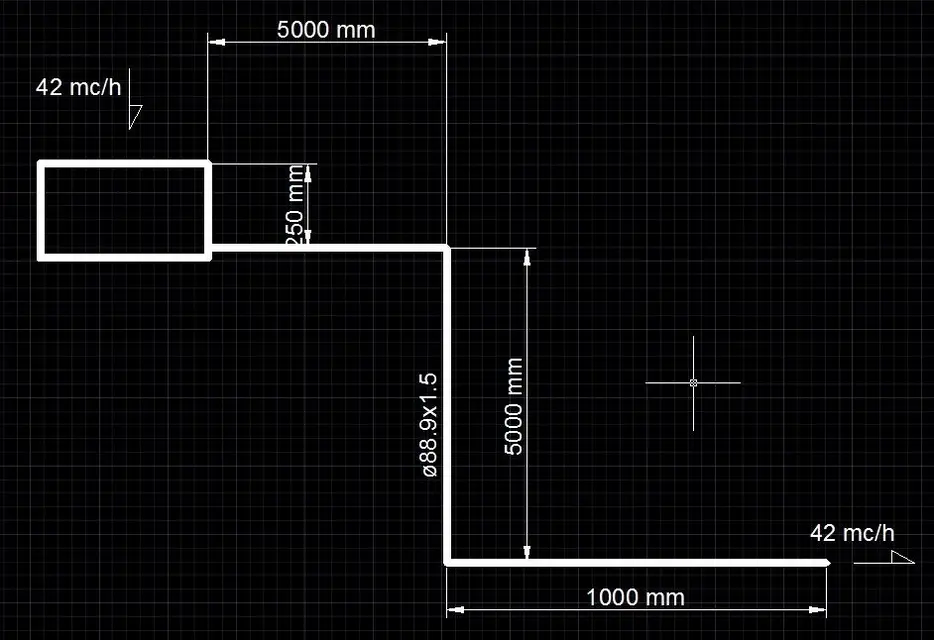
I am not very hard in hydraulics and I ask you something: in the attached design you see a bathtub where 42 mc/h of water enter. from the tub comes a tube (with 250 mm swing) that goes in a giant vasque ... now according to my calculations (using hazen-william) I would need at least 230 mm of swing because the ø88.9x1.5 tube is enough.

Does it seem correct?

Thank you.
 

Attachments

  • perdita.webp
    perdita.webp
    22.6 KB · Views: 22
Hi.
But I don't understand the problem with your question.
What do you need to optimize?

Why do you "brutally" two curves at 90°? Can't you go straight?

Does the water have to go from above down or with a pump is pushed backwards?
 
then, according to my first calculations (powering from above down):

- capacity 700 l/min
- inside tube 88.9 mm
- geometric features as highlighted by you
- concentrated load losses: 2 curves at 90°
- no filter
- no check valve
- plastic pipes
- water temperature 20°c

results
fluid speed in the duct: 2.35 m/sec
concentrated load losses 0.07 bar
distributed load losses 0.09 bar
 
no curves must remain. I have to understand if it is better to put a tube of 4" (which from the accounts I made asks me 80 mm of swing) or if I can keep the tube of 3" (which instead wants 230 mm of swing)
 
Would you like to let the water go from the tank top to the bottom and would you like to dimensional the pipe to prevent cavitation?
 
but the cavitation can also have without the presence of pumps?

However basically what I try to get is not to find water coming out of the mountain tub because the pipe fails to dispose of the flow.
 
0.16 bar?! of loss ... need a beating of 1.6 m?
load losses can be considered both in terms of pressure and in meters of water column (mca).
attention that are not meters...the mca indicate the Press 1 meter high water column.

1 mca = 9806 pa = 0.09806 bar
 
load losses can be considered both in terms of pressure and in meters of water column (mca).
attention that are not meters...the mca indicate the Press 1 meter high water column.

1 mca = 9806 pa
i.e. if I have load losses of 0.16 bar means I have to have a tank with height 1.6 m. of water swing.... right?
 
but the cavitation can also have without the presence of pumps?
Of course, when the fluid speed increases, pressure decreases (see bernoulli... see also the reason why the carrier is generated on air wings).
when the pressure reaches a depression so as to be less than the vapor tense begins to evaporate and the first bubbles are formed.

It is obvious that the cavitation phenomenon is more sensitive to pumps than pipes... but for economic reasons not because there is no.
 
I attach my "solution"

attention: are calculations drawn down quickly between one thing and the other at work. I look forward to your opinions/recommendations.

the result is to have a diameter of ø65mm otherwise the flow to the valley tank would be excessive.
 

Attachments

Forum statistics

Threads
44,997
Messages
339,767
Members
4
Latest member
ibt

Members online

No members online now.
Back
Top