• This forum is the machine-generated translation of www.cad3d.it/forum1 - the Italian design community. Several terms are not translated correctly.

machine construction exercise - reducer

  • Thread starter Thread starter aguayo
  • Start date Start date

aguayo

Guest
Bye to all,
for the construction course there was assigned the sizing of a reducer (as tradition), the delivery date almost arrived. I have prepared a design of the aid but I have doubts and thought of "share them":

1) I would like to add pins of centering, where do they posiziono? Can I represent them with a partial section on the front view (the one where you see the plan perpendicular to the axes of the trees)?

2) the reducer will be lubricated to oil bath for which a stopper will be necessary for input and a stopper for discharge. same problem: where to place them? How do I represent them?

advice on other aspects are also accepted. more or less the reducer is 550 in height (just for an idea on the size), it is made with two shells cut into the perpendicular plane to the axes because otherwise, if cut into the other direction, there would be little room for the screws.
 

Attachments

I think the design is fine as it is.

the center plugs can not put them, but if you want to use them you can put them up and down, two thorns between the three screws, and you can represent them in the section.

for caps depends if the reducer works vertical or horizontal, so you can put the caps above and below.


Bye to all,
for the construction course there was assigned the sizing of a reducer (as tradition), the delivery date almost arrived. I have prepared a design of the aid but I have doubts and thought of "share them":

1) I would like to add pins of centering, where do they posiziono? Can I represent them with a partial section on the front view (the one where you see the plan perpendicular to the axes of the trees)?

2) the reducer will be lubricated to oil bath for which a stopper will be necessary for input and a stopper for discharge. same problem: where to place them? How do I represent them?

advice on other aspects are also accepted. more or less the reducer is 550 in height (just for an idea on the size), it is made with two shells cut into the perpendicular plane to the axes because otherwise, if cut into the other direction, there would be little room for the screws.
 
the reducer seems to me quite well and also well detailed unlike many exercises I have seen posted here.
the only thing is that you have made some spacers a little too long, infectious you have the tree at the top that is very slender (long and narrow).
the thorns you should put them to ensure the coupling of the two shells because otherwise you will never find yourself during a disassembly and reassembly. the thorns must be put up one at the top and one at the bottom where there are the 3 screws or even on the other two sides, perhaps a little internally, perhaps making the hole in the seal.
the loading and unloading plugs take them from the elephant that are already beautiful that made.
hypothesizes an orientation of the reducer and places the level (glass) flush of the lower bearing rolling track....the rest of the oil salt to beat. the cap at the highest point and the discharge in the lowest one.

I continue to see that the minkiates are always present and that our teachers do not update:
- uni en iso 2768 no more since 30/11/1996 and has been replaced by uni en 22768-1:1996
- the blurring seals are no longer used since the time of the reducers of World War II, because they are uncomfortable and wear over time. it is preferable to make mechanical shavings with plates or iron spacers. paper seals have fixed thickness and are used only for large series of gearboxes. if they flatten, usually for commercial gearboxes does not matter the axial play increase of 0.05 mm. the serious economic reducers, where the mechanical dimension of the case called law, is used the rope or inside the quarry obtained in one of the two semicasses. use red paste as a sealant creates a thickness that is not constant, but if the reducer is of those little important you can also put red paste as a seal between the two contact surfaces (but it is not maximum).- Dear teachers, get old! go to the companies to work a few years, read some technical books, buy some new manuals... that maybe you can update yourself. in 2014 we are still there studying adamo and eva of mechanics ... I also understand that there are no young preparations to fit properly into the companies and we are forced to wait for the aliens who come to save us.... wake up!! !
 
- Dear teachers, get old! go to the companies to work a few years, read some technical books, buy some new manuals... that maybe you can update yourself. in 2014 we are still there studying adamo and eva of mechanics ... I also understand that there are no young preparations to fit properly into the companies and we are forced to wait for the aliens who come to save us.... wake up!! !
I quote your point of view.

enigma
 
perfect, I added plugs and plugs but in the design to be delivered you do not see why only the view in section :finger was required: and I replaced the uni en iso 2768 with the new.
As for the rolling thicknesses, we have been told that they do not mount for the purposes of the seal, because they have added the o-rings, but they serve when tightening the screws to preload the bearings and the preload will depend on the deformation of the thickness therefore on its stiffness, in this way too many dinammetric keys should be avoided. but the same deformation of the thickness should not depend on the moment of tightening of the screws? (so the keys need the same:confused: )
other thing, there are loading and unloading plugs on elesa. but what do they differ in? is it not possible to use the same type of threaded cap in both the loading and unloading hole?
 
I'm sorry if I'm intruding, but you've made me wonder.
Mechanicalmg, rightly, points out that the norm uni en iso 2768 was replaced by the uni en 22768.
and here I am.

But I continued to keep iso 2768-xy on my cartilage because this word is defined by the new norm.
see on the uni en 22768-1, paragraph 5, "indications on the drawing".
same speech for uni en 22768-2 paragraph 6.

Now that you have made me doubt you are prayed to solve it:tongue::wink:
 
...
As for the rolling thicknesses, we have been told that they do not mount for the purposes of the seal, because they have added the o-rings, but they serve when tightening the screws to preload the bearings and the preload will depend on the deformation of the thickness therefore on its stiffness, in this way too many dinammetric keys should be avoided. but the same deformation of the thickness should not depend on the moment of tightening of the screws? (so the keys need the same:confused: )...
that I know, those thicknesses serve to compensate for the deviations that could be created due to tolerances.
Imagine that you can't close the hat well because you bang against the bearing and stay a little relieved from the bar. What are you doing? throw a hat and put one with perfectly centered tolerances? Of course not.
put the thicknesses:finger:

I've never heard of the dinammetric keys sincerely.
 
perfect, I added plugs and plugs but in the design to be delivered you do not see why only the view in section :finger was required: and I replaced the uni en iso 2768 with the new.
As for the rolling thicknesses, we have been told that they do not mount for the purposes of the seal, because they have added the o-rings, but they serve when tightening the screws to preload the bearings and the preload will depend on the deformation of the thickness therefore on its stiffness, in this way too many dinammetric keys should be avoided. but the same deformation of the thickness should not depend on the moment of tightening of the screws? (so the keys need the same:confused: )
other thing, there are loading and unloading plugs on elesa. but what do they differ in? is it not possible to use the same type of threaded cap in both the loading and unloading hole?
First of all, I wanted to congratulate you on the quality of the design, which you don't often see among the students.

for shavings, you could put them on one side: On the one hand, put the beanie on the counter against the gearbox, and on the other you will put these shaves to allow the assembler to record the preload of these bearings.

for caps:
the load has a vent of air vent, which is used to compensate for any level changes due to oil heating or the reducer itself.
 
legislation unen 22768uni en 22768 bears the same indications of the old norm. See qui. the norm of transposition is the uni en 22768 that goes to take the same references to iso 2768. It's a round of words, but nothing has changed.
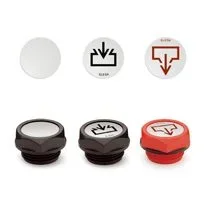
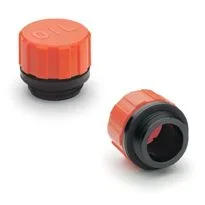
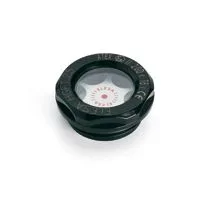
oil capElesa caps are 4 types:
- Load with drawing on the cap 7558_MH__p_i.webp (generic, load, exhaust) but without vent
- Exhaust with indication design on the cap 7558_MH__p_i.webp - general stopper or oil load or stopper - Load cap with vent 7599_SFN__p_i.webp- cap with level slide 8623_HGFT_ATEX_p_i.webpI would say that the types are very clear, just look carefully at the drawings and understand that a model has the exhaust hole in order not to push the room, the other is a stopper and just, the other has on the drawing on the hexagon and the other is transparent.
leafy thicknessesserve only and exclusively as shaving, i.e. as thickness that you can browse by hand cent at a time as long as you reach the correct size to make the pack bearings/spaces/shaft. have no ability to do hydraulic sealing even if in small applications it can also be satisfactory. are not springs, so the packing force is given purely by the tightening force of the screws with or without the dynamometric key. Clearly if it doesn't pack and the spacer can push, I'd say you can push the hat until you iron the tightening screws proportionally.
guarnizioni orindispensable when you mount caps and you do not want the drawing of oil between hat and case. excellent hydraulic seal even dynamic if we have sticks to make the switches mechanical (incists).
 
Do not normally use "magnetic" ones as exhaust caps?
View attachment 37027enigma
They cost too much! are used only for cars and gear systems that turn at 4000/6000 rpm and there is need to collect metal impurities. normally you work with gears with module 8/10/14 then you play 0.2 0.4 mm on your teeth...and you eat everything quietly. so no magnetic plug. even on bonfiglioli/rossi/piv etc. I have never found a magnetic cap. only on epicloid shorts.
 
Hi.
excuse the intrusion
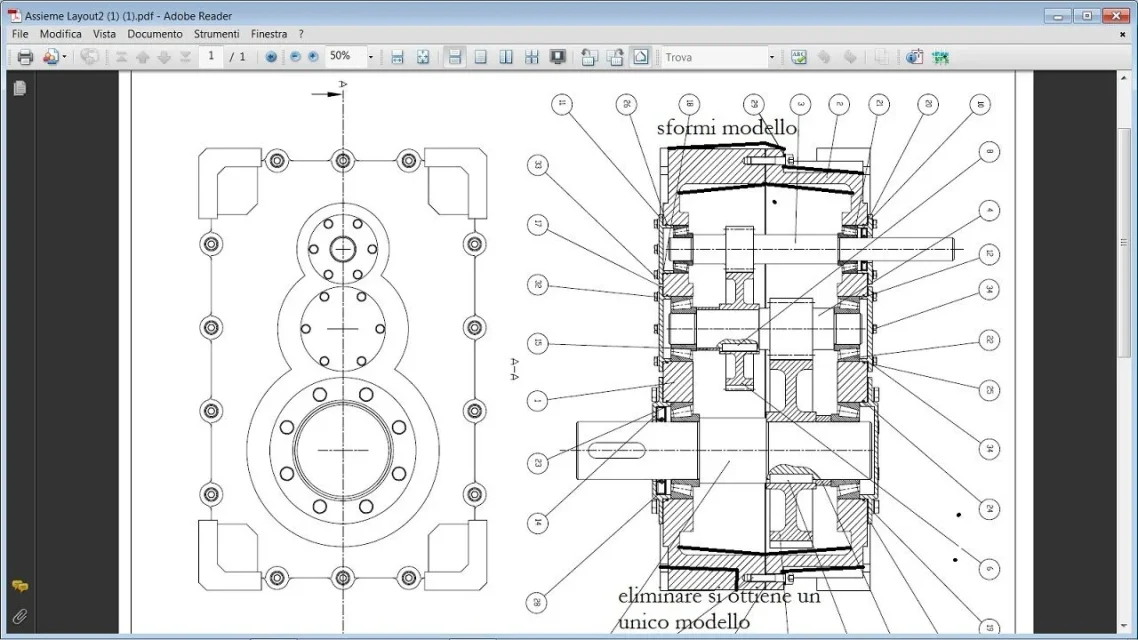
I saw the reducer's sez
the two shells perhaps are realized in fusion with the construction of its model and specific soul case

in case it is necessary to consider that in order to realize the whole perhaps it is necessary to realize the corners of the reform
outdoors safely
x the soul could be questionable to make them or not
I have not seen a sizing of the table
pero at least 0.50-1° disform or 2-3 mm of sheet to tighten the internal measurement
2-3 mm widening external measures
if you draw with sforms
perhaps changes the conceptuality of the spazzi
Thank you very much
 
Hi.
excuse the intrusion
I saw the reducer's sez
the two shells perhaps are realized in fusion with the construction of its model and specific soul case
Hi.
add to previous post a sketch
Moreover it is evident that with some modification
the two shells become symmetrical
so you avoid building two casting equipment
It's enough
Thank you very much
 

Attachments

  • Immagine.webp
    Immagine.webp
    97 KB · Views: 75
as "reference" I took the box of a bonfiglioli reducer, model hdp60. from cad bonfiglioli boxes all seem made with angles of 90, is it possible that they were made by fusion with corners of sform and worked subsequently?
 
as "reference" I took the box of a bonfiglioli reducer, model hdp60. from cad bonfiglioli boxes all seem made with angles of 90, is it possible that they were made by fusion with corners of sform and worked subsequently?
could be die casting and therefore with very reduced angles
Hi.
that kind of gearbox is in spheroidal cast iron gs 400-gs500/7
and is certainly produced with gravity fusion
the 2-3 d drawings that "download" from the web
serve only for the dimensions of bulk
in the sense that if you have to put them in a set they give you the security of feasibility
are not constructive designs and do not contain info on construction technology
in the annexed section. aa passes for the locking studs
I'm sure it's raw, so they have corners of puff
while the areas are working at the 4 corners
Thank you very much
 
I thought the case was aluminum.

also on the site it is written that the case is in spheroidal cast iron.
 
However those locations for oring it is better to put them on the lid rather than on the base, because it is easier to do the turning gorges rather than in milling. Bye.
 

Forum statistics

Threads
44,997
Messages
339,767
Members
4
Latest member
ibt

Members online

No members online now.
Back
Top