• This forum is the machine-generated translation of www.cad3d.it/forum1 - the Italian design community. Several terms are not translated correctly.

maximum cutting force of a screw.

  • Thread starter Thread starter Lucaallegrini
  • Start date Start date

Lucaallegrini

Guest
Good evening, everyone,
I am new to the forum, I just presented myself (I hope I caught the correct presentation section) and wanted to ask you an opinion if possible.
I have seen that the ntc standards 2018 indicate the formulas for the sizing of a bolt subjected to cutting.
in particular they provide the following formulation:Immagine 2022-12-18 161913.webpI asked myself a general question: If you want to know what would be the maximum cut force overcome which the bolt pulls (always if subjected to a cutting action), it is enough to use the above formulas by simply eliminating the coefficient darkens?
Then I also wondered, but what did that 0,6 do to the numberer? I thought it was a coefficient to be inserted to consider the fact that the term "ftb" is the traction breaking load, while here we are talking about cutting.
these were my reasonings, but I am not sure; What do you think?
I thank all those who can clarify my ideas.
 
I asked myself a general question: If you want to know what would be the maximum cut force overcome which the bolt pulls...reasoning is correct.
example:
bolt d12, class 8.8, ftb=8000 kg/cm2, area net of thread 0,843 cm2

break voltage per cut = 8000*0,6*0,843= 4046 kg.
then submitting the d12 bolt to a cut of 4046 kg, this breaks.
by "it breaks", it means that you reach the probability 5% break of the bolt.
if 100 bolts broke, 95 must break with a force greater than 4046kg and 5 for a lower force (Gaussian distribution).

more generally, the standard ntc2018 indicates the test formulas of the bolt for traction-cut, in which case the cutting resistance is reduced due to the effect of the traction.
below see the verification of the bolt d12 for only cutting, but there are general formulas for traction-cut.
Hi.Taglio.webp
 
Then I also wondered, but what did that 0,6 do to the numberer? I thought it was a coefficient to be inserted to consider the fact that the term "ftb" is the traction breaking load, while here we are talking about cutting.
in practice yes.
I am not experienced but, by memory, factors 0.6 or 0.5 come out of the theory for calculating cutting efforts.
in practice if you develop the theoretical mathematical model that leads to this formula (the concise of saint venant if I remember well), it turns out that, to cut, the resistant section of the "trave" is not to, but 0.6*a.

the durable section would actually be to, only for pure traction load.
 
What is that 0,6 to the numberer?
in a pure tangential voltage state, the equivalent voltage of von mises is rad(3) for the cutting voltage, the reverse does about 0.6, so the maximum cutting voltage is 0.6. the criterion of tresca is more restrictive is previewed that the maximum cut is instead half. eventually changes little.1672420171064.webp
 
in a pure tangential voltage state, the equivalent voltage of von mises is rad(3) for the cutting voltage, the reverse does about 0.6, so the maximum cutting voltage is 0.6. the criterion of tresca is more restrictive is previewed that the maximum cut is instead half. eventually changes little.View attachment 67235
Thank you very much davidex for clarification.
 
Good evening, excuse the trouble; I wanted to ask you an opinion on the cutting force applicable on a screw; I would also like to know what strength will be able to rinse the material of the screw.
I thought that just always eliminate the safety coefficient and replace the breaking load with the yielding load; according to you is correct how to approach the problem?
 
Good evening, excuse the trouble; I wanted to ask you an opinion on the cutting force applicable on a screw; I would also like to know what strength will be able to rinse the material of the screw.
I thought that just always eliminate the safety coefficient and replace the breaking load with the yielding load; according to you is correct how to approach the problem?
a screw faints when it exceeds the rinse. attention that the screws are calculated according to the standard.
Inventing strange things leads to making even gross mistakes.... 200%.
 
thanks to the mechanical responsemg and advice. I was wondering, but isn't the yielding voltage multiplied by 0.6?
 
some clarification: the breakup of bolts is fragile. therefore the phase of yielding is practically nothing. for that you do not consider it.
to specify that coefficients do not derive from von mises because they cannot be applied to elements with low ductility. It is precisely a theoretical limit of von mises (you can not have the homothetic enlargement of the breaking boundary but only of the yielding that in this case is almost null).
take a look at the old uni 10011 that maybe is more clear about it. there used a negative parabolic interaction diagram for the verification of bolts and the link between pure traction effort and pure cutting effort was obtained by simple rotation (cauchy) which led to divide by square root of 2. as it is still today; in fact 0,9/rad2=about 0.6.
Today the test formulas of ntc18 are different because they work with a negative linear interaction diagram with a cut edge (the verification formulas are always used in pairs i.e. pure traction verification + combined cutting/traction verification) but the base is the original one indicated in the old one.
 
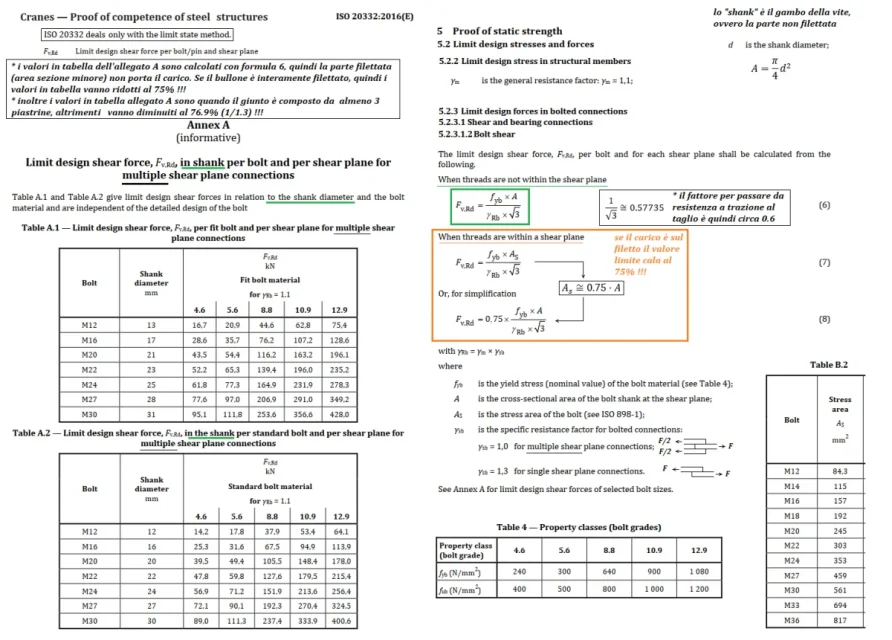
It is not to be pignolo, but the uni 10011 is based on mta (admissible tension method), while the ntc 2018 is based on msl (limited state method), I do not know if you can compare or if you do something; but the dependence on the rad factor(3) is also proven by the iso 20332 cap 5.2.3.1.2 bolt shear formula (6), which explicitly indicates it, see the following extract from the norm:1677072743698.webp
 
thanks legs and davidex for answers.
If I can give youdex, I would like to ask you for clarification; supposing, therefore, to neglect the plastic tract of the cut screw, but in case you want to simulate this cutting force on the screw I can want to set a linear simulation; i.e. since the plastic tract is almost null, when I exceed the breaking voltage I can interpret this as the bolt break.
Is that correct as reasoning? Thanks anyway for the help.
 
I have the 1988 version. reports both checks to limit states and those to eligible voltages.
then it can be that the concept of the ball can be extended also to this particular case. At the end of the day, he rules the trial and if he says it's okay, then okay.
 
... a linear simulation;...
I will try to answer you if I understand what you mean: the simulations (finished elements) always provide an incredible number of complex hypotheses and reasonings, which then one must take back and interpret. . .


I can't tell you whether it makes sense or not your reasoning, but realize that for steels to make static and linear fem simulations (not in the plastic field) both with guesttresca criterion (a little more restrictive) that con vonmises (which is the classic reference model for example on many simulators) is quite consolidated. the plastic field does not even take it into consideration therefore (then the fact that a bolt is permanently deformed is certainly not a thing that can go well and I think it is comparable to a break).

then how to choose the limit value, it is another pair of sleeves, because you know that those values, both of yielding and of breaking in traction are statistical and usually are also the minimum values (type a screw class 8.8 are 800mpa break and 640mpa of minimal yield); Moreover usually the safety coeff. in a calculation code for a bolt is different than for another component even if dimensionally identical (perhaps this is not an exact science) so imagine to simulate fem a m10 or a tondo with the equivalent diameter, for the simulator are identical, but for the code they would have 2 fairly different admissible values; cmq regarding the verification of bolts there is an endless series of building codes, standards, regulations and legislation, which is to be asked, because you want to go to take this responsibility to make your personal considerations, if you are planning with a code follow that, for such a simple component is the most logical thing to me, leaves the fem for much more complex geometries that you can not easily schematize. in any case the truth of when it actually breaks the bolt certainly does not find it with these calculations because these formulas serve more to verify that the bolt does not break, to know actually when breaking the only way is to do tests and measure the maximum load of breakage.
 

Forum statistics

Threads
44,997
Messages
339,767
Members
4
Latest member
ibt

Members online

No members online now.
Back
Top