
• This forum is the machine-generated translation of www.cad3d.it/forum1 - the Italian design community. Several terms are not translated correctly.

modellazione dice

  • Thread starter Thread starter Mito125
  • Start date Start date

Mito125

Guest
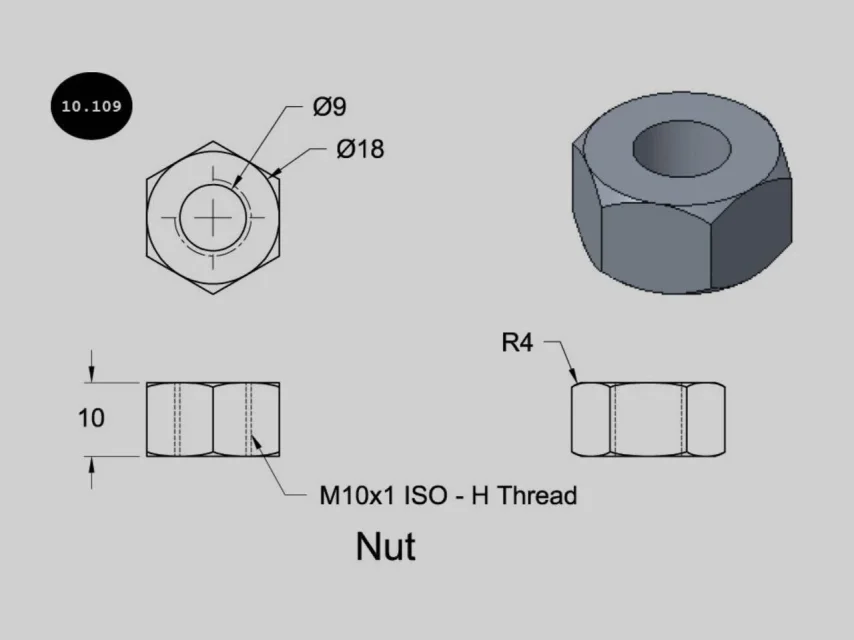
Hello, I have this detail to model:1.webpI don't understand that r4. resuming a drawing book used for the compnetrations, it is written that a nut is made by the compnetration of a hexagon with an isoscele triangle with an angle at the top of 120°. This is in the manfè-pozza-scarato. I tried to make a r4 connection but did not jump out as I imagined the "savasatura" that is instead present in model 3d (made with creo). You know how to treat that value?
but it's another problem. should the dice not always have a symmetry axis? They didn't clean it up, did they?

Thank you.
 
the fact of the r4 is technically wrong because the turning is done to degrees and unspoiled....who has quoted that dado I think technical drawing knows nothing.
That diameter 9 doesn't mean anything.
the axis of symmetry takes us because the hole is a solid of negative revolution.
if it is a m10 the pre-light is not 9.
It's better that you take a nut m10 and a caliber and see how it is done.

with any cad you will do it....the procedure is This is what.
 
Last edited:
It makes no sense even the ø18 being:
to the circle written in the hexagon
b the resulting diameter from the bevel (or ray)

instead lacks the size of the width of the hexagon, dimension that is indicated in all the catalogs and tables of the dice; you quote the width both because so you start from hexagonal threaded bar both because you know that hexagonal key you have to use.
 
Okay, there's a lot of problems in these quotes. It's a book I took to learn creo, so far there have been small quotation problems but I've always been able to figure out what they wanted to indicate, but now in the last 3 chapters they started to get high... sin because 9 chapters were also cute.. .

I will look at the video but I think I will go to the eye in modeling this detail, I have their model 3d and they have shaped like in the video, which I did too but that still does not allow to get that r4...

I have ignored diameter 9 because so much does not serve in modeling, on creo choose the hole you want to do and does not ask you how to do it in reality (prefores and centrings). . .

18 diameter I used it like that. I did the hexagon, I made the inner circle and put it tangent with the constants, I quotated the circle making the hexagon so of the right size because of the tangency bond... I would not have quoted either so but at least with this data you can trace back to a modeling method. . .

thanks to explanations
 
good morning mito125, try to take a look at the attached document.

as it has already correctly answered mechanicalmg, the r4 share does not make any sense.

the edge of a hexagonal nut or the hexagonal head of a screw is beveled by turning.
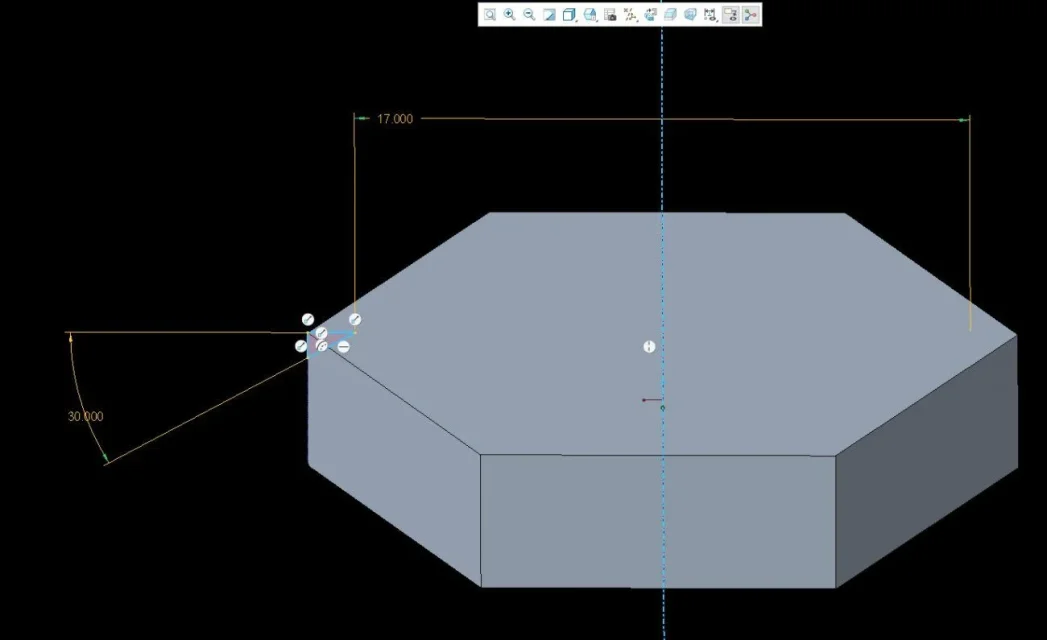
as to say that if you want to replicate this processing as on the actual details, you do not have to use the fitting feature, but remove the excess material, for example as in the second attachment.

greetings
 

Attachments

  • DESIGNAZIONI.pdf
    DESIGNAZIONI.pdf
    1.1 MB · Views: 11
  • bandicam 2020-07-15 11-43-49-160.webp
    bandicam 2020-07-15 11-43-49-160.webp
    17.7 KB · Views: 6
thanks for the further explanation. In fact I have always done so but the drawing to be modeled provided me with that quota which I think was strange;)
 
I allow myself to participate only x highlight that the thread is quoted m10x1, so the foreskin must be ø9.
if the design is "didactic" this indication can be inserted to make it more evident that the thread is "end pass", then it serves a different preforus, in the case ø9.
I too, in my little one, when I come across fine steps I evide them in this and other unorthodox ways to be more than sure that the "Monday morning" who is in turn aggorga and don't touch us throw the piece...

and usually a m10 is in a hexagon from 17mm, not 18... if one wants to build it like that, very free.

I think, moreover, that neither the "line stems" relative to the threaded hole are exact.

(ihmo: I would say that that text of drawing is definitely under the sufficiency )
 
the text was intended to teach to use creo, which more or less has reached. this, along with other incorrect designs, were inside. I probably would have treated them more, but in the end creo was explained pretty well with well developed examples. as a technical design I think there are more indicated books (I will always remain in my heart the manfè pozza discarded even if dated and not updated to today's regulations).

I don't understand. I indicate what I want m10x1, then the operator will verify the data needed to get that thread. Am I right?
 
x m10x1 you're right.
For before me, they warned you that ø9 made no sense to put it. but between theory and practice...
 
the text was intended to teach to use creo, which more or less has reached. this, along with other incorrect designs, were inside. I probably would have treated them more, but in the end creo was explained pretty well with well developed examples. as a technical design I think there are more indicated books (I will always remain in my heart the manfè pozza discarded even if dated and not updated to today's regulations).

I don't understand. I indicate what I want m10x1, then the operator will verify the data needed to get that thread. Am I right?
creo drilling tables, have by default the note with thread size, hole size, hole depth and thread depth.
Obviously this note is a "heavy" moment in many contexts, normally or you create ad hoc tables (starting from those present) or edit these tables and only the notes that interest you.
 
everything is fine to learn, but let's see what is clearly wrong, at least.
Bada, it is not to make controversy, but to help us avoid errors in the real world:
if you send in the workshop that design, the operator sees that must drill ø9; but if, for any reason, male only to roar the correct preforum is not ø9, but ø9,5÷9,6, which is "very different".
so arise doubt, etc, if you are lucky,
loses time to pierce 2 times if you are so,
first he sees against all the saints in heaven because the male does not enter and then against ut because they give him "menga" drawings if you are hurt.

Unfortunately the technical drawings should not leave room for personal interpretations because they should contain all, and only, the neccessarie information to the construction of the piece.
I personally think that table is really wrong, not just hurt. and it is not an excuse that should serve as "tutorial" x any sw. In fact, maybe it's even worse.
I, io, finished the "course" I would take the brigade to censor in red, or blue..., errors in the book and make it to the editor. I wouldn't need much anyway at some point.
and know that I know I'm wrong to draw.

end ot, preach, dick and who puts it more.
;)
 

Forum statistics

Threads
44,997
Messages
339,767
Members
4
Latest member
ibt

Members online

No members online now.
Back
Top