
• This forum is the machine-generated translation of www.cad3d.it/forum1 - the Italian design community. Several terms are not translated correctly.

obtain loads on certain areas

  • Thread starter Thread starter Dmaz
  • Start date Start date

Dmaz

Guest
Hello, everyone.
if I solve with a structural analysis a complete model formed by different volumes separated from some areas and then I wanted to determine the extent of forces on certain areas how can I do?
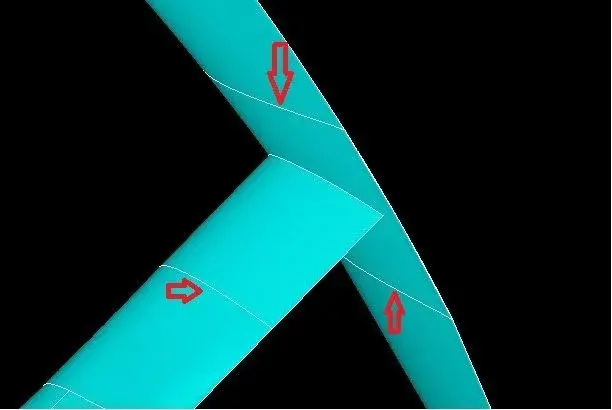
I would need to know the forces n, t and the moments m acting on the areas indicated by the red arrows to study then in detail the set area in figure. that is to know the extent of the loads to be applied to the ink brush to be tested in the laboratory
I thought of selecting the nodes of the area and then doing postproc - nodalcalc - total force sum.
is this procedure correct?
Thank you.
dmaz
 

Attachments

  • Immagine.webp
    Immagine.webp
    11.9 KB · Views: 8
Thank you very much!
One last question.. as a measuring unit I used
size: [mm]elastic modules: [Pa]density [kg/cm3]angle speed [rad/s]as results I have: deformations [mm] e tensioni [Pa], of this I am sure, I checked it with an academic exercise.
as regards the sum of the Nod forces on one of those areas (cylindrical system) comes out a result of fx (due to the centrifugal force of a rotating mass) pairs to 0.104578e10 when from a fairly simplified calculation paper and pen should be 1136n therefore I assume that the forces in output are multiplied of an e6 i.e. [N*e6].
for one of those moments on that area comes out me 0.339652e12: the unit of measurement of the moment therefore is the product of the units of measurement in otuput i.e. [e6*N]* [mm] ?
Is the reasoning correct?
Thank you as always!
 
Consistent measuring units, right?
Look at that risk of madness!
1- choose newton-meter-second, and then you have density in kg/m^3, modules and stress in pa and moments in nm
2- choose newton-millimeter-second, and then you have density in kg/mm^3, modules and stress in mpa and moments in nmm

You make this choice right now because sooner or later you get hurt... :tongue:
 
in fact the units in ansys always fans me crazy! :smile:
the units of measurement should be consistent, I checked them long ago simulating in ansys the behavior of a rotating disk calettato on a tree of which I had calculated the analytical solution previously.(I attach the result file if you want to throw an eye!)
if I use the combination 1 with meter-second therefore density in [kg/m3], pressure and modules in [Pa] Everything is fine, I get as a result tensions calculated analytically in [Pa].
I would like to use the millimeters but with combination 2 that you told me I get completely different results! I keep checking if I was wrong to set something up but it seems to be all right.. the solution instead is square if I use millimeter-second, density in [kg/cm3], modules and pressures [Pa]: In this way the voltages on the disk assume the correct trend and the output values are expressed in [Pa]. the problem is that I have no analytical feedback on the values of the forces and moments I should get. .
 

Attachments

the attached pdf has errors. in order:
1-the mesh displayed in the figure is not a brick but to solid tetraedri186.
2-the density of 7.8e-6 is in kg/mm^3 and not in kg/cm^3 (it would be 7.8e-3)
3-in the last page of the pdf the units are inconsistent.

I repeat, look at the consistency of the units of measurement.

n-m-s -> density kg/m^3, tensions in pa
n-mm-s -> density kg/mm^3, tensions in mpa
 
I'm sorry if I ask you again, but I want to understand this. . using the millimeters with the measuring units you told me I can't find the analytical solution of the rotating disk.
if you can give us an eye I attach the log files of the 3 models (between one and the other only change the units of size, density, elastic module, internal pressure to the disk).
the first has measurements in meters and solving the main tensions sigma 1 and sigma 3 have the trends of tangential and radial tensions (image file of the analytical solution). the same for the third model with the units I told you I'm using.
I can't understand why if I use the units of measurement of the second model I get totally different results and deformations some orders of magnitude higher than reality (if I interpret them as millimeters). .
I also wanted to ask you, for coherent units, do you mean mathematically right? I mean, they have to be the units of the same accounts that I would do by hand, don't they?
regarding the pdf, the density I wrong to write it, I excon the results if I use 7.8e-3 as you see from the log file of the soluz3..
 

Attachments

hi dmaz I checked your files and actually with the millimeters the result is totally high.
disabling the angular speed the accounts return, so there must be something that is wrong (or more likely that I escape) in the calculation of the centrifugal forces.
I still take time to think about it.
Meanwhile I attach a summary input file for other users who want to hit their head in this problem!
 

Attachments

Consistent measuring units, right?
Look at that risk of madness!
1- choose newton-meter-second, and then you have density in kg/m^3, modules and stress in pa and moments in nm
2- choose newton-millimeter-second, and then you have density in kg/mm^3, modules and stress in mpa and moments in nmm

make this choice right away because sooner or later you get hurt.. .
I have always used the following measurement units:
newton-millimeter second. density in ton/mm^3. modules and stress in mpa and moments in n*mm.
In this way I express the accelerations in mm/s^2. the forces due to centrifugal acceleration are therefore: [mm/s^2]*[ton/mm^3]*[mm^3]=[ton*mm/s^2]=[1000*kg*m/1000/s^2]=[kg*m/s^2]=newton.

I see no other way to use the mm.
wave
 
wave, I deserve to be fused for my pressapochism!
You're perfectly right.
In terms of dimensional analysis I deserve a nice 0/30.
 
wave, I deserve to be fused for my pressapochism!
You're perfectly right.
In terms of dimensional analysis I deserve a nice 0/30.
normally your posts are accurate and very interesting. Although I haven't used ansys for many years, I've known it for the graduation thesis and consider it superior to nastran in many points, then you go where the company takes you, and to me it brought on patran/nastran.
Hi.
wave
 
perfect now the accounts come back!
do not worry stefano the important thing is to understand where you are wrong and get to the correct solution! :smile:
you have already solved a lot of doubts in the use of ansys in recent months, you are really an expert in this field!
useful the apdl file you did for the units of measurement (I had done it myself in its time but nn I find it more!). if it can be useful to other users I can fix the pdf so you would have a single tutorial for measuring units and for cylindrical symmetry that could be another critical point.
 

Forum statistics

Threads
44,997
Messages
339,767
Members
4
Latest member
ibt

Members online

No members online now.
Back
Top