• This forum is the machine-generated translation of www.cad3d.it/forum1 - the Italian design community. Several terms are not translated correctly.

parallel oleodynamic distributor

  • Thread starter Thread starter Patrick Gorza
  • Start date Start date

Patrick Gorza

Guest
Good morning forum!
simple question (and for many banal):
having an oleod pump. delivers 160 lt/min and aligning it to 2 oleod distributors. connected in parallel, will the extent to users be given by the sum of the range of 2 distributors (80+80=160 lt/min), if they are operated simultaneously?
Thank you.
Patrick.
 
Yes, if the two parallel hydraulic distributors are operated simultaneously, the pump will deliver a range of 160 l/min, equally divided between the two distributors (80 l/min for each distributor). therefore the sum of the rates of the two distributors will actually be 160 l/min.
if there is no opening by-pass, so come in and out.
 
Yes, if the two parallel hydraulic distributors are operated simultaneously, the pump will deliver a range of 160 l/min, equally divided between the two distributors (80 l/min for each distributor). therefore the sum of the rates of the two distributors will actually be 160 l/min.
if there is no opening by-pass, so come in and out.
thanks for the answer, as usual, mechanicmg.
 
thanks for the answer, as usual, mechanicmg.
...the problem will not so much dimensional the exit from the distributors, which is usually 1/2" each, as the entry to only hydraulic cylinder, which is the purpose in question. looking at the formula q=a⋅v and taking into account viscosity, loss of load, etc. I believe that 3/4" is not enough and needed instead of 1" which is really exaggerated (as is the cylinder in question, among other things... )
 
Good morning.
Honestly, I have some doubt about the fact that the flow is equally between the two distributors. I think the flow is equally divided between the two distributors only if the two users are exactly the same and put to work in the same conditions. If this is not the scope, it will depart differently between the two distributors. I make an example:
Suppose we have the two parallel distributors connected to two identical linear actuators (called for simplicity 1 and 2) as in the circuit represented in the image below (or attached). on the actuator n° 1 is applied a constant load in double compression compared to the one applied on the actuator n° 2 (f1=2xf2). this means that the pressure in the lower chamber of the actuator n°1 is double than in the lower chamber of the actuator n°2. because the pressure upstream of the two distributors the same, being connected in parallel, but the downstream one not, for the reason just explained, according to me the flow through the two distributors will be different. in particular the flow through the distributor connected to the actuator n°1 will be lower than that of the distributor connected to the actuator n°2.
let me know if I made the idea and/or if I say heresies. Thank you.1704354522121.webp
 
Good morning the gibernaut.
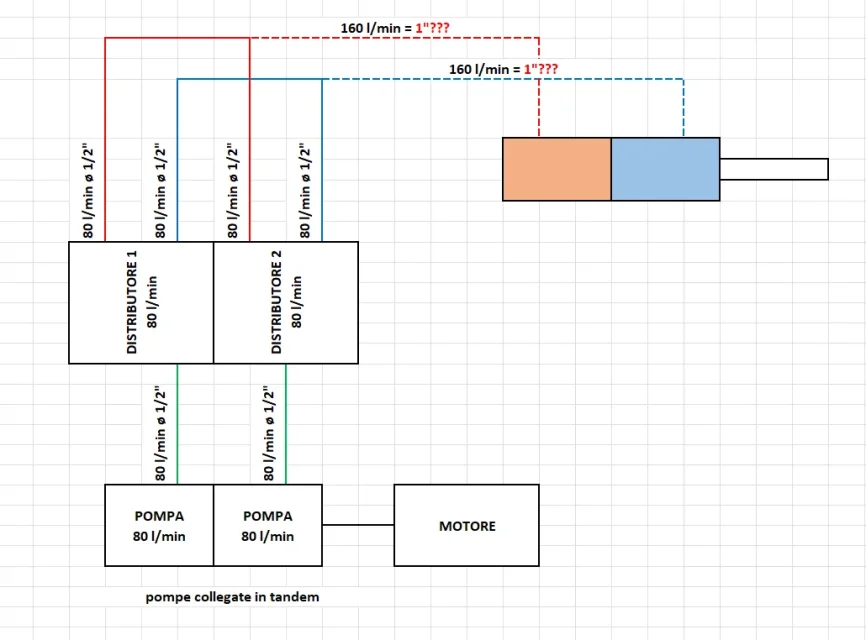
I attach a very simple design of the subject in question.
the problem is to dimension the tube that collects both outputs/inputs of the distributor towards/from the oleod cylinder.
I believe that 1" is excessive. . .dim. tubi.webp
 
Good morning the gibernaut.
I attach a very simple design of the subject in question.
the problem is to dimension the tube that collects both outputs/inputs of the distributor towards/from the oleod cylinder.
I believe that 1" is excessive. . .View attachment 69987
the inch measurements of hydraulic and hydraulic pipes, are met with these problems, even if not perfect, as you have to talk about the internal section of the pipes, i.e. flow rates and not diameters.
even if the thumb is less than twice the half inch, as a measurement of diameters, its flow rate would be well higher than double, than the half inch.
that's why there's 3/4" between them, which is the only measure you can and you need to use in your connections.
 
Good morning.
Honestly, I have some doubt about the fact that the flow is equally between the two distributors. I think the flow is equally divided between the two distributors only if the two users are exactly the same and put to work in the same conditions. If this is not the scope, it will depart differently between the two distributors. I make an example:
Suppose we have the two parallel distributors connected to two identical linear actuators (called for simplicity 1 and 2) as in the circuit represented in the image below (or attached). on the actuator n° 1 is applied a constant load in double compression compared to the one applied on the actuator n° 2 (f1=2xf2). this means that the pressure in the lower chamber of the actuator n°1 is double than in the lower chamber of the actuator n°2. because the pressure upstream of the two distributors the same, being connected in parallel, but the downstream one not, for the reason just explained, according to me the flow through the two distributors will be different. in particular the flow through the distributor connected to the actuator n°1 will be lower than that of the distributor connected to the actuator n°2.
let me know if I made the idea and/or if I say heresies. Thank you.View attachment 69985
In fact, as it was assumed at the beginning and as you affirm, the rates are equal if, in parallel connection, everything is double with equal measures.
However, the pressure must not be confused with the flow rate, since, in a closed circuit, the pressure is always exerted with equal measure on each smaller part of the contact surface. physics law.
who then determines the force of thrust, will be the formula: f (force) : superfice = pressure.
In order to achieve a greater degree of pressure, it will be necessary to act on a larger surface.
 
Good morning the gibernaut.
I attach a very simple design of the subject in question.
the problem is to dimension the tube that collects both outputs/inputs of the distributor towards/from the oleod cylinder.
I believe that 1" is excessive. . .View attachment 69987
Good morning patrick,
First of all, I didn't realize it was a pattern as in the figure. I think it's better to detail it right away to avoid misunderstandings.
However if the problem is the sizing of the tube as in figure quoto the answer of @marco f inox . Consider that the area of a 3/4" tube is 2.25 times that of a 1/2" tube." or more than twice. this means that in the 1/2" tube section you will have a pressure drop per unit of tube length even lower than the one that you have in the 1/2" tube that brings half the flow.
 
Good morning patrick,
First of all, I didn't realize it was a pattern as in the figure. I think it's better to detail it right away to avoid misunderstandings.
However if the problem is the sizing of the tube as in figure quoto the answer of @marco f inox . Consider that the area of a 3/4" tube is 2.25 times that of a 1/2" tube." or more than twice. this means that in the 1/2" tube section you will have a pressure drop per unit of tube length even lower than the one that you have in the 1/2" tube that brings half the flow.
thanks to the clarification. therefore a 3/4" is more than enough. . .
 
the inch measurements of hydraulic and hydraulic pipes, are met with these problems, even if not perfect, as you have to talk about the internal section of the pipes, i.e. flow rates and not diameters.
even if the thumb is less than twice the half inch, as a measurement of diameters, its flow rate would be well higher than double, than the half inch.
that's why there's 3/4" between them, which is the only measure you can and you need to use in your connections.
Thank you, Marco. being therefore the 3/4" greater than 2,5 times the 1/2" I see it indicated as connections/valve/cylinder.
 
In fact, as it was assumed at the beginning and as you affirm, the rates are equal if, in parallel connection, everything is double with equal measures.
However, the pressure must not be confused with the flow rate, since, in a closed circuit, the pressure is always exerted with equal measure on each smaller part of the contact surface. physics law.
who then determines the force of thrust, will be the formula: f (force) : superfice = pressure.
In order to achieve a greater degree of pressure, it will be necessary to act on a larger surface.
Good morning.
Thank you for the correction. I agree with your analysis.
 
Good morning forum!
Now there is the problem of setting up the above mentioned hydraulic circuit.
I was assuming two alternatives and here I need your expertise:
-the first is to connect the two distributors (autocycle type) to a single drive lever and set the two distributors to different pressures, so that above a certain "strength" one is excluded to avoid the shutdown of the tractor for excessive power demand.
-the second is to operate both levers (and therefore not connected) until a certain effort and then release one in neutral position and continue only with the other until completed release.
in both cases during the return of the stem, not being effortless, both levers will be activated, to increase its speed.
I attach a simple hydraulic scheme, missing safety valves necessary for proper operation.
I ask you if it is possible to add to my attachment (or with other representation), the necessary valves (not return, maximum, etc.) and their position, at the completion of the circuit.
I look forward to your advice and of course your comments for any idiocy I have expressed in the formulation of the project. . .
Thank you.
Patrick.
 

Attachments

  • Circ. Idr..webp
    Circ. Idr..webp
    27.1 KB · Views: 6
Hello, I would first put a tarable valve, between the outlets of the distributors and the inlet of the plunger, with direct discharge of the overload in the tank, with possible non-return valve.
By doing so, you can calibrate this valve at the maximum capacity that can be endured by the tractor and, at the same time use at your discretion one or both distributors, depending on the need.
I would therefore leave the two free and independent distributors.
As the piston rod is present in the return warrant, there is already an increase in return speed, which could also be enough.
 
Hello, I would first put a tarable valve, between the outlets of the distributors and the inlet of the plunger, with direct discharge of the overload in the tank, with possible non-return valve.
By doing so, you can calibrate this valve at the maximum capacity that can be endured by the tractor and, at the same time use at your discretion one or both distributors, depending on the need.
I would therefore leave the two free and independent distributors.
As the piston rod is present in the return warrant, there is already an increase in return speed, which could also be enough.
Thank you, Marco.
 
Good morning forum!
Now there is the problem of setting up the above mentioned hydraulic circuit.
I was assuming two alternatives and here I need your expertise:
-the first is to connect the two distributors (autocycle type) to a single drive lever and set the two distributors to different pressures, so that above a certain "strength" one is excluded to avoid the shutdown of the tractor for excessive power demand.
-the second is to operate both levers (and therefore not connected) until a certain effort and then release one in neutral position and continue only with the other until completed release.
in both cases during the return of the stem, not being effortless, both levers will be activated, to increase its speed.
I attach a simple hydraulic scheme, missing safety valves necessary for proper operation.
I ask you if it is possible to add to my attachment (or with other representation), the necessary valves (not return, maximum, etc.) and their position, at the completion of the circuit.
I look forward to your advice and of course your comments for any idiocy I have expressed in the formulation of the project. . .
Thank you.
Patrick.
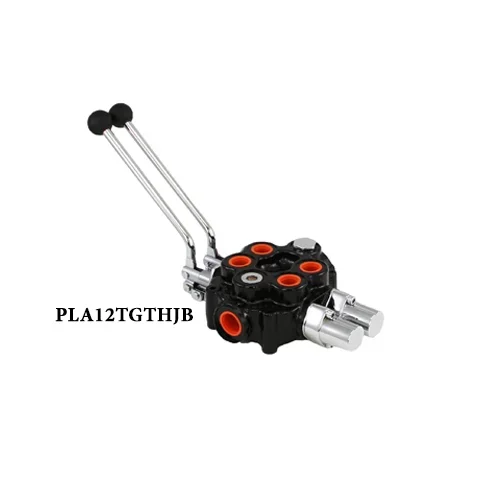
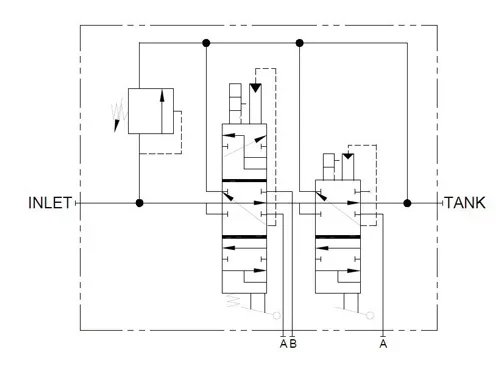
hello, could you please share the autocycle distributor scheme you would like to use? I looking on the internet I found the pattern of this block with 2 distributors (at this link) autocycle type. If you want to use this type of block for me not clear how to integrate this into the circuit that you designed.1704660848243.webp1704660606386.webp
 
hello, could you please share the autocycle distributor scheme you would like to use? I looking on the internet I found the pattern of this block with 2 distributors (at this link) autocycle type. If you want to use this type of block for me not clear how to integrate this into the circuit that you designed.View attachment 70002View attachment 70001
Good morning, the gibernaut.
I would like to communicate with you by name, more than by nickname. Anyway it is your choice, at the end of discussion, to sign by name or not...
returning to our circuit, I reassessed the use of a autocycle as, if not mistaken, while being a double spool distributor, the management of flows is regulated by one output and therefore not able to support the 160 l/min required.
At the end I think I will have to opt for a simple effect distributor, with leverage block in both uses.. .
 

Forum statistics

Threads
44,997
Messages
339,767
Members
4
Latest member
ibt

Members online

No members online now.
Back
Top