Sanbimu
Guest
Hello everyone, I ask this question because maybe I did not understand how the dentate wheels work, or simply took a bark or who knows it.
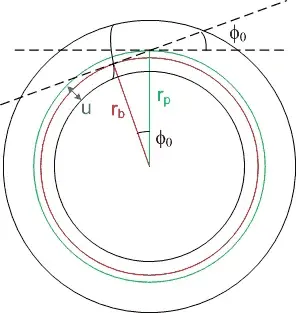
By doing some checks with a wheel produced by the manufacturer, relying on his data on the data sheet, I realized that a basic radius of the foot comes out.
the wheel is a simple toothed wheel with straight teeth of module 1.5 with tooth number z=19 and primitive diameter 28.5.
considering a pressure angle of 20° the basic gage from where the evolving profile starts:
radius_base = radius_primitive*cos(20) = 13.39
while the foot radius considering it placed at a distance of 1.25*m from the primitive comes out:
radius_piede = radius_primitive - 1.25*1.5 = 12.37
Also considering a dedendum of m (and not 1.25*m) I always get a value lower than the base radius. you can not consider a lower dedendum because it must always be greater than the addendum that is equal to m.
how is it possible that the tooth foot is lower than the basic circumference?
I need to reproduce such dense rout but how can I do it? Is everything normal? I was wrong with the calculations, am I wrong with considerations or what?
thank you in advance to those who will be able to explain the matter well.
By doing some checks with a wheel produced by the manufacturer, relying on his data on the data sheet, I realized that a basic radius of the foot comes out.
the wheel is a simple toothed wheel with straight teeth of module 1.5 with tooth number z=19 and primitive diameter 28.5.
considering a pressure angle of 20° the basic gage from where the evolving profile starts:
radius_base = radius_primitive*cos(20) = 13.39
while the foot radius considering it placed at a distance of 1.25*m from the primitive comes out:
radius_piede = radius_primitive - 1.25*1.5 = 12.37
Also considering a dedendum of m (and not 1.25*m) I always get a value lower than the base radius. you can not consider a lower dedendum because it must always be greater than the addendum that is equal to m.
how is it possible that the tooth foot is lower than the basic circumference?
I need to reproduce such dense rout but how can I do it? Is everything normal? I was wrong with the calculations, am I wrong with considerations or what?
thank you in advance to those who will be able to explain the matter well.
 .
.