
• This forum is the machine-generated translation of www.cad3d.it/forum1 - the Italian design community. Several terms are not translated correctly.

project lines in a plan

  • Thread starter Thread starter Betoniera
  • Start date Start date

Betoniera

Guest
Good morning, everyone.
I'm a strutturist.
Before calculating a structure I build a 3d model unifilare with autocad which then amounts the model in the calculation program.
It often happens that when designing inclined rods such as the axes of a ladder's cosmos, the terminal points of these rods do not intersect with the horizontal rods of the upper plane, despite the accuracy of the design.
It is, almost always of small errors of some traction of millimeter but, for me, the intersection of the knots and the flatness of the rods is fundamental, otherwise you have problems in the calculation.
it would be useful to have a lisp program that projects the lines on a plan identified by the user so as to ensure the subsequent intersection of the auctions.
gp had provided me, in the past, a similar program that works well, but projects lines only on the xy plane in the global system.
I would need a more generic one projecting the lines on a generic plan.
I kindly ask if someone has such a program.
Thank you, hello to all
 
I don't know if I can help you but I have such a problem with the files I need to print in 3d and that require the perfect coincidence of the vertices, otherwise the network created by the vertices is "cut" and generates errors.
when I am tired of problems, especially on broken drawings several times on some parts, and I find myself missing coincidences caused by the approximation of float calculations, I do something drastic and rustic but that works.
dxfout of the parts that have problems, asking to round only 4 decimals.
you could ask more, it depends on the measuring unit you use, critical decimals start from the eighth.
then I gate these parts, and the re amounts from the dxf, flared by the decimal extremes flot that cause these scented points among themselves.
 
it would be useful to have a lisp program that projects the lines on a plan identified by the user. . .
I tell you how to create it: (setq pp (cal "ilp(p1,p2,p3,p4,p5)))))the function calculates the pp point of intersection between the line (p1,p2) and the plan that passes by the points (p3,p4,p5).
found that point you can replace it at the end point of the line.
 
Hello, everyone.
the problem I have placed is to find the intersections of lines not perfectly flattened in any plan.
intersections between lines are essential for import into structural programmes.
I found an ingenious solution that partially solves the problem, but it's okay in 99% of cases. so I make it available so to be useful to others who have the same problem.
First of all, I better explain the problem to better understand what it is.
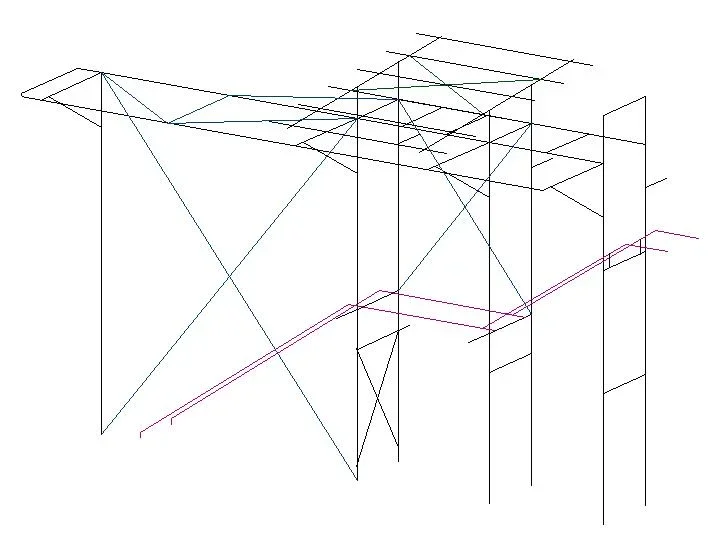
this below is a unifilament frame of a steel structure where only axles are represented which then will become steel beamsStruttura1.webpIt is a load bay to inspect the tanks,
on top there is a small tilted roof and in the middle are drawn the axes of the thighs of the stairs.
now, you want for small import errors, you want the copy command of the lines is not exactly aligned with the axes, it happens very often that the lines do not intersect even paying much attention to the design for which, for example the scale does not lean on the below rods. the attempt to correct these small errors leads, generally to worsen the situation, to lose a lot of time and, often to have to remake the design.
but, in the vast majority of cases, alignment plans are always either vertical or horizontal.
I had already written in the past a lisp that changed the share of the objects by intervening in the database and changing the coordinate z.
therefore it is not a problem to align objects horizontally to the desired quota.
with regard to vertical alignment it is sufficient to rotate objects of 90 degrees and then align them and then return to rotate them of -90 degrees.
It works.
in the figure below is explained better what the program does.Struttura2.webphorizontal alignment is indicated by the pq point (quota floor)
vertical alignment is indicated by pq and p2 points
selecting the entities these are projected as indicated by the red color.
the program, called alpi.lsp (flat alignment) is not defined as function, therefore, if you want to try it, type (load "beams").
I will not be as good as gp and others, but sometimes some good idea comes to me too. What do you say?
Hello everyone
 

Attachments

Forum statistics

Threads
44,997
Messages
339,767
Members
4
Latest member
ibt

Members online

No members online now.
Back
Top