• This forum is the machine-generated translation of www.cad3d.it/forum1 - the Italian design community. Several terms are not translated correctly.

reducer and manoeuvre flyer sizing

PiE81

Guest
Good morning.
I am making a sizing to turn a platform by 90°. weight 300 kg, baricentro about 250mm from the rotation axis.
I had thought of using a 340mm diameter manoeuvre handwheel connected to an endless screw reducer. hypothesized a 1:30 report, I have that on the flyer, less than the yield (which will probably not be negligible), a force of about 15kg is required. what can be an acceptable value for manual handling?
the size and choice of the reducer I have to make it on the maximum torque (output), in my case 750nm?
Thank you.
 
hi, you will know already but if you need it and it is an application in safety also controls the irreversibility (up to i=1:28 generally there are no problems, but you must always check the angle of the propeller). If you need to know how force you need to turn the flyer to comply with the rules check as well but 15 kg surely fall (otherwise from tomorrow I have to remake all the accounts on the plants and hope not! >- < < < < < < < < >- < < < < < >- < >- >- < < >- < . the sizing takes into account the friction pairs that develop in the reducer but hypothesize a yield of 50% (it is required double input power) , to the eye the calculation seems to me correctly , you should be able to move it without too many problems. However the last question is not clear to me...you mean if you need to understand if the outgoing couple should not exceed that request from the manufacturer?
 
x calender: Irreversibility with i=28 is a data that comes from direct experience or is there a calculation criterion? I had negative experiences (that is, I was hoping for irreversibility but there was no...) with much higher relationships, even if with gearboxes of excellent invoice and performance, so a little more easily reversible . Also for safety regulations it is enough to declare "autonomously" the irreversibility of the chosen reducer or need it to be declared by the manufacturer of the reducer? once on the bonfiglioli catalogs there was an asterisk on the irreversible relationships but I never found it in the last editions.
 
I had seen on a catalog that irreversibility depends on i, but I think I can get rid of this requirement.
I have not found regulations (at least from a fast search), but I am pleased that you say that 15 kg are adequate.
about the last question, you mean that. or in the catalog of the gearboxes, according to the size I see a maximum torque and a maximum power.
I have no problem with the power. but the outgoing couple is relatively high.
hi, you will know already but if you need it and it is an application in safety also controls the irreversibility (up to i=1:28 generally there are no problems, but you must always check the angle of the propeller). If you need to know how force you need to turn the flyer to comply with the rules check as well but 15 kg surely fall (otherwise from tomorrow I have to remake all the accounts on the plants and hope not! >- < < < < < < < < >- < < < < < >- < >- >- < < >- < . the sizing takes into account the friction pairs that develop in the reducer but hypothesize a yield of 50% (it is required double input power) , to the eye the calculation seems to me correctly , you should be able to move it without too many problems. However the last question is not clear to me...you mean if you need to understand if the outgoing couple should not exceed that request from the manufacturer?
 
hi to everyone, this topic has already been treated at least a couple of times on the forum, that is to make a mass around a distant horizontal axis x.
so first you go to look at the discussions already made.

According to the machinery directive, it is necessary to look at the standard for the ergonomics of man-made loads, see one iso 11228-2 and other annexed rules. it is obtained that if the handwheel is made to " navel" height and with a radiant frequency can reach about 15kg. in complete ergonomics, there are coefficients that estimate the "fatigue to repeated cycles", because you don't need two crank turns....but you have to unleash and therefore the actual useful load to be evaluated on a project is reduced to 10 kg.

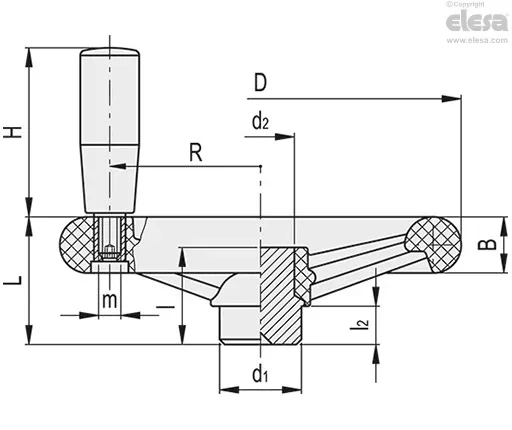
if you use a flyer ofthe, the largest has a radius of 160 mm and is already among those that begin to be not very manable because the more the radius increases and then the more you have to move back.1602186295157.webptherefore 100n of hand multiplied 0.16 m of arm makes the man exercises 16nm of incoming torque.
If you have to win 3000n of force multiplied arm 0.25 m you will have an outgoing pair to win of 750nm.
to have the minimum reduction ratio, that is what multiplies the incoming couple to give the outgoing one, you have to do 750/16 = 47.
So if you take a reducer with i=28 you will never make it to generate a sufficient couple if you don't put on weight at the flyer.
keep in mind that all this works with 100% performance. If you take an endless screw reducer you will have a yield around 60/70%, and this is strength you lose in friction and do not use to win your outgoing load.

Since the man is lazy you can't expect more than one round per second, then 60rpm rotation regimen... at most if he is young he arrives at 90rpm.

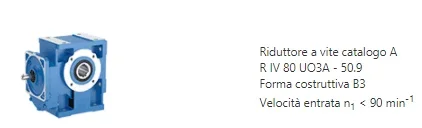
going to the catalog (online configurator) of red gearboxes, you will get this reducer.
1602185849236.webpthat as you can see from pdf file has 62% yield and this means that to get 750nm out, with i=50.9 ratio you need in input 14.7nm that are generated by a total of 23nm considering the yield of 62%. This means that it will actually take 14.5kg of force on the crank....so we are at the limit of the application. ...and increase the reduction ratio a little more or increase the crank radius.

keep in mind that this reducer is not irreversible and therefore to be safe it needs a mechanical brake upstream to ensure that the load does not roar during the abandonment of the flyer.

These are the accounts, without acceleration.
then regulations stick a lot for these applications, especially if there are people and things on the platform and near.
 

Attachments

x calender: Irreversibility with i=28 is a data that comes from direct experience or is there a calculation criterion? I had negative experiences (that is, I was hoping for irreversibility but there was no...) with much higher relationships, even if with gearboxes of excellent invoice and performance, so a little more easily reversible . Also for safety regulations it is enough to declare "autonomously" the irreversibility of the chosen reducer or need it to be declared by the manufacturer of the reducer? once on the bonfiglioli catalogs there was an asterisk on the irreversible relationships but I never found it in the last editions.
with the endless screw gearboxes it is necessary to go beyond i=90 to have proven irreversibility with weight attached to the exit shaft and abundant sling.
ratio i=15 - 30 - 60 are reversible less and less to rise of the report but if you attack an exit lever.... piano begin to turn.
 
the selection of the gearboxes, in the catalogue, must be made by imposing the output couple that must be greater or equal to that required. if it is greater, the ratio between the required torque and torque will be the service factor or oversized.
the reduction ratio is what you have to go to look at and the number of turns out or incoming...depending on the paper or digital catalog.
If you use a performance configurator, such as that of red gearboxes, you can already determine the gearbox for you.
It is not your case, but the gearboxes must also be verified at heat disposal capacity.
certain that these concepts, for a technical office person who puts in his profile the use of kisssoft, must be much more than assimilated. are at the base of the mechanics of the gears and the transmission of the bike.

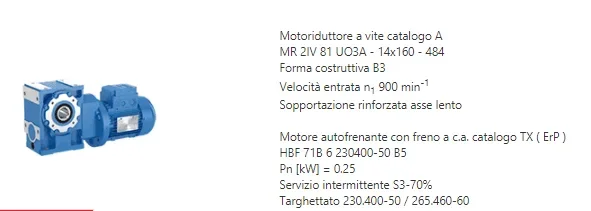
All in all, if you can bring 400v three-phase, I suggest you put an electric motor with alternating current brake on the motor, so that it does from parking brake when you do not apply the torque to the engine. Moreover if you reduce even more, since a motor will turn to 1000rpm, you will also have more chance to go towards an irreversibility of motion and therefore greater safety of the application.

you will get this item:1602188218651.png
 

Attachments

Last edited:
x calender: Irreversibility with i=28 is a data that comes from direct experience or is there a calculation criterion? I had negative experiences (that is, I was hoping for irreversibility but there was no...) with much higher relationships, even if with gearboxes of excellent invoice and performance, so a little more easily reversible . Also for safety regulations it is enough to declare "autonomously" the irreversibility of the chosen reducer or need it to be declared by the manufacturer of the reducer? once on the bonfiglioli catalogs there was an asterisk on the irreversible relationships but I never found it in the last editions.
hi, the concepts are linked to the angle of the propeller, above a certain value (I go a little by memory but should be 20) there is a full reversibility, below a certain value (if I don't remember badly 3°) there is a full irreversibility. for the type of application in question, also speaking with the technicians of the varvel in the past (340 kg to 200 mm of arm) I was given that value but I confirm that there are catalogs to rigurado and however we used a pneumatic brake. However, irreversibility is a subtle concept, if there is a very high load and light vibrations, even with full irreversibility the load could descend (you create micro internal contacts). This happens especially when the reducer is rode (suits adapted to the lip, counting points polish..), this happened for example in one of our applications. for which if the application determines a risk for people working in the area for example it really takes a brake (in the case of motor, use an autofrenant).
According to the machinery directive, it is necessary to look at the standard for the ergonomics of man-made loads, see one iso 11228-2 and other annexed rules.
but if you use a flyer without a knob? Is the speech equal? from us for example use two arms to move them and therefore the couple with equal strength doubles because you do not consider the radius but the diameter (ruoting with two hands) ... then it is also true that the forces are not perfectly radial however but I admit that I do not have much technical culture of the regulations in regard ... so I care to better understand these details of regulations.... (provided that following this concept none of the customer operators ever complained or did not receive complaints >-< )
 
but if you use a flyer without a knob? Is the speech equal? from us for example use two arms to move them and therefore the couple with equal strength doubles because you do not consider the radius but the diameter (ruoting with two hands) ... then it is also true that the forces are not perfectly radial however but I admit that I do not have much technical culture of the regulations in regard ... so I care to better understand these details of regulations.... (provided that following this concept none of the customer operators ever complained or did not receive complaints >-< )
Forgive me but a round a second with two hands you can't do, so the couple is given with the knob and one arm.
with two hands you make only adjustments.
However, they are things that in the legislation are more or less explained and that is why we talk about ergonomics of movements.
 

Forum statistics

Threads
44,997
Messages
339,767
Members
4
Latest member
ibt

Members online

No members online now.
Back
Top