
• This forum is the machine-generated translation of www.cad3d.it/forum1 - the Italian design community. Several terms are not translated correctly.

resolution "cinematism"

MikLikeDrugs

Guest
Good morning.
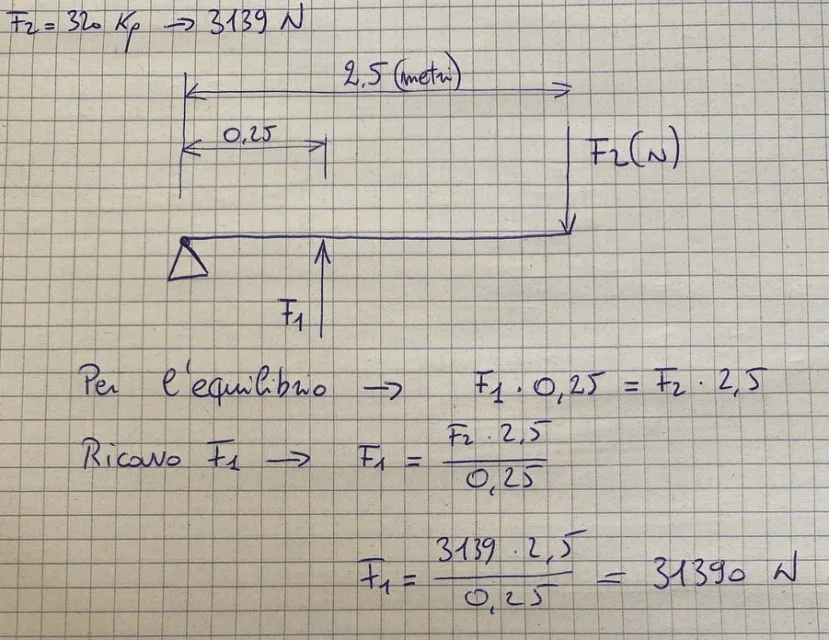
I'm back here asking for help. I am in the design phase of a pneumatic cylinder, I have just been given the application (extremely spannometric and superficial): This is a cylinder that will raise a bar hinged at one end (lg. 5000mm weight 320kg). the assembly previews that you create a lever of third genus; what I care about is how to calculate the minimum f force to raise the bar; My problem is that I don't know how to "convert" the weight of the bar (I imagined you can see it as a distributed load) in a force at the end of the bounce.
allego pdf.

I also found this thread (https://www.cad3d.it/forum1/threads/come-calcolare-questo-cinematismo.20684) but I didn't get the same.
 

Attachments

just consider the weight strength of the bar applied to its center.
actually so I could find the moment in point c. but later I do not know how to find binding reactions being not an isostatic structure.
the point of the question would be to find the minimum force applied at the point and useful to raise the bar (transcuring frictions and what else). I would need to understand how to find a data based on which to size the cylinder.
 
actually so I could find the moment in point c. but later I do not know how to find binding reactions being not an isostatic structure.
the point of the question would be to find the minimum force applied at the point and useful to raise the bar (transcuring frictions and what else). I would need to understand how to find a data based on which to size the cylinder.
Why isn't hetastatic? However, do the balance of moments around the zipper and you should solve.
 
Hi.
I have attached you a fast simulation of your application. I wanted to try to simulate motion of solidworks and took the opportunity of your request.

Keep in mind that in the output values of the video I sent you the system is ideal and you have no friction. increases the right forces when size the cylinder.
In addition, in the simulation, I put the cylinder in good sense and the race is not what you requested...it should be refined everything. ..however, last info, in the simulation the action of the actuator works in 4 seconds.

ps.: you could dimensional the cylinder without much contour considerations for this application.

Good job!1620658031288.png
 

Attachments

Last edited:
actually so I could find the moment in point c. but later I do not know how to find binding reactions being not an isostatic structure.
the point of the question would be to find the minimum force applied at the point and useful to raise the bar (transcuring frictions and what else). I would need to understand how to find a data based on which to size the cylinder.
What's the point? calculates the moment generated by the weight of the landing by applying it to its centerpiece (which if it is a constant profile, corresponds to half of its length). knowing that you will apply your cylinder to 250 mm from the fulcrum, calculate the force necessary to lift the bar as if it acted perpendicularly to the axis of the bar. then, since the cylinder is tilted, with the trigonometric calculations the force that must have the cylinder. add some friction and the game is done. the bars in horizontal position will constitute the worst condition, so as the bars rise, the effort will decrease.
 
Hello, I have attached you a fast simulation of your application. I wanted to try to simulate motion of solidworks and took the opportunity of your request. Keep in mind that the output values of the video I sent you the system is ideal and you have no friction. increases the right forces when size the cylinder. in the simulation I put in common sense the cylinder and the race is not what you requested...it would be refined everything...however the action of the actuator works in 4 seconds. Good job!View attachment 62080
it would only miss the trigonometric calculation due to the inclination of the cylinder, for the rest it is as I said.
 
Why isn't hetastatic? However, do the balance of moments around the zipper and you should solve.
should not have the same number of degrees of bond and freedom?
Hi.
I have attached you a fast simulation of your application. I wanted to try to simulate motion of solidworks and took the opportunity of your request.

Keep in mind that in the output values of the video I sent you the system is ideal and you have no friction. increases the right forces when size the cylinder.
In addition, in the simulation, I put the cylinder in good sense and the race is not what you requested...it should be refined everything. ..however, last info, in the simulation the action of the actuator works in 4 seconds.

ps.: you could dimensional the cylinder without much contour considerations for this application.

Good job!View attachment 62080
firstly interesting the latest motion. I have solid, but I never even thought of such an application. As far as the exercise is concerned, I do not understand why you have speculated f2=320kg when in reality it would be the weight of the beam itself or, as suggested by me, the load distributed over the entire beam.

Unfortunately it has gone too long from schools and I really remember little: eek::eek:
What's the point? calculates the moment generated by the weight of the landing by applying it to its centerpiece (which if it is a constant profile, corresponds to half of its length). knowing that you will apply your cylinder to 250 mm from the fulcrum, calculate the force necessary to lift the bar as if it acted perpendicularly to the axis of the bar. then, since the cylinder is tilted, with the trigonometric calculations the force that must have the cylinder. add some friction and the game is done. the bars in horizontal position will constitute the worst condition, so as the bars rise, the effort will decrease.
I meant the minimum force applied in point "b".
 
should not have the same number of degrees of bond and freedom?

firstly interesting the latest motion. I have solid, but I never even thought of such an application. As far as the exercise is concerned, I do not understand why you have speculated f2=320kg when in reality it would be the weight of the beam itself or, as suggested by me, the load distributed over the entire beam.

Unfortunately it has gone too long from schools and I really remember little: eek::eek:


I meant the minimum force applied in point "b".
Look at the two formulines I posted.
 
the calculation system is very similar to what we've done several times on the forum for opening up shovels or hangers with gas springs.
basic is the barycentric point and trigonometry of the triangle that is formed. depending on the opening angle you have a decrease in the strength of the cylinder.
 
the calculation system is very similar to what we've done several times on the forum for opening up shovels or hangers with gas springs.
basic is the barycentric point and trigonometry of the triangle that is formed. depending on the opening angle you have a decrease in the strength of the cylinder.
would you have a reference link? I'd like to watch it!
thank you in advance, give
 
Look at the two formulines I posted.
I didn't want to, but I didn't get the procedure:
- I do not understand the formula q*l^2/2;
I don't understand equality, like, because it disappears when you get fy? is the sum of moments not equal to zero only in the isostatic beams?
the calculation system is very similar to what we've done several times on the forum for opening up shovels or hangers with gas springs.
basic is the barycentric point and trigonometry of the triangle that is formed. depending on the opening angle you have a decrease in the strength of the cylinder.
in fact I had seen some discussions (see links below https://www.cad3d.it/forum1/threads/come-calcolare-questo-cinematismo.20684) that have about the same problem, indeed, my perhaps is more trivial. but I couldn't understand the procedure to deal with everything.
 
balance equations always apply, both in static and in kinematics. when there is a degree of freedom, then the system is isovinculated (not labile), all that is not discharged into the constraints or does not counterbalance with the resistant forces, goes to speed up the system and generate movement.

but the balance of forces and moments is always worth, that your beam has one, three or fourteen thousand constraints. in hyperstaticity changes the resolve procedure because you have more incognite than fundamental equations, but at the end of the resolution, the sum of reactions still equals the external forces that apply.
 
I didn't want to, but I didn't get the procedure:
- I do not understand the formula q*l^2/2;
I don't understand equality, like, because it disappears when you get fy? is the sum of moments not equal to zero only in the isostatic beams?


in fact I had seen some discussions (see links below https://www.cad3d.it/forum1/threads/come-calcolare-questo-cinematismo.20684) that have about the same problem, indeed, my perhaps is more trivial. but I couldn't understand the procedure to deal with everything.
q= distributed load (n/mml)newton on linear millimetre.
the rest is the resolution of a simple isostatic schematic.
 
Good morning.
I'm back here asking for help. I am in the design phase of a pneumatic cylinder, I have just been given the application (extremely spannometric and superficial): This is a cylinder that will raise a bar hinged at one end (lg. 5000mm weight 320kg). the assembly previews that you create a lever of third genus; what I care about is how to calculate the minimum f force to raise the bar; My problem is that I don't know how to "convert" the weight of the bar (I imagined you can see it as a distributed load) in a force at the end of the bounce.
allego pdf.

I also found this thread (how to calculate this cinematicism) but I didn't get the same.
this lever is disadvantageous so you will have to use a force greater than that of the resistance of 320 kg. you have to imagine concentrating the weight of the bar in half, in point h. the relationship you need to calculate f is this: f x ab equals 5000 x ah from which f is equal to 5000 x ah divided ab. It is then necessary to take into account other components such as the position of the fulcres and of attack of the cylinder.
 

Forum statistics

Threads
44,997
Messages
339,767
Members
4
Latest member
ibt

Members online

No members online now.
Back
Top