• This forum is the machine-generated translation of www.cad3d.it/forum1 - the Italian design community. Several terms are not translated correctly.

russian overcraft

  • Thread starter Thread starter rinato
  • Start date Start date

rinato

Guest
Hello, can anyone explain why the Russians (and probably the others) have overcrafts in the military fleet? What advantages do they give? only the landing on low ground?
because, given the video of the Russian capatina in the baltico, it seems to me that the surprise effect if you play it well before the landing, with the cloud of water that lifts (and I do not dare imagine the noise), and if they put under water the horses of frisia, ahi want with the "canotto".

I mean, what's the point?
Greetings, reborn.
 
one of the reasons is that if they pass over an anti-tank mine they do not blow it, there are videos where they pass over eggs without breaking them.
 
landing means, can quickly overcome obstacles, mines, beaches and arrive in the hinterland downloading entire divisions without need of ports and infrastructure
 
I saw on dmax the other Sunday that can also carry tanks. It was impressive to see how in the middle of a storm they managed to load tanks from a carrier.
 
bhè, the overcraft that do not break the eggs are certainly not military means, while if you look at American or Russian videos, that at some point you have to stop, to land means and troops, I doubt that they can not trigger some kind of mina, from sgongs.
But I have to clarify that under naja they did not want me, so I miss the fundamentals.
 
Mines are always a problem but still manageable. the task of these means is to quickly download large quantities of heavy materials behind an existing bridgehead and "safe". Alternatively, large battle media should be downloaded from existing docks or infrastructure or to be built after months. it is also possible to try fast landings on "lontane" beaches or however not defended to download heavy means to bypass or widen the front of any bridgehead. you can consider mobile pontoons able to move quickly and transfer really heavy material close to the troops "read" (paracadutisti, marines or other) after just a few hours.
 
Okay, so it was the Russian maneuver "out of catalog", since if the overcraft is a second wave medium, in the estonia there was no sign of vanguards or bridgeheads. admitted and not allowed that it was really and/or only an exercise.
 
Okay, so it was the Russian maneuver "out of catalog", since if the overcraft is a second wave medium, in the estonia there was no sign of vanguards or bridgeheads. admitted and not allowed that it was really and/or only an exercise.
Apparently it was an exercise and that the crew had a mile wrong beach. things that happen...:eek:
 
hovercraft is a vehicle supported by air cushion and moved by one or more propellers. according to what can be found on the internet, at the moment there is no world norm for the detailed definition of "air cushion vehicle" so for some a hovercraft can be classified as belonging to the class of aircraft and in that area, can be defined as a support aerodynamics by direct reaction (the quoted "air cushion") . with the term aerodynamics is meant to be more heavy. for others instead it is part of the class of the boats, although it does not have propellers immersed in water.
hydrodynamically it is considered as a boat with an air hull but that maintains floating capacity even with the inflation cushion. amphibious performance is allowed by the perimetric fuse of the constantly produced air, which creates a "fast" lubricant. initially the edge was rigid and to create a veil sufficiently often were necessary great powers, the invention of the perimeter skirt and single skirts later, which adapt to the asperity of the soil as a soft seal, allowed to greatly decrease the thickness of the air veil and the necessary powers.

historically the medium has uncertain origin.
Apart from improbable projects dating back to 1716 of arm-powered air cushion vehicles, in 1870 the thornycroft engineer built prototypes whose purpose was to create an air cushion between hull and water surface to reduce friction. They did not find any application and it was necessary to arrive in 1959, thanks to the development of the intubate propellers, before they were able to realize a means that was actually employable. Sir christopher cockrell, with simple experiments made using a vacuum engine and two cylindrical cans showed that it was possible to make a vehicle capable of moving on different types of surfaces thanks to an air cushion. the major novelty he introduced was a jet system able to confine the air cushion under the vehicle. the air cushion allowed to move on muddy soils, water, swamps as if it were on compact soils. the British aircraft manufacturer saundersroe developed the first hovercraft capable of carrying a man, the sr-n1 with which many tests were conducted between 1959 and 1961 (with the first public demonstration in 1959) including a sleeve crossing. it was thus discovered that it was possible to increase the capacity of "sustainment" with the addition of a "tube with a gonnelle" of flexible rubberized canvas between the surface and the hull, with the purpose of "containing the air" under the hull and have a "flagging" effect if minimal in the air.
the sr-n1 is now exhibited in a former base of the wroughton raf transformed into a science museum.http://www.sciencemuseum.org.uk/wroughton/This is the link to the hovercraft museum:http://www.hovercraft-museum.org/index.htmlthe first hovercraft, able to cross the sleeve in two hours, although unable to carry a payload, gave impetus to research and led to the introduction of inflatable tubes, fans and other efficient solutions. After two years, in 1961, the vickers va3 began the connection service between the coasts of the galles transporting passengers then, in 1970 the largest hovercraft entered service until then realized. was the sr-n4 that ceased service in 2002, defeated by the operating costs and the competition of the tunnel under the sleeve. but high costs have not prevented military development where the speed, speed and launch skills have been appreciated, and especially for its versatility in crossing different composition surfaces (ground, water, ice). the Americans realized the landing craft air cushion (lcac), in service since 1986. 26.4 meters long and 14.3 meters can load up to 75 tons of material and men reaching thanks to the gas turbine motorization, the 70 knots.

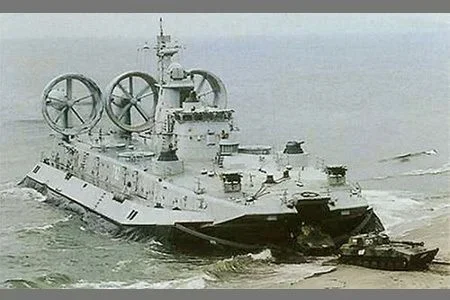
after the fall of the sedan wall, the West realized that in the meantime the Soviets had realized some real giants who were baptized by the born Hovercraft class zumro and katalyna, huge hovercraft were able to carry entire wards in any weather condition and on any battle ground offering undue tactical advantages seen the ability to approach the coasts, where to almost dump means and men, with no means. High speed, easy manoeuvrability, great load capacity, multiple usage, indifference and insensitivity to the surface roughness traveled, invisible to radar and sonar, in military versions, make the hovercraft a unique and irreplaceable medium. the hovercraft that wrong course is finished among the wet unbelievers, is a class pomornik (born code) actually called in Russian "project 1232.3 class zubr" whose production began in 1987. are the greatest means of the genus ever made, 57,3 meters long, 25,6, 21.9 high have a displacement full load of 550 tons. and are powerfully armed thanks to two ak-630, an automatic cannon from 30 mm to 6 rotating rods cooled to water, with a shooting cadence of 3000-5000 hits per minute, with radar control 'bass tilt' that disjoined from the affected Moreover light missiles ir, launchers for the coastal bombardment of type bm-122 navalized.
made of aluminium-manganese alloy, has the hull divided into three compartments in turn divided by longitudinal wallpapers. in the central compartment are placed the armored vehicles (3 middle wagons) while in the lateral ones there is the motor apparatus consisting of 2 almaz m-70 fans for the support and swelling of the air cushion, while 3 others operate the huge propulsive propulsive propulsive propulsive propulsive propulsive propuls, intubated, of 5.5 meters (the tubes have a diameter of 6 m). the 5 gas turbines have a power of 11,800 hp each . the inflating of the cushion is obtained with 4 2.5 m fans arranged on the sides of the load compartment. the speed is 60 knots. in the upper part of the hull can be accommodated 180 soldiers.

Hovercraft was classified as a penultimate invention in the transport sector, before the space shuttle.
68848-450x-h_22.webp68829-450x-h_3.webp68843-450x-h_17.webp68847-450x-h_21.webp
 

Forum statistics

Threads
44,997
Messages
339,767
Members
4
Latest member
ibt

Members online

No members online now.
Back
Top