• This forum is the machine-generated translation of www.cad3d.it/forum1 - the Italian design community. Several terms are not translated correctly.

size fork denture.

  • Thread starter Thread starter Iason
  • Start date Start date

Iason

Guest
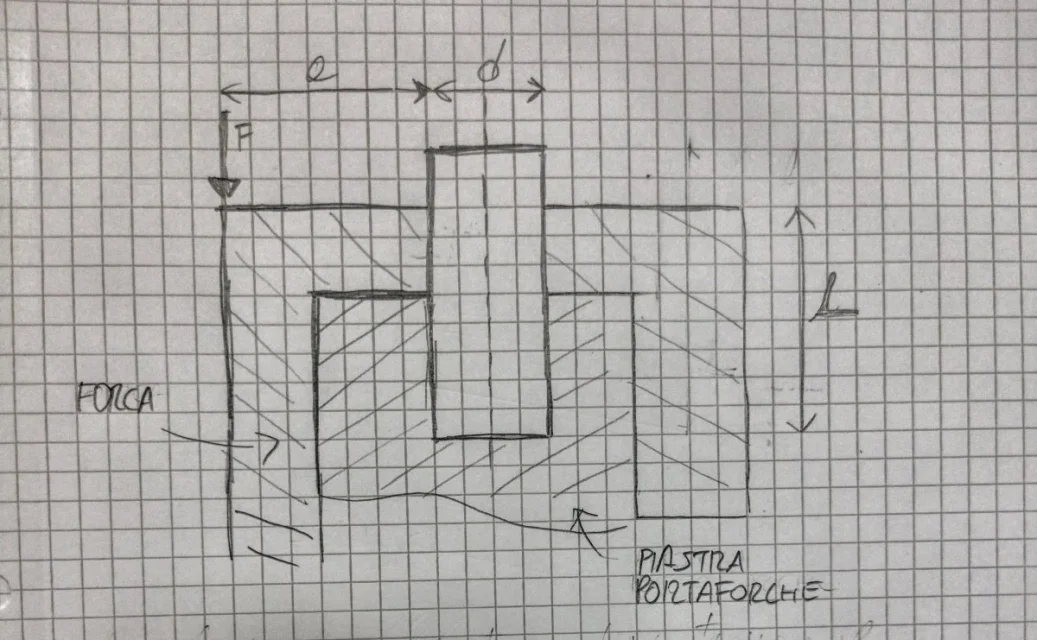
good evening to all, I would have a question to ask you, I am preparing a project for the construction examination of machines for the three-year mechanical engineering. specifically I am designing the lift group of a forklift. are in difficulty with the sizing of the pin that prevents the translation of the fork against the fork holder. I have the possibility to choose from catalog the components but I would like to justify the choice made with considerations on the loads agents on the pin. would you tell me how to approach the problem? I attach an indicative pattern, where f represents the load on the fork. I ask forgiveness in advance for the dissatisfaction of the question, unfortunately after doing the second year including construction science I left the university for almost ten years and so at the moment I have big gaps on it.
 

Attachments
  • IMG_20240501_165621.webp
    IMG_20240501_165621.webp
    125.8 KB · Views: 22
Last edited:
good evening to all, I would have a question to ask you, I am preparing a project for the construction examination of machines for the three-year mechanical engineering. specifically I am designing the lift group of a forklift. are in difficulty with the sizing of the pin that prevents the translation of the fork against the fork holder. I have the possibility to choose from catalog the components but I would like to justify the choice made with considerations on the loads agents on the pin. would you tell me how to approach the problem? I attach an indicative pattern, where f represents the load on the fork. I ask forgiveness in advance for the dissatisfaction of the question, unfortunately after doing the second year including construction science I left the university for almost ten years and so at the moment I have big gaps on it.
Bye. It is not clear the pattern but that pin if it is orthogonal to the forks....what load should it take? Nothing... if...1714579904478.pngif the f force is the red vertical of the image (force weight/2) you will not have horizontal components as long as you do not prone forward or backward the holes.
Keep in mind that if it's the pens that don't show the prolongation of the fork you have over f multiplied coefficient of friction... and that doesn't move the extension. then the rest makes it to cut and bending the pin.
normally the pin is horizontal and goes to the bottom.1714580263795.pngIf you put it upside down, it doesn't allow you to load to the bottom.

and then vertically it can fall into the ground and it's not good for security....it's horizontal.

if instead you refer to the snap lock that is there when you set a width of forks, you have the same consideration before and1714580631405.pngyou have to consider using the tipping model with the maximum weight and rotated 90°:1714580497093.pngyou put the maximum load on it and the pushbutton should not be cut.
If you don't have the tipping model you should calculate the maximum strength that can generate the mule against the wall that beats the tip of the shovel.

however the force weight if not rough if it brings the whole door forks in its seat.1714580974879.webp
 
Last edited:
Bye. It is not clear the pattern but that pin if it is orthogonal to the forks....what load should it take? Nothing... if...View attachment 71097if the f force is the red vertical of the image (force weight/2) you will not have horizontal components as long as you do not prone forward or backward the holes.
Keep in mind that if it's the pens that don't show the prolongation of the fork you have over f multiplied coefficient of friction... and that doesn't move the extension. then the rest makes it to cut and bending the pin.
normally the pin is horizontal and goes to the bottom.View attachment 71099If you put it upside down, it doesn't allow you to load to the bottom.

and then vertically it can fall into the ground and it's not good for security....it's horizontal.

if instead you refer to the snap lock that is there when you set a width of forks, you have the same consideration before andView attachment 71101you have to consider using the tipping model with the maximum weight and rotated 90°:View attachment 71100you put the maximum load on it and the pushbutton should not be cut.
If you don't have the tipping model you should calculate the maximum strength that can generate the mule against the wall that beats the tip of the shovel.

however the force weight if not rough if it brings the whole door forks in its seat.View attachment 71102
Thanks a thousand of the answer, yes the pattern is unclear, I refer to the pin for snap locking on the fork holder, I do not expect to use the tipping model, but I predicted the shredding. so if I have understood correctly in vertical load conditions and without inclination of the holes I do not have to make special checks? instead if I planned the staging forward I should see if there is a cutting component on the pin?
 
Thanks a thousand of the answer, yes the pattern is unclear, I refer to the pin for snap locking on the fork holder, I do not expect to use the tipping model, but I predicted the shredding. so if I have understood correctly in vertical load conditions and without inclination of the holes I do not have to make special checks? instead if I planned the staging forward I should see if there is a cutting component on the pin?
if you consider branding forward is not the pin it holds.
there is the half-tailed guide of swallow that carries the load even forward.
 
if you consider branding forward is not the pin it holds.
there is the half-tailed guide of swallow that carries the load even forward.
Thank you very much now. I take advantage to ask another question (but if necessary I can open a new thread); always regarding the fork plate, on a similar project that I am consulting as a guideline, a dimensioning of the "dent" on which the fork would rest. A certain force is taken, however, that I cannot determine, it is calculated as an equivalent effort such a force f fractures the sloped surface to the tooth, and this effort is imposed lower than the admissible stress known the material and the safety coefficient. I can't find anywhere a verification of this kind, which in the text I'm following is called "plasticization", is a correct verification in this case? How can I determine, in case, the actual load agent on the tooth? I attach an image of the upper part of the plate with the teeth highlighted the surface to, and the calculations that are made. Thanks mile and I apologize if I ask too much.
 

Attachments

  • dimensionamento.webp
    dimensionamento.webp
    26.2 KB · Views: 9
  • piastra portaforche 2.webp
    piastra portaforche 2.webp
    16.2 KB · Views: 8
You don't need to open a new topic.
Too many teeth on the blade door.
your shovel carries half the total load of the pallet you lift.
Depending on the width of the shovel and width of the shovel door traits there will be one/two/three slanted plane areas that carry the weight indicated before.
simply is making a contact pressure check to see if one of the two (because it should be done on both pieces) is fingerprinted or not.
Actually the tooth of the blade door will be a shelf that reacts to bending and cutting.
Screenshot_20240501_203302_Samsung Notes.jpgtherefore the forces and reactions on the fork are these:
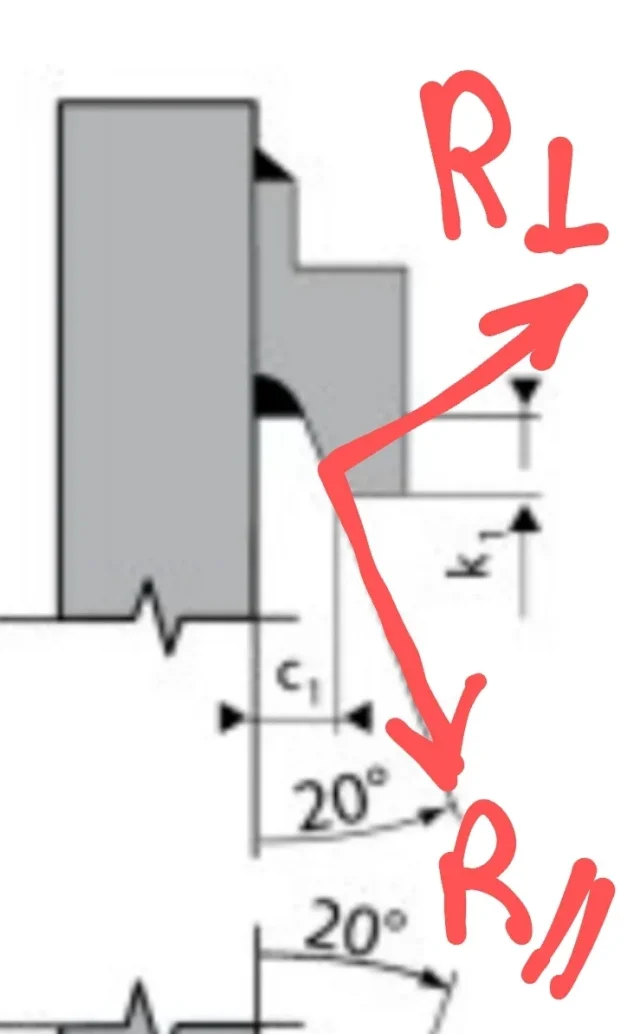
capacity1~2.jpgthen the reactions at the top must be split on the 20° dowel.Screenshot_20240501_205220_Photos.jpgr perpendicular is the force that presses on the area of the calculation above.

decomposition of a vector along two lines assigned​

you have assigned a carrier
immagine-lafisika-53.png
and two unparalleled straights r ed s we want to find two components vectors that have the right direction r ed s and that give as sum, that is as resultant, the given vector
immagine-lafisika-53.png
.
immagine-lafisika-54.png
from the summit the parallels are drawn to the straights r ed s to intersect in points p e q. joining the point o con p e q you get the components
immagine-lafisika-56.png
.
if aprà:
immagine-lafisika-57.png
 
Last edited:
You don't need to open a new topic.
Too many teeth on the blade door.
your shovel carries half the total load of the pallet you lift.
Depending on the width of the shovel and width of the shovel door traits there will be one/two/three slanted plane areas that carry the weight indicated before.
simply is making a contact pressure check to see if one of the two (because it should be done on both pieces) is fingerprinted or not.
Actually the tooth of the blade door will be a shelf that reacts to bending and cutting.
View attachment 71105therefore the forces and reactions on the fork are these:
View attachment 71106then the reactions at the top must be split on the 20° dowel.View attachment 71107r perpendicular is the force that presses on the area of the calculation above.

decomposition of a vector along two lines assigned​

you have assigned a carrier
immagine-lafisika-53.png
and two unparalleled straights r ed s we want to find two components vectors that have the right direction r ed s and that give as sum, that is as resultant, the given vector
immagine-lafisika-53.png
.
immagine-lafisika-54.png
from the summit the parallels are drawn to the straights r ed s to intersect in points p e q. joining the point o con p e q you get the components
immagine-lafisika-56.png
.
if aprà:
immagine-lafisika-57.png
Thank you very much. You were incredibly exhaustive. tomorrow I try to set the reasoning and calculations. Thanks again.
 

Forum statistics

Threads
44,997
Messages
339,767
Members
4
Latest member
ibt

Members online

No members online now.
Back
Top