• This forum is the machine-generated translation of www.cad3d.it/forum1 - the Italian design community. Several terms are not translated correctly.

sized/verification welding

lEiNaD

Guest
Bye to all,
they are at grip with a sizing of a seam welding angle and I can’t find the legislation to use/take as a reference in accordance with current regulations.
Does anyone know the rules to be considered in the case of welding?
 
If you look for google you find.
if you are looking for the forum find.
welds are explained by Eurocodice 3 united in 1991-1-8 and two methods of verification are proposed.
Alternatively, you can see ntc 2018 even if it is a little smaller in explanations.

If you take old regulations, it is not that welds are not verified however there are different considerations.
If you look well you will find both the norms, and the university dispenses with examples.
 
but Eurocode 3 is still valid. to me it seemed old and not yet valid.
I wanted to understand the legislation valid today in Italy and Europe... compliant also with 9001 quality
 
with the quality does nothing.

Eurocode 3 is alive and well and valid. if you ever look at the year of edition. ntc 2018 is the summary of Eurocodes.

It is the one cnr 10011 that died buried.
 
in fact I remember the 10011 still from the time of the university (and was already old)
because you said that with quality it has nothing to do with... the dimensionalities must be made respecting the norms...
because otherwise I could make up a dimension. .
 
is not the 9000/9001 system that obliges the use of norms but the morality of not being a winemaker. everything must be dimensioned and checked according to the rules in force, without inventing anything. is the ethics of the professional who comes first of all....for who has it
 
I think it's not a question of basement or not a basement... even if we are in Italy things must be done as they must be done.
anyway thanks for the suggestions. . .
 
In fact, in order not to invent, regulations are always used. so you have a safe and reliable calculation base always.
 
I think it's not a question of basement or not a basement... even if we are in Italy things must be done as they must be done.
look that mechanicmg was just telling you how things have to be done correctly...in this forum there is very high professionalism, and no one has ever said or will tell you "fall so much we are in Italy" (but what reasoning is then?).

quality (iso9001) has nothing to do with technical standards: cares that business processes are traceable, and provides systems to verify that design outputs are in line with customer requests. how to do it in practice? He doesn't tell you... it's up to you to decide! calculations, rules, physical evidence, simulations...is the designer! technical standards are optional, unless they are referred to in specific legislation or in the contract with the customer.

a soldering can also verify it with criteria of construction science: no one will ever come to recriminate what you did until it breaks: However, since there is en1993 (Eurocode 3) on steel constructions that is universally recognized, so much so it is worth applying it not? represents a guarantee for everyone.

Bye!
 
I have written on this forum just to receive advice from very prepared people and industry expert. . .
Thank you all again for the advice.. .

Hi.
 
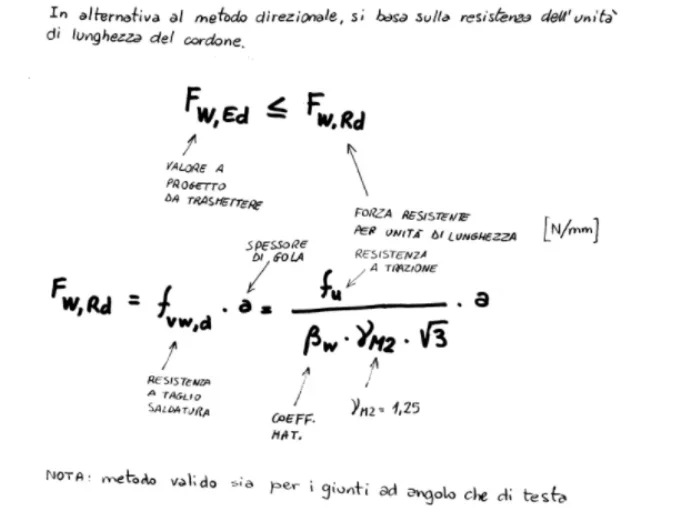
summarizing the two methods of verification are the directional one that takes into account all the components in all directionswp_ss_20180211_0003.webpor the simplified method that concentrates everything in a single termwp_ss_20180211_0004.webp
 
after static verification there is the second fatigued one en iso 1993-1-9 where it presents different methods, including the hot spot method you find qui.
 

Forum statistics

Threads
44,997
Messages
339,767
Members
4
Latest member
ibt

Members online

No members online now.
Back
Top