
You are using an out of date browser. It may not display this or other websites correctly.
You should upgrade or use an alternative browser.
You should upgrade or use an alternative browser.

xxfast
Guest
I don't use catia, but I think with a sweep you solve.
marcofa
Guest
I also believe with a sweep, but how since it is wavy?
You need an expert.
Mar
You need an expert.
Mar
ferrezio
Guest
I would develop it as solid to surface thickness with a sweep with "line" type section
for the director of the sweep I would build a spline lying on a cylindrical surface area
These are the photos with the sequence.
Hi.


for the director of the sweep I would build a spline lying on a cylindrical surface area
These are the photos with the sequence.
Hi.
alpole
Guest
I'll send you this different one.
(ii) the Commission's proposal for a Directive on the approximation of the laws of the Member States relating to
It is the same, the percose I used is different.. .
I created two spline and a loft to make
tape surface to be "thick" ...
...
then, with mirror and joint I joined the surfaces, and eventually I gave a thickness
to the "molla"-
I added a design table with different conformations for the inner diameter, external,
and for the height these can be customized. .
in this way that you can use the file for different needs-
to the
(ii) the Commission's proposal for a Directive on the approximation of the laws of the Member States relating to
It is the same, the percose I used is different.. .
I created two spline and a loft to make
tape surface to be "thick"
...then, with mirror and joint I joined the surfaces, and eventually I gave a thickness
to the "molla"-
I added a design table
with different conformations for the inner diameter, external,and for the height these can be customized. .
in this way that you can use the file for different needs-
to the
Attachments
alpole
Guest
the exercise is stimulating. . looking for there are many ways
different to build spring
Today I send another one, in which I used a law
customizable(by drawing a sketch)
applied to semicircle profile generator... .
In this way I get the basic profiles for the tape
to the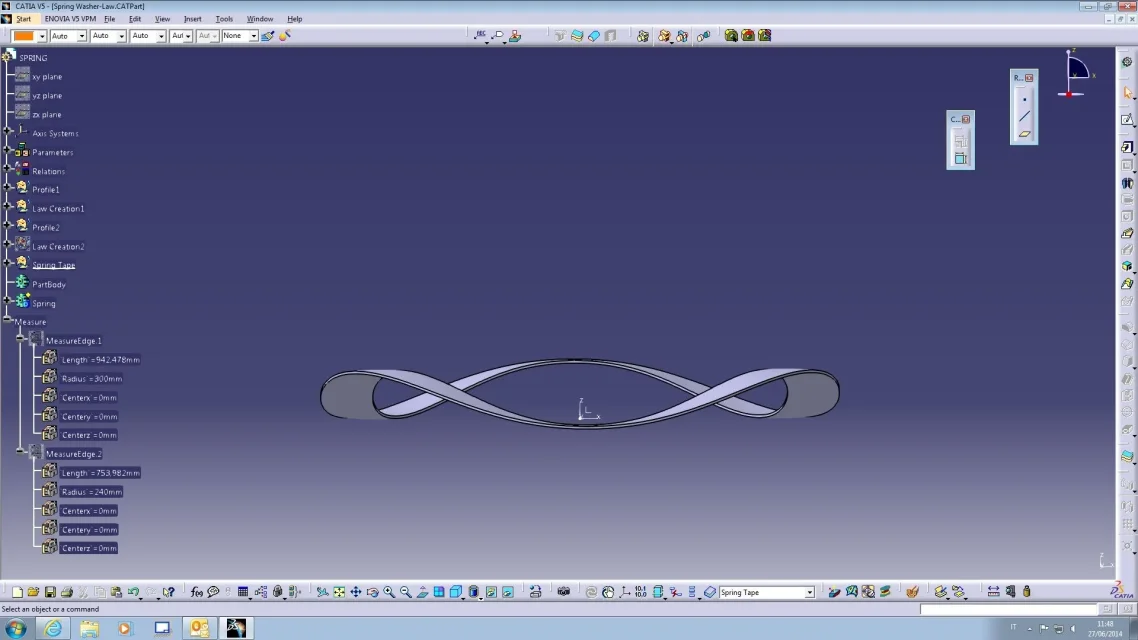
different to build spring
Today I send another one, in which I used a law
customizable(by drawing a sketch)
applied to semicircle profile generator... .
In this way I get the basic profiles for the tape
to the
Attachments
marcofa
Guest
Beautiful, I think I use the second.
a question: where to enter data ? diam 22, diam 18, spess 0.3 , 3 or 5 ?
normally ondulations are 3
Thank you.
Mar
a question: where to enter data ? diam 22, diam 18, spess 0.3 , 3 or 5 ?
normally ondulations are 3
Thank you.
Mar
alpole
Guest
Thank you for your appreciation of your questions
I send you back to the pictures

 However, I also "built" a udf that you can use
repetitively when you want, where the curves of the
tape are built with a law (by applying trigonometric mathematical parameters)
the quality of the curves as you will see and qualitatively excellent
you can't do better..... .
 Good job
I send you back to the pictures
However, I also "built" a udf that you can userepetitively when you want, where the curves of the
tape are built with a law (by applying trigonometric mathematical parameters)
the quality of the curves as you will see and qualitatively excellent
you can't do better..... .
Good jobAttachments
marcofa
Guest
fantastic, I would like to know how to use caia like you!!!
Thanks again
Mar
Thanks again
Mar
marcofa
Guest
alpole
Guest
the value of the arrow is to be understood in both directions of the turns of the curve.. .
Moreover, I have noticed that the value I set in the paremeters for the (cold) is
integer(full) does not accept decimals.. you should replace it with a paremeter
(real) accepting digits with decimals and then, lastly, creating a parameter
length with formula = (real parameter x 1.mm )-
the length parameter will have to replace the current parameter (cold)
the above described also applies to the offset parameter from the curve...... .
the file I sent you was for demonstration purposes. . .
if you need decimal values for the arrow you should
rebuilding it by following what I gave you. .
you will need exercise.... .
to the
Moreover, I have noticed that the value I set in the paremeters for the (cold) is
integer(full) does not accept decimals.. you should replace it with a paremeter
(real) accepting digits with decimals and then, lastly, creating a parameter
length with formula = (real parameter x 1.mm )-
the length parameter will have to replace the current parameter (cold)
the above described also applies to the offset parameter from the curve...... .
the file I sent you was for demonstration purposes. . .
if you need decimal values for the arrow you should
rebuilding it by following what I gave you. .
you will need exercise.... .
to the
Forum statistics
ciao