• This forum is the machine-generated translation of www.cad3d.it/forum1 - the Italian design community. Several terms are not translated correctly.

strange rules on fire extinguishers

  • Thread starter Thread starter Fulvio Romano
  • Start date Start date

Fulvio Romano

Guest
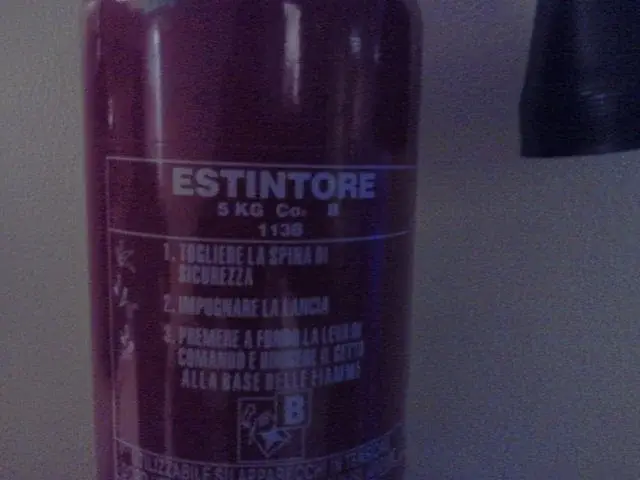
I noticed this situation, and I took pictures. Who explains me?

So, we are inside a hospital, there are two extinguishers.

extinguished at:
6l foam, suitable for categories "a" and "b", usable on electrical equipment under voltage up to 1000v.

extinguisher b:
5kg co2, suitable for category "c", usable on electrical equipment under voltage up to 1000v.

for the under voltage equipment, I would say that it is usable only the extinguisher "b", instead not only, on the extinguisher there is written that it is good also the extinguisher "a", but even the cartel suggests to prefer precisely this.

What am I missing?
 

Attachments

  • 2012-04-18 20.34.00.webp
    2012-04-18 20.34.00.webp
    16.7 KB · Views: 16
  • 2012-04-18 20.34.14.webp
    2012-04-18 20.34.14.webp
    18.5 KB · Views: 14
  • 2012-04-18 20.34.26.webp
    2012-04-18 20.34.26.webp
    28.3 KB · Views: 19
  • 2012-04-18 20.35.23.webp
    2012-04-18 20.35.23.webp
    22 KB · Views: 17
What do you mean by a-b-c?
I imagine the kind of fire...

then, from here: http://www.sardellaconsulenze.it/banca-dati.asp?id_bancadati=48
water extinguishing: they contain water as extinguishing and act for fuel cooling, moreover, water vaporizing, due to the heat generated by the fire, generates a choking action. is indicated in class fires a and is not usable on equipment and plants under voltage, if not in particular cases (surplus of specific tests provided for in the technical standard uni en 3-7). similarly it is not usable for extinguishing class b fires (flammable liquids) and, in the absence of anti-glaze additives, at temperatures below 0 °C;

(ii) the following:

Hi.
 
What do you mean by a-b-c?
I imagine the kind of fire...

then, from here: http://www.sardellaconsulenze.it/banca-dati.asp?id_bancadati=48
water extinguishing: they contain water as extinguishing and act for fuel cooling, moreover, water vaporizing, due to the heat generated by the fire, generates a choking action. is indicated in class fires a and is not usable on equipment and plants under voltage, if not in particular cases (surplus of specific tests provided for in the technical standard uni en 3-7). similarly it is not usable for extinguishing class b fires (flammable liquids) and, in the absence of anti-glaze additives, at temperatures below 0 °C;

(ii) the following:

Hi.
the fire class depends on the type of fuel. a for solids, b for liquids, c for gasses, d...it seems to me for stuff like unstable metals, etc.

what is stated in your text is exactly what I knew. I wonder, there's the co2 extinguisher at one meter, why does the cartel induce to use the foam?

we are inside a public hospital, if there is a fire in an electrical picture and use the foam, risk of making the electrical system of the plan unusable until the next public notice of repair. I don't think I'm smart.
 
Well there is also dielectric foam if I'm not mistaken...... So :)
even if it leaves me perplexed: (I in doubt would use co2 and many greetings.
Anyway...

class to – solid fuels. (wood, paper, coal, etc.)
class fire is characterized by a reaction of solid fuel or with its own shape and volume. combustion is manifested by the consumption of often luminescent fuel as brace and with low emission of flame. This is in fact the typical manifestation of the combustion of gases and, with regard to the topic in place, it is generated by the emissions of distilled vapors for the heat from the solid in combustion that contains them. the extinguishing action therefore can be exercised with substances that can also settle on the fuel (extinguisher dust) that is able to support the extinguishing without swallowing it and/or sinking it inside. the action of separation from air oxygen is therefore relatively simple and the fuel does not spread due to the proper smoothness of liquids.
extinguishing: water, foam and chemical powders

class b - flammable liquids. (petrol, oil, alcohol, etc.)
The specific characteristic of this type of fuel is to possess a proper volume, but not a proper form.
It is evident that the binding action of such a type of fuel is necessary, identifiable in its most peculiar characteristics in the common gasoline.
a good extinguishing, for this type of fire, must, besides the action of cooling, exercise a choking action identifiable in the separation between fuel and fuel. in the case of liquids all extinguishing agents which are swallowed by liquid fur, since at greater density, (heavier), they cannot exercise any capacity in this regard. It's the water case on the gas.
extinguishing: foam, carbon dioxide (co2) and chemical powders

class c - flammable gases. (propane gas, methane, hydrogen etc.)
The specific characteristic of this type of fuel is that it does not possess any form or volume of its own. fuel gases are very dangerous if mixed in the air, for the possibility of generating explosions. the extinguishing action is exercised by the action of cooling, separation of the gas-air mixture. In fact, outside of precise mixing percentages, the fuel gas does not burn.
extinguishers: carbon dioxide (co2 ) chemical powders, halogenated hydrocarbons

class d - flammable metals. (magnesium, potassium, sodium)
"d" class fires refer to particular types of reaction of solids, mostly metals, which have the characteristic of interacting, even violently, with the common means of shutdown, especially with water. the most common fuel elements that give rise to this category of combustion are light terrosis metals such as magnesium, manganese, aluminum (the latter only if fine powder), alkaline metals such as sodium, potassium and lithium. fires of this category are classified also the reactions of peroxides, chlorates and perchlorates.
extinguishers: carbon dioxide (co2 ) and chemical powders

class - and (electric panels, electric cabs, power stations)
are electric fires. voltage electrical equipment requires extinguishing non-conductor dielectrics.
extinguishers: carbon dioxide (co2 ), chemical powders, halogenated hydrocarbons

but, I would not say stupid, the class and now has been modified and/or replaced.
Hi.
 
the new norm un of 2005 regarding the classification of the extinguishers did a little cleaning reset some things. first of all the extinguisher to co2 is not homologated for class fires c (gasses) but only for class fires b( liquids).according to what the new norm has eliminated the class and (electrical) to make these types of fires in the category to fall all those materials that during combustion produce braces. So if we follow the normative aspect we must stick to the class reported on the extinguisher plate. Therefore dust, slurry, hydromer if expressly reported (usable on equipment under voltage up to 1000 volts at a minimum distance of m.1) can be used on these types of focolare.
 
The sign is just wrong. the one on the left is a dust collector and the other to co2, both can be used in case of fire on electrical plants. the powder, unfortunately damages the electrical material.
 
The sign is just wrong. the one on the left is a dust collector and the other to co2, both can be used in case of fire on electrical plants. the powder, unfortunately damages the electrical material.
on the adhesive label of the extinguisher (Annex 3) is written: 6l. foam.
 
the co2 extinguisher brings out snow of carbon dioxide at a temperature that reaches almost 80 degrees below zero. is used especially in closed environments (in outdoor environments its effectiveness is reduced by much); Co2 acts at the base of the flames by suffocating them or cooling the fuel. since it does not leave residual is more suitable on precious materials.
powder extinguisher is composed of powders that suffocate the fire and for its high effectiveness it is also used and underline also on electrical equipment and plants under tension.
 
I'm not an expert on the branch, but I'd say that with the co2 extinguisher, turn off the flame, with the foam one, but also keep what was burning covered. The difference is that if there's a free electric arc, when you take off the co2 he continues to spark and probably then the fire starts again. with the foam maybe you keep it suffocated better.
 

Forum statistics

Threads
44,997
Messages
339,767
Members
4
Latest member
ibt

Members online

No members online now.
Back
Top