
• This forum is the machine-generated translation of www.cad3d.it/forum1 - the Italian design community. Several terms are not translated correctly.

sweep on spline or surface adaptation

  • Thread starter Thread starter Cla
  • Start date Start date

Cla

Guest
Good morning.

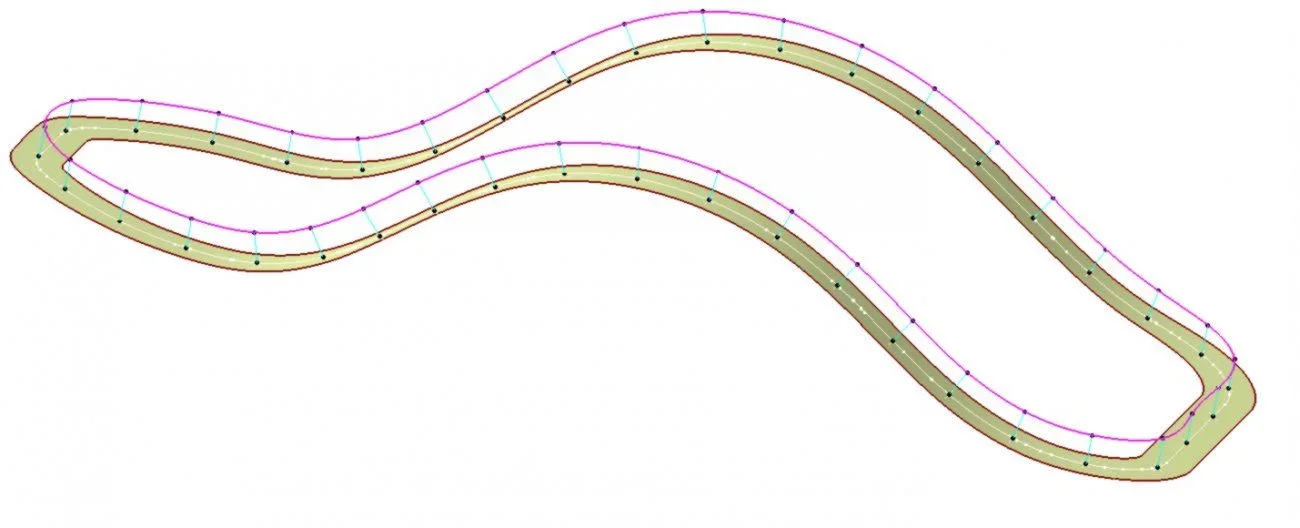
I should adapt an existing surface to a spline that I will have to build (in the current model it is only for example).

in practice in the attached model there is a spline built on 40pt (the position of which is defined by the celestial lines) that will have to be the generating of a parallel surface at every point to the starting surface (the most possible) and distant as indicated by the celestial lines. I tried doing a sweep but it can't do anything good, maybe I did something wrong.

I have to do this work on different similar pieces and therefore I would like to outline a common and fast model to internize when then I will have the correct position of the points (modifying the lines in heaven).

I am a crisis,

Thank you.
 

Attachments

  • Part2.zip
    Part2.zip
    1.8 MB · Views: 5
  • 1.webp
    1.webp
    36.2 KB · Views: 12
hi, I see that all segments are 2mm long, I guess the sup offset function has not been used to have something more variable,
so generated spline has a somewhat "strange" pattern (give me the term), use a 90° high 2mm sweep to define the starting line?1542287701018.webp
 
hi, the spline was created starting from 40pt on a sketch projected on the surface, from 40pt were made 40line long x default 2mm but then these lengths will have to be varied according to values I will have to receive (they will not all be equal). I thought I'd proceed like this but if there are less laborious roads well come, the most specific catechism commands I don't know how to use them....
 
I have understood little, but it would be more suitable for the environment quick surface reconstruction http://catiadoc.free.fr/online/catiafr_c2/qsrugcatiafrs.htm
that in yellow is a known surface, the sweep (currently it is only of example, must be modified) will have to trace the new surface, this new surface (I did not manage to make it in the attached model) will have to be distant from the known surface (in each of the 40pts) of the value provided by the line and parallel to the surface known in each section
 
hi cla, I can't open your example (I have lower version), and it's not clear what you want to get. . . Perhaps to better control the surface, it would be appropriate to use both the external and the internal edge, or you could use the isomorphism command (although then check how it handles the deformed surface is not simple), I do not know if the sweep allows what you need.. .
please put an igs and tell us more or less what you need to get, maybe we can think of a solution
 
hi cla, I can't open your example (I have lower version), and it's not clear what you want to get. . . Perhaps to better control the surface, it would be appropriate to use both the external and the internal edge, or you could use the isomorphism command (although then check how it handles the deformed surface is not simple), I do not know if the sweep allows what you need.. .
please put an igs and tell us more or less what you need to get, maybe we can think of a solution
https://viewer.autodesk.com/id/dxju...xmzi3nmytowyzms00ogjjltkwodctztq5zjnmmti0m2e1
 
hi cla, I can't open your example (I have lower version), and it's not clear what you want to get. . . Perhaps to better control the surface, it would be appropriate to use both the external and the internal edge, or you could use the isomorphism command (although then check how it handles the deformed surface is not simple), I do not know if the sweep allows what you need.. .
please put an igs and tell us more or less what you need to get, maybe we can think of a solution
I have to brass a new surface that will pass for the 40pts created (the ends of the 40 lines) and that it has a trend traceable to the initial surface (the yellow one) ...
Thank you.
 
I have to brass a new surface that will pass for the 40pts created (the ends of the 40 lines) and that it has a trend traceable to the initial surface (the yellow one) ...
Hi, cla, I understood this very well and you don't need to repeat it... the fact and that to me it seems (not having vision of mathematics I say precisely "seem") that of the points placed in the middle of the surface of origin and united with a spline, generate a trend that is too dissimilar from the surface origin, as already evidenced by dalmott, where perhaps you should interrupt the spline and use a straight as there is a evident damping. or place the points not equidistant but according to the logic of the curves of origin, and perhaps to control everything better, use the points on the outer edge and on the inner edge.

Let me know.
 

Forum statistics

Threads
44,997
Messages
339,767
Members
4
Latest member
ibt

Members online

No members online now.
Back
Top