• This forum is the machine-generated translation of www.cad3d.it/forum1 - the Italian design community. Several terms are not translated correctly.

test job interview

  • Thread starter Thread starter exxon
  • Start date Start date
we take a rigid column c, homogeneous, length l, volume v and mass ρ, and we support it on an ideal plane in the presence of gravitational acceleration g.
I thought you'd throw me the curvature of space to induce a tension inside the rigid body.
:
I have given the information that that initial tension is present, without affecting the method by which it would be generated.
Yes, apply an external force to the rope to provide a "tiro" is legitimate, but this assumption would be implicit and say that the plate is held in place by the initial tension of the wire could make you think that such tension is an inherent property to the wire. the confusion was born from here. I agree that for the purpose of the solution of the exercise, no one should worry about the nature of that tension.

p.s. the diagram of the opposing constraints I imagined it a few days ago exactly for the same end, as extreme simplification of the case #1, so as soon as I saw your scheme I immediately recognized it.
 
the system solves it by imposing t2 = 0. this is not an arbitrary imposition, but a specific request requiring to "fix" the system without changing its variables. of the rest, t2 < 0 would not be possible because it is a thread, while t2 > 0 would mean deliberately impose a voltage on the lower section of wire.
but as I said, to put t2 = 0 would like to assume that the thread is not tense, or that it does not exist (previous case). when I put it, regardless of additional considerations, I cannot fail to write a t2 reaction (otherwise it would mean not to put it, I repeat). even placing q = p, but without specifying that the difference in level between or and c is such as not to stretch the wire in or (and therefore to consider t2 = 0), I do not think I am allowed to place t2 = 0.

instead, in reference to #137
we know therefore that the reaction of the bond is equal and contrary to the force exercised by the plate, which in turn is given by the difference between tension and weight force. and they are all established. binding reaction provides "the missing force" to maintain balance.
and on this I agree: but on the plate it acts - besides the weight - also the tension of the wire. Therefore it is true the principle of action and reaction (other than synthesized by the balance we have written), but while knowing the weight I would not be able to determine the reaction (I would not know the tension, which you have arbitrarily fixed at 2 n).

Ultimately after this discussion (on which I had to think a lot too, because we are on strong levels of abstraction), I would say:

- the scheme in #1 is formally correct and resolvable with balances, once defined one of the three forces (the tension in this case), although in my opinion it lacks physical feedback (always with the hypotheses made);

- the scheme in #107 is correct and resolvable without any additional hypothesis;

- the scheme in #114 is always solveable except for the case q = p, in which I feel I have to specify a further condition on the lengths of the wires, so as to allow me to write t2 = 0;

- the scheme in #15 is what I like most (;)), as it allows to understand perfectly (and physically) the concept of precarious in case - always theoretical but desirable not to load the tie under the action of the external load - of rigidity of the very high compressed parts and the very low woven parts.


I believe that beyond certain controversies this discussion has helped to clarify ideas to all (no excluded), and to rethink certain concepts with greater abstraction, returning "to the basics" of physics! which, although it may seem a subject of philosophers, I do not think it is a bad thing, especially if there are new problems for which pre-packaged formulas are not enough.
 
from what I can understand, your doubt (and as yours, even so many others) is to not know whether or not to accept that the thread stretched between two points may be at the same time not to leave and not to live. to follow all doubts about hyperstaticity and so on.

a system composed of two fixed points p1 e p2, apart from each other, and a generic thread f with the ends connected to the two p points1 e p2.

we try to prove that a thread of length l is simultaneously not lascous and not in tension.

the thesis may appear trivial: Anyone (or almost) would accept it without demonstration, but when a simple system like this is part of a larger system, then certain doubts of the type “but to ensure the lack of tension, is it not necessary a minimum of delta-length more?”, they can make their way and undermine the security that instead should allow to focus on more important issues.

Let's first guess:
ip1: ideal floor conditions. there is no friction, there is no gravity, all the dimensions not mentioned are null, etc. etc.
ip2: elastic thread. this allows us to consider it both lasco, and in tension between the two points. the elastic constant is influential for the purpose of the demonstration.
ip3 if the rest wire is shorter than the distance between the two fixings, then, once fixed, it will result in tension. It seems obvious...
ip4 if the wire is initially longer than the distance between the two fixtures, then, once fixed, it will be lasco. as above.

Thesis is
ts: when the thread has resting length equal to the distance between the two points to which it will be fixed, then, once in operation, it will be tense between the two points without any tension in the wire.

demonstrations do not improvise: math provides all the tools necessary to formalize every smallest detail of the scientific world and proceed with deductions that allow to affirm with certainty the truthfulness of thesis on the basis of few axioms questioned only by revisionists.

Unfortunately, formal demonstrations are long and sometimes somewhat twisted. this because they are based only and exclusively on axioms and not on the principles that we all consider true because evident in our eyes. However, this formality is also the key to passing beyond the doors made up of anti-intuitive behaviours to which we often find ourselves in front.

Let's calculate...

deduction 1. if the distance between the two points is l, then, considering positive ε, the length wire l+ε, will result “not in tension”. this first deduction comes from the ip4 hypothesis: If the wire is lasco, it cannot be in tension.

deduction 2. first we see it written formally:M1.webpthat read in Italian read: “for each ε greater than zero, there is at least one such that it is between l and l+ε. this deduction derives directly from the property of completeness of the real numbers.

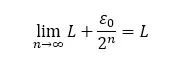
now comes the beautiful part: as representative of this element l, we take what halves ε, and we create succession s = { s, s1, s2, ... }, basing each time on the criterion chosen. if we call ε the first “addition” of thread, then we will get succession (infinite)M2.webpwe have built a succession of cauchy that for the axiom of dedekind admits a lower limit. This limit represents the minimum length of the wire for which the same is not in tension conditions. Let's find him...M3.webpThis is the result of a limit, it is not something that tends to something else. It's a number. we have shown that a length l thread is the minimum to not have the thread in tension. it does not serve the most “something”, more an infinitesimal or other: just.

this demonstration is based on fundamental mathematical axioms and can only be questioned by demonstrating any inconsistency in the deductions used. also the demonstration of inconsistencies will have to follow the same criterion and this ensures the incontestability of the set of formally demonstrated theorems.

without tediating who reads, “from the other side” does the same thing, demonstrating that it is also the maximum length possible to not have the lasco thread.

being the two equal numbers (l) we have formally demonstrated that, when the thread has rest length equal to the distance between the two points to which it will be fixed, then, once in operation, it will be tense between the two points without any tension in the wire (which is precisely the thesis).

Corollary: since the length of the wire in operation is the same as the thread before fixing, which is extensible or unextensible does not make any difference.

the key passage of the demonstration is the creation of succession and consequent application of the axiom of dedekind. is a formal step, which you do not learn with experience or internships, you should teach at university (when they did).

another important step to remember is that if a function, under certain conditions can tend to a number, under the same conditions the limit of that function (if it exists) è That number. the difference is substantial because the function at that point could also not exist at all. a limit does not tend to anything, a limit (when defined) is a number.
 
Last edited by a moderator:
from what I can understand, your doubt (and as yours, even so many others) is to not know whether or not to accept that the thread stretched between two points may be at the same time not to leave and not to live. to follow all doubts about hyperstaticity and so on.
No, that was not my doubt, and indeed it was not even a doubt but an observation: hypothesize tension nothing in an inextensible thread bound to two fixed points requires that the length of the wire is chosen accurately, that is exactly equal to the distance between these fixed points (which is what it shows).
That's what I said in #142.
"the scheme in #114 is always solveable except for the case q = p, in which I feel I have to specify a further condition on the lengths of the wires, so as to allow me to write t2 = 0; "

per me, quell'further condition on the lengths of the wires it was precisely to fix this so that you do not generate tension: Perhaps it was subtent in the problem, but instead I think it is necessary to write it. I'm good! ;)
 
Last edited:
yesterday I had six interviews for the selection of a junior mechanical designer to be included in a company in Verona. the candidates were:

1. mechanical expert with 5 years of experience as a designer/projectist;
2. three-year engineer mechatronic graduate;
3. three-year mechanical engineer with 1 year quality office experience;
4. three-year mechanical engineer graduate;
5. mechanical master engineer graduate;
6. Mechanical master engineer with experience only in non-binding sectors.

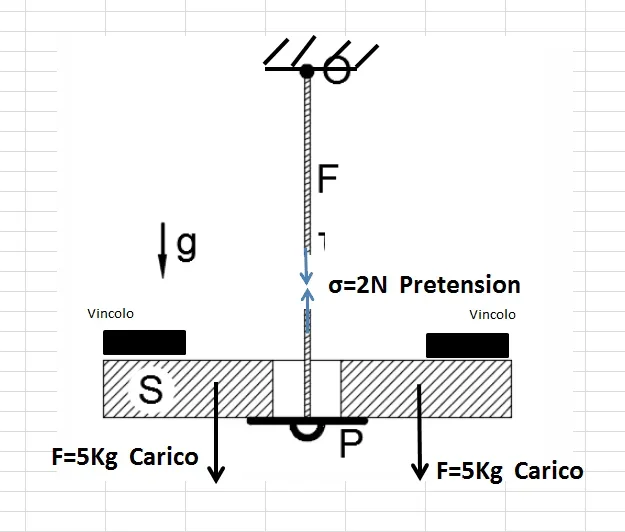
I asked everyone the same question about a simple exercise that I bring back below, obtaining a result that left me base. I would like others in the community to try to answer to see if the result obtained yesterday is a fortuitous case or not.

test:

View attachment 53184Note 1: exercise is exactly as trivial as it appears. There are no tricks or hidden details that need strange inventions. the simple calculation necessary can be carried out in mind, without the use of any instrument.

Note 2: who wants to post the answer, answer only yes or no, without (at the moment) justify it, so as to leave to others the possibility to try without conditioning.
hi, sorry for the old post, but I was going through a little static instead of going to have fun (also because the static is fun); I try to say mine even if I read only the first answers I probably would not have passed the interview :d

using on the plate the best friend of a mechanical engineer, the free body diagram, I have two forces, t upward of 2 n and mg down. balance system, t=mg. embroidery then m.
then add m, then the new voltage will be (m+m)g, which should be slightly greater than 100. I hope I don't have to twist the meriam's "statics" book, because it's really nice :d
 
hi, sorry for the old post, but I was going through a little static instead of going to have fun (also because the static is fun); I try to say mine even if I read only the first answers I probably would not have passed the interview :d

using on the plate the best friend of a mechanical engineer, the free body diagram, I have two forces, t upward of 2 n and mg down. balance system, t=mg. embroidery then m.
then add m, then the new voltage will be (m+m)g, which should be slightly greater than 100. I hope I don't have to twist the meriam's "statics" book, because it's really nice :d
rope to the ceiling of negligible weight.
Hang m.
balance by cutting the rope t=mg.
Hang m.
balance by cutting the rope t=mg+mg=(m+m)g

in post 147 the "wine" I don't know what there is to do.....the weight plate moves away from it.
If it wasn't such... there would be a k*x of the rope.

in 147 we have a pre-treated tension... so it is an existing force of preload.

t=(m+m)g - t0
 
rope to the ceiling of negligible weight.
Hang m.
balance by cutting the rope t=mg.
Hang m.
balance by cutting the rope t=mg+mg=(m+m)g

in post 147 the "wine" I don't know what there is to do.....the weight plate moves away from it.
If it wasn't such... there would be a k*x of the rope.

in 147 we have a pre-treated tension... so it is an existing force of preload.

t=(m+m)g - t0
more than anything else I do not understand the history of the precarious vines etc. to me it seems a simple (?) exercise of physics 1, and the free body diagram does not lie, as you confirmed with your calculation... There's not much to say. But always ready to change your mind a

right by curiosity, I know that it is not always reliable of course, but I have described the problem also to chat gpt, and also he comes to our result, saying that neglecting the 2 n is an error and cmq consider the precarious as "absorbed" from the system is "a very common interpretation in some technical contexts".
 

Forum statistics

Threads
44,997
Messages
339,767
Members
4
Latest member
ibt

Members online

No members online now.
Back
Top