
ACX
Guest
Hi, guys, I'm struggling with my three-year degree thesis, and I've been having a lot of problems and doubts lately. I write in hope that some experienced users can help me move forward by giving me a few tips/suggestion.
I am working on the rocker-bogie system adopted by the nose on the rover perseverance for the space mission Mars 2020.
the purpose of this work is to optimize the structure by reducing the weight (producing with a fem analysis on the inventor software), to dimensional the 6 electric motors for the rotation of the six wheels, and the 4 electric motors mounted on the front and rear wheels necessary to steer the wheels to the rover, identifying the optimal transmission ratio to reduce the power absorbed by the 4 engines.
3d screenshoot allego made by me: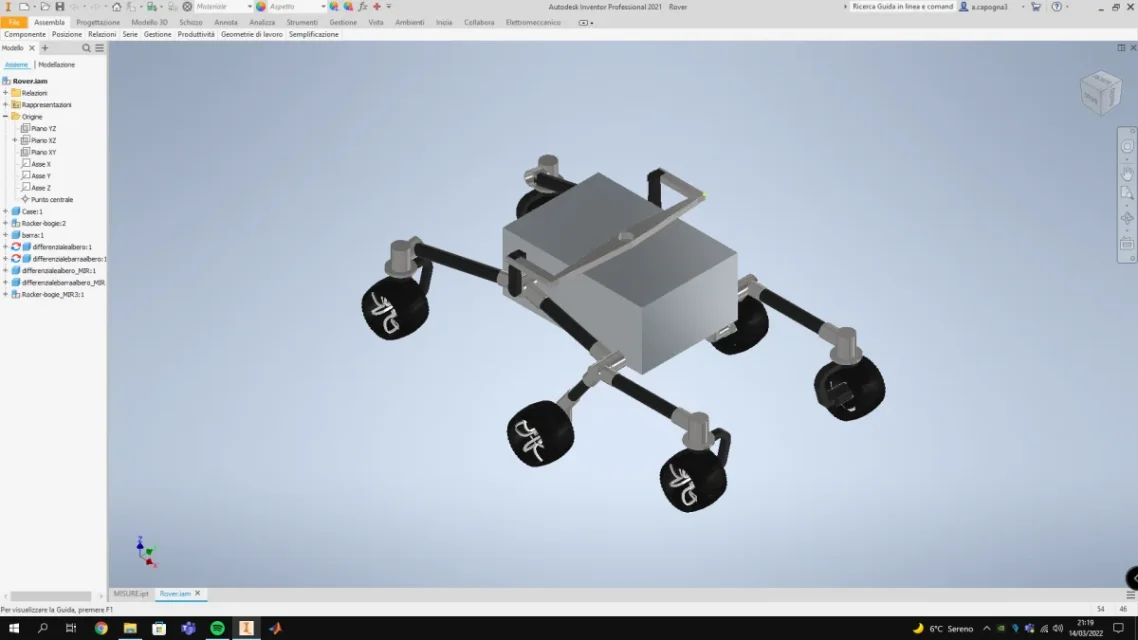 I played the rover based on the information on the nasa site and started designing the engines to move the wheels from this data:
6 moving wheels
total mass 1250 kg
v=152 m/h progress speed
d=0,526 m diameter wheels
(I omitted system mass center calculations on xy plane)I will not have to study any transitory and the speed of advancement is constant.
Therefore starting from the speed of advance I calculated the angle speed of the single wheel and subsequently I obtained the number of turns of the wheel and the motor.
I then went to isolate the single wheel and calculated the torque that the electric motor will have to provide to the wheel. here begin doubts, I hypothesized n equal to the total weight divided the six wheels, so each wheel holds 1/6 of the weight of the rover. then the static friction coefficient exist tables to estimate it? same speech for and (on the design is indicated with u). I am considering that the contact between a titanium wheel and Martian soil (predominantly rocky).
following my procedure then I identified an electric motor with a pair of about 60 nm and a number of laps previously calculated in the excel sheet.
I therefore wanted to verify the maximum slope that the rover manages to overcome by installing these engines, so I studied the system on a sloped plane.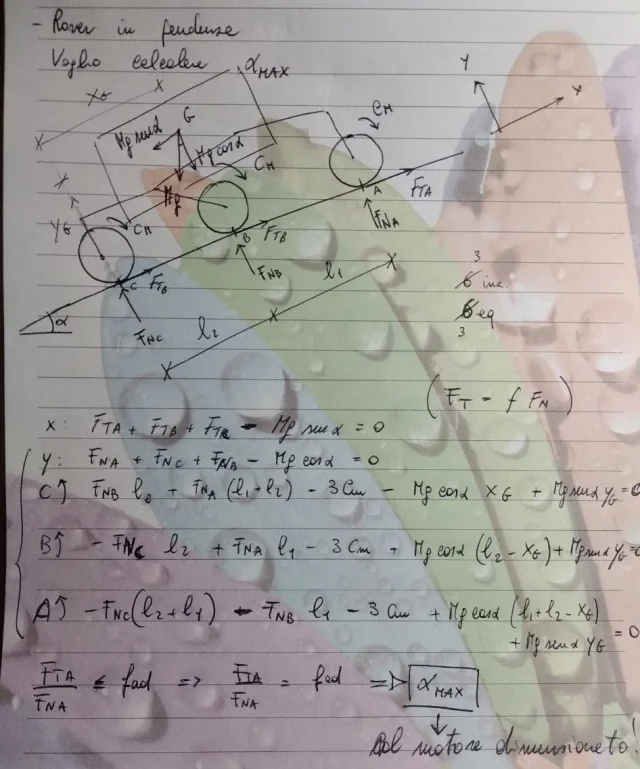 solving the system I got a maximum inclination of 30,85° quite consistent with what also stated by the information on the nasa site.
 However the doubt that I have in this part of the sizing is relative to the value of the forces, I used the same values of the normal reaction and the tangential one calculated previously on the excel sheet and I assumed the values of the two equal reactions for each wheel.
once calculated the 6 engines remain the 4 engines for the front and rear wheels and I have already thought of a temporary solution (see picture below). dimensionalized the 4 motors for steering and the 6 motors for each single wheel, I will transfer the efforts (on the knots where the wheels are mounted) to the structure that I schematized in a fictitious way on ftool. In this way I will be able to calculate the characteristics of the stress and dimension the "tubes" and calculate the efforts on the internal hinges that in reality represent the bearings.
  Sorry if I was prolisso, I hope I was clear in the description of the various phases of the sizing, and thank you for the attention! :
I am working on the rocker-bogie system adopted by the nose on the rover perseverance for the space mission Mars 2020.
the purpose of this work is to optimize the structure by reducing the weight (producing with a fem analysis on the inventor software), to dimensional the 6 electric motors for the rotation of the six wheels, and the 4 electric motors mounted on the front and rear wheels necessary to steer the wheels to the rover, identifying the optimal transmission ratio to reduce the power absorbed by the 4 engines.
3d screenshoot allego made by me:
I played the rover based on the information on the nasa site and started designing the engines to move the wheels from this data:6 moving wheels
total mass 1250 kg
v=152 m/h progress speed
d=0,526 m diameter wheels
(I omitted system mass center calculations on xy plane)I will not have to study any transitory and the speed of advancement is constant.
Therefore starting from the speed of advance I calculated the angle speed of the single wheel and subsequently I obtained the number of turns of the wheel and the motor.
I then went to isolate the single wheel and calculated the torque that the electric motor will have to provide to the wheel.
here begin doubts, I hypothesized n equal to the total weight divided the six wheels, so each wheel holds 1/6 of the weight of the rover. then the static friction coefficient exist tables to estimate it? same speech for and (on the design is indicated with u). I am considering that the contact between a titanium wheel and Martian soil (predominantly rocky).following my procedure then I identified an electric motor with a pair of about 60 nm and a number of laps previously calculated in the excel sheet.
I therefore wanted to verify the maximum slope that the rover manages to overcome by installing these engines, so I studied the system on a sloped plane.
solving the system I got a maximum inclination of 30,85° quite consistent with what also stated by the information on the nasa site.However the doubt that I have in this part of the sizing is relative to the value of the forces, I used the same values of the normal reaction and the tangential one calculated previously on the excel sheet and I assumed the values of the two equal reactions for each wheel.once calculated the 6 engines remain the 4 engines for the front and rear wheels and I have already thought of a temporary solution (see picture below).
dimensionalized the 4 motors for steering and the 6 motors for each single wheel, I will transfer the efforts (on the knots where the wheels are mounted) to the structure that I schematized in a fictitious way on ftool. In this way I will be able to calculate the characteristics of the stress and dimension the "tubes" and calculate the efforts on the internal hinges that in reality represent the bearings. Sorry if I was prolisso, I hope I was clear in the description of the various phases of the sizing, and thank you for the attention! :